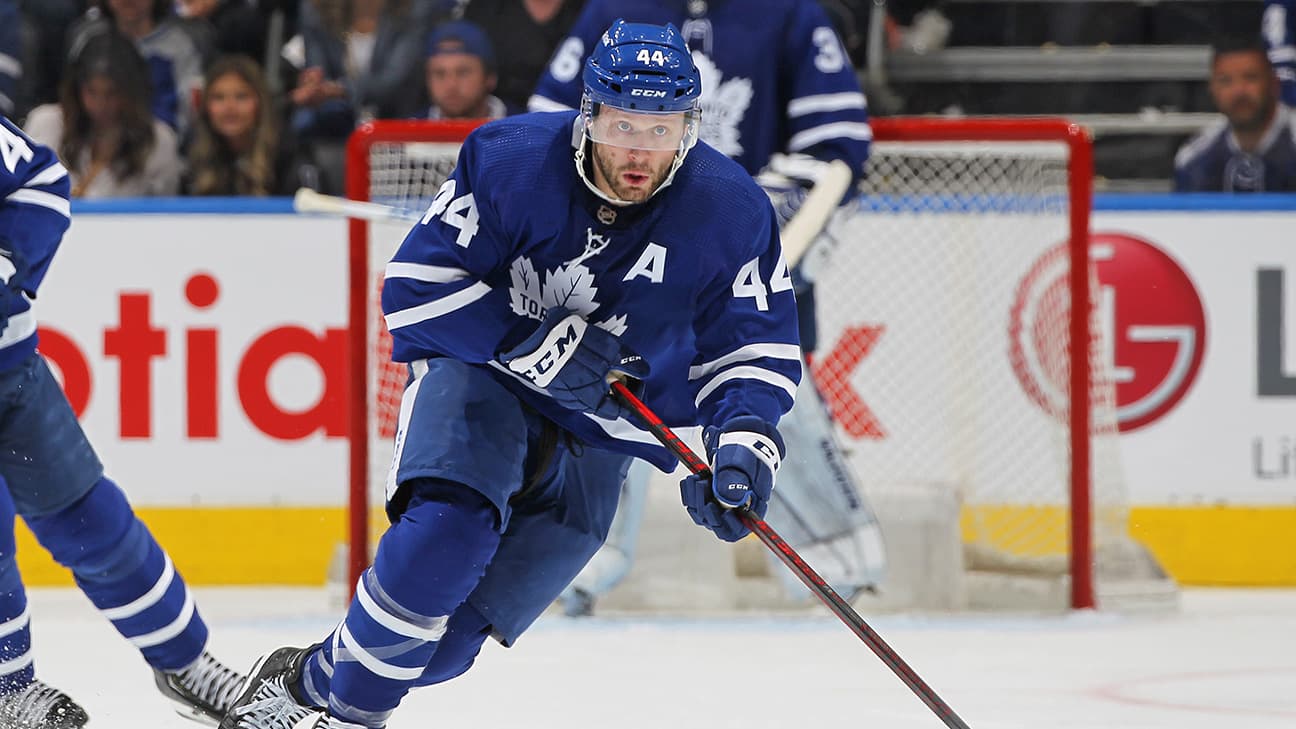
Photo: NHL.com
Oliver Ekman-Larsson Is the Maple Leafs' Most Underrated Defenceman
Table of Contents
Oliver Ekman-Larsson led the Maple Leafs blue line in scoring and almost nobody noticed
Oliver Ekman-Larsson finished the 2025-26 season with eight goals and 31 assists in 78 games, and that 39-point total led every Toronto defenceman. He did it while averaging 20:36 a night, in his age-34 season, on a $3.5-million cap hit. It was his best offensive season in both goals and points since 2018-19, when he was a top-pairing defenceman in Arizona. And it happened almost entirely without comment, on a team whose blue line spent the summer being discussed as a problem.
That combination — quietly excellent, cheap, and old — is why the Oliver Ekman-Larsson conversation in Toronto is upside down. He is currently being talked about as a cap-clearing candidate and a third-pairing defenceman. He was the most productive defenceman on the roster last year. Both things are true, and only one of them is a plan.
The contract is the whole argument
Start with the money, because in Toronto the money is always the argument. Ekman-Larsson has two years left at $3.5 million against a $104-million upper limit. That is 3.4 per cent of the cap for a defenceman who plays 20 minutes a night in every situation, kills penalties, moves the puck out of his own end, and led his team's blue line in scoring.
For comparison, the Maple Leafs are paying Morgan Rielly $7.5 million. Rielly registered six power-play points last season, his lowest total since 2016-17. We broke down the full arithmetic of Toronto's $25-million defence corps in August; the short version is that the money on this blue line is distributed almost exactly opposite to last season's production.
None of that makes Rielly a bad player or Ekman-Larsson a better one in the abstract. It makes Ekman-Larsson the single most efficient contract on the Toronto blue line, and efficient contracts are the only thing keeping a capped-out team functional. Check the full cap picture on our contracts page.
Where he actually fits in 2026-27
The projections circulating around the league put Toronto's pairings roughly as Jake McCabe with Darren Raddysh, Morgan Rielly with Chris Tanev, and Ekman-Larsson with Troy Stecher. Read that literally and last year's leading scorer among Leafs defencemen opens the season on the third pair.
There is a defensible version of that. Ekman-Larsson is a left shot on a roster stacked with left shots, he is 35, and an 84-game schedule is a real workload consideration for a defenceman who has already played more than a thousand NHL games. Sheltering him to keep him fresh in April is legitimate coaching, not an insult.
But there is a lazier version too, where the depth chart just follows the cap hits and the reputations, and the guy who outproduced everyone gets buried because he is the sixth-most-famous name in the group. Jim Hiller's staff has to be honest about which version they are running.
The versatility is the actual asset
What makes Ekman-Larsson unusually valuable to this specific roster is that he can play almost anywhere on it. He has logged first-pairing minutes in his career. He can run a second power-play unit. He kills penalties. He can play his off side. On a blue line where Tanev is 36 and coming off core-muscle surgery, Rielly's role is unsettled, and Raddysh is being asked to be a power-play driver he has never been over a full season, having one defenceman who can absorb any assignment is not a luxury. It is the insurance policy.
The 84-game schedule sharpens that point rather than softening it. A longer season means more nights when someone is unavailable, more back-to-backs, and more games where the sixth defenceman is actually playing 18 minutes because the fourth is in a walking boot. Depth on a blue line is not the seventh man on the roster. It is how far you can move the pieces you already have before the structure breaks. Ekman-Larsson is the piece that moves furthest.
Bruce Boudreau said last week that this defence is too old to make the playoffs. We argued the age math is real but the diagnosis is wrong, and Ekman-Larsson is the clearest evidence why. He is one of the oldest players in the group and he was the most productive. Age is not the variable. Health and usage are.
Why trading him would be the wrong cap solution
Toronto is the only team in the NHL still projected above the ceiling, sitting around $105.85 million against a $104-million limit with a full 23-man roster and no long-term injured reserve relief booked. Something has to move. Ekman-Larsson's $3.5 million is one of the two or three cleanest ways to get there, alongside Dakota Joshua's $3.25 million.
Clean is not the same as correct. Moving Ekman-Larsson would solve a $2-million problem by removing the defenceman who most reduces the odds of a $20-million problem — an injury to Tanev or McCabe that leaves Toronto starting a rookie on the second pair in November. If John Chayka needs a million and a half in space, there are forwards further down the depth chart whose absence would cost less. Selling your most versatile defenceman to fit a fourth-liner under the cap is the kind of move that looks fine in September and indefensible in January.
The other route is the one Chayka has been chasing all summer: moving real money off the roster in a hockey trade rather than a compliance dump. That has been complicated by Rielly's full no-movement clause, which runs through July 2027, and by a four-team trade list that narrows the market to almost nothing.
What Hiller should do with him
Three things, none of them complicated.
- Start him with Stecher on the third pair, but give that pair real offensive-zone starts rather than the leftovers. Ekman-Larsson's value is in transition; burying him on defensive-zone draws wastes the part of his game that produced 39 points.
- Give him the second power-play unit outright. Daniel Alfredsson's first job is making PP2 something other than a 20-second afterthought, and Ekman-Larsson is the most obvious quarterback for it.
- Treat him as the injury answer, not the injury casualty. When Tanev misses time — and he has missed time in each of the last two seasons — Ekman-Larsson moves up rather than a Marlie moving in.
Our full read on how the new staff should sort the deployment questions is in our look at Morgan Rielly's role under Hiller, and the health side of it in Chris Tanev's return.
What's next
Ekman-Larsson is not going to be the story of Toronto's training camp. Gavin McKenna is, and after him the goaltending, and after that whatever trade Chayka makes to get cap compliant before opening night on September 29.
But he is the player most likely to determine whether the blue line holds together, and the one whose usage will tell you fastest whether this coaching staff is reading its own data or its own depth chart. If Ekman-Larsson opens the season playing 20 minutes with real offensive responsibility, the new regime is paying attention. If he is playing 15 and killing penalties while the power play runs through players who did not produce last year, nothing much has changed. Follow the roster on our players page as camp opens.
Frequently Asked Questions
What were Oliver Ekman-Larsson's stats in 2025-26?
Ekman-Larsson played 78 games for Toronto and recorded eight goals and 31 assists for 39 points, leading all Maple Leafs defencemen in scoring. He averaged 20:36 of ice time per game. It was his best season in goals and points since 2018-19 with Arizona.
What is Oliver Ekman-Larsson's cap hit with the Maple Leafs?
Ekman-Larsson carries a $3.5-million cap hit with two years remaining on his contract. Against a $104-million upper limit for 2026-27, that is roughly 3.4 per cent of the cap for a defenceman who played more than 20 minutes a night last season.
Will the Maple Leafs trade Oliver Ekman-Larsson?
He has been named as a cap-clearing candidate because Toronto is projected above the $104-million ceiling, with his $3.5 million and Dakota Joshua's $3.25 million cited as the cleanest exits. No trade has been reported. Moving him would remove the most versatile defenceman on a blue line already carrying significant injury risk.
What are the Maple Leafs' projected defence pairings for 2026-27?
The commonly projected alignment is Jake McCabe with Darren Raddysh, Morgan Rielly with Chris Tanev, and Oliver Ekman-Larsson with Troy Stecher. Philippe Myers and Emil Andrae are the extra defencemen under contract, which leaves Toronto with eight NHL blueliners for seven roster spots.
How old is Oliver Ekman-Larsson?
Ekman-Larsson is 35 for the 2026-27 season. He has played more than 1,000 NHL games across stints with Arizona, Vancouver, Florida and Toronto, and won a Stanley Cup with the Panthers in 2024.
How much are the Maple Leafs over the salary cap?
Toronto is projected at roughly $105.85 million against the $104-million upper limit, about $1.85 million over with 23 roster spots filled and no long-term injured reserve relief currently booked. Max Domi's $3.75-million cap hit could provide relief if he opens the season on LTIR.
Who led the Maple Leafs defencemen in scoring in 2025-26?
Oliver Ekman-Larsson, with 39 points in 78 games. It was reportedly the first time since 2019-20 that a Toronto defenceman other than Morgan Rielly led the blue line in scoring. Rielly finished last season with six power-play points, his lowest total since 2016-17.


