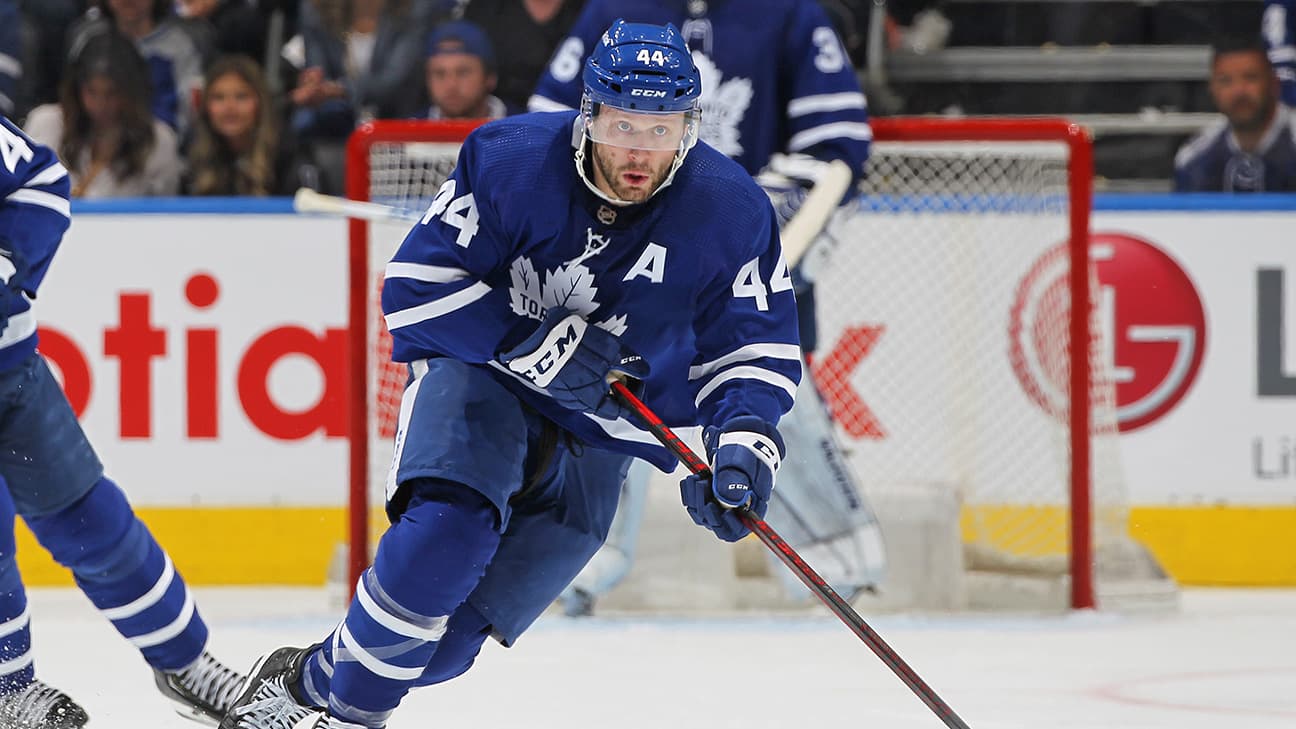
Photo: NHL.com
Morgan Rielly Role: He's Staying, So Where Does He Actually Play?
Table of Contents
The Morgan Rielly role question replaces the trade question
The Morgan Rielly role for 2026-27 is now a more useful thing to argue about than the Morgan Rielly trade, because the trade increasingly looks like it is not happening. The Athletic's Jonas Siegel and Sportsnet's Frankie Corrado have both predicted this week that Rielly opens the season in a Maple Leafs uniform — a meaningful shift from June, when the working assumption around the league was that Toronto's longest-serving player would be moved before camp.
Nothing has changed about the underlying facts. Rielly has four years left on an eight-year, $60-million contract at a $7.5-million cap hit, running through 2029-30. He holds full no-movement protection for the next two seasons and submitted a four-team list. Those three details, taken together, produce exactly the market Toronto found: small, unenthusiastic and unwilling to pay.
We wrote last week that John Chayka would not pay a sweetener to move him, and that holding was the correct call. The follow-on question is the one nobody has answered: what is Rielly actually for on this team?
The job he used to have is taken
For most of a decade, Rielly's role was straightforward. He was Toronto's first-unit power-play quarterback, its primary transition defenceman, and the guy who logged 22 minutes a night because there was nobody else to log them.
Two of those three jobs have been claimed. Darren Raddysh arrived from Tampa Bay on an eight-year contract, and Chayka was explicit at the time that Raddysh is "the type of defenceman we haven't had in this organization for a long time." That is not the language of a depth acquisition. Toronto committed eight years to a right-shot puck mover because it wants him running a power play and driving offence from the back end.
Meanwhile, the heavy defensive assignments belong to Jake McCabe and Chris Tanev. We argued yesterday that McCabe is the most important defenceman on the roster, and that has not stopped being true because Rielly stayed.
Which leaves a $7.5-million defenceman without an obvious portfolio. That is uncomfortable. It is also solvable, and the solution is more interesting than the trade would have been.
The case for a genuine second-pairing role
The honest read on Rielly's last two seasons is that he was miscast, not finished. He was asked to be a matchup defenceman on a team that did not have a better one, and he is not a matchup defenceman. He never was.
Put him on a second pairing with defined offensive-zone usage and the profile changes considerably. Rielly's skating remains an asset, his first pass is still his best tool, and his production has always tracked with how much time he spends going forward rather than defending. A second-pairing assignment against middle-six competition, with favourable zone starts and second-unit power-play time, is a role he can win rather than survive.
The catch is that it costs $7.5 million and it requires Rielly to accept a demotion in everything but title. Players who have been the guy for eleven years rarely enjoy that conversation. It is a real test of Jim Hiller's first months in the job, and the structure he installs will tell you a lot about how he plans to handle it.
Why Toronto might get more value this way anyway
There is a cynical argument for the role change that happens to also be the smart one: a rehabilitated Rielly is worth more in February than a stalled Rielly was in July.
Toronto's problem all summer was that it was selling a defenceman whose recent results looked worse than his ability, on a contract that magnified every flaw. Nobody wanted to absorb that. But a defenceman putting up 40 points in a sheltered second-pairing role, on a team that is winning, is a different asset — and Rielly's no-movement protection drops in scope after two more seasons.
This is not a plan that requires Chayka to say anything out loud. It just requires Hiller to deploy Rielly in the situations where he is good and keep him out of the situations where he is not. If it works, Toronto either keeps a productive defenceman or creates a market that did not exist. If it does not work, Toronto has learned something it needed to learn anyway.
The blue-line traffic jam behind him
Rielly staying does not happen in isolation. It compresses everyone below him.
Emil Andrae, acquired from Philadelphia in the Joseph Woll trade and signed for two years at a $1.55-million cap hit, needs games to develop and there are only so many left-side minutes available. We flagged the logjam Andrae is walking into earlier this summer, and Rielly's continued presence is the single biggest reason it exists.
Toronto now has more competent NHL defencemen than it has meaningful roles, which sounds like a good problem and functions like a bad one. Depth on the blue line only converts to value if somebody plays. A young defenceman who spends the year as a healthy scratch has not developed; he has aged.
That is the strongest remaining argument for moving Rielly at some point during the season rather than before it. Not because he is bad, but because the roster below him needs oxygen.
What this says about Chayka's first offseason
Step back and the Rielly file is the clearest illustration of the limits of Toronto's summer. Chayka reshaped the forward group, replaced the goaltending, changed the coach and won the draft lottery. What he could not do was materially improve the top four on defence — the hole we have been calling unfinished since July.
He tried. Zach Werenski's no-movement clause killed the best available option. Alexander Nikishin's price ran past what Carolina would accept from anyone. The market for top-pairing defencemen in 2026 is essentially closed, because every one of them has protection and none of them wants to come to a team that finished last in the Atlantic Division.
So Toronto returns the same blue line it had, with Raddysh and Andrae added at the margins, and asks a new coach to get more out of it. That is a legitimate plan. It is not the plan anybody drew up in May.
The counter-argument worth taking seriously
There is a version of this where keeping Rielly is simply the wrong answer dressed up as patience.
A $7.5-million cap hit on a second-pairing defenceman is a luxury a team with no cap space cannot really afford. Toronto sits roughly $2.75 million over the ceiling, one of only two clubs above it, and every dollar tied up in a player performing below his contract is a dollar unavailable at the trade deadline. If Toronto is a wild-card team in February and needs a rental forward, the money to acquire one does not exist — and a meaningful share of the reason is Rielly.
The rebuttal is that moving him at a discount does not fix that either. Trading Rielly while attaching a sweetener means paying assets for the privilege of losing a good defenceman, and the space it creates gets partially eaten by whatever replacement Toronto has to sign. There is no version of this file where the Maple Leafs come out ahead. There is only the version where they lose least, and running him in a role he can handle is a reasonable candidate for that.
Rielly is also, it should be said, still a good hockey player. The discourse around him has curdled to a point where that gets forgotten. He was a legitimate top-pairing defenceman for a decade on teams that gave him no help, and he has never once asked out of Toronto in a market that would have given him plenty of reasons to.
What's next
Training camps open in the second week of September, with preseason games running Sept. 19-26 and opening night on Sept. 29. Rielly's usage in the first week of camp — who he is paired with, which power-play unit he joins — will answer this faster than any interview.
Three specific things to watch. Does Hiller pair him with Raddysh, which would signal Toronto is still trying to maximize his offence? Does Raddysh take the first power-play unit outright, which would confirm the demotion? And does Chayka say anything at all about Rielly's role, or does he leave it entirely to the coach?
The trade may still come, at the deadline or next summer, when the protection loosens and the sample is larger. But the decision Toronto has actually made is to run it back with a $7.5-million defenceman in a role he has never held. That is a bet on coaching, and it deserves to be judged as one. You can follow how the pairings and cap picture develop on our contracts page and standings tracker once the season begins.
Frequently Asked Questions
Is Morgan Rielly being traded by the Maple Leafs?
It now looks unlikely before the season. The Athletic's Jonas Siegel and Sportsnet's Frankie Corrado have both predicted Rielly opens 2026-27 in Toronto. His four-team trade list, full no-movement protection and $7.5-million cap hit through 2029-30 shrank the market to almost nothing.
What is Morgan Rielly's contract?
Rielly is signed through the 2029-30 season on an eight-year, $60-million deal carrying a $7.5-million average annual value. He holds full no-movement protection for the next two seasons, which means he controls whether any trade happens at all.
Who runs the Maple Leafs power play in 2026-27?
Darren Raddysh is the most likely first-unit quarterback after arriving from Tampa Bay and signing an eight-year contract. John Chayka described him as the type of defenceman the organization has lacked, which points to a primary role rather than a depth one.
What role will Morgan Rielly play under Jim Hiller?
The most sensible fit is a second pairing with offensive-zone usage and second-unit power-play time, rather than the matchup role he was miscast in over the past two seasons. His skating and first pass still play; his defensive results have historically suffered against top competition.
Why couldn't the Maple Leafs upgrade their top-four defence this summer?
Because the market closed. Zach Werenski used his no-movement clause to block a framework with Dallas, and Alexander Nikishin's extension demands reportedly exceeded $8 million per season, which stalled Carolina's willingness to move him. Nearly every top-pairing defenceman available carries trade protection.
How does Rielly staying affect Emil Andrae?
It squeezes him. Andrae, acquired from Philadelphia in the Joseph Woll trade and signed for two years at a $1.55-million cap hit, needs regular minutes on the left side to develop. With Rielly, Jake McCabe and Chris Tanev ahead of him, those minutes are scarce.
When does Maple Leafs training camp start in 2026?
NHL training camps open in the second week of September. The league's preseason schedule runs Sept. 19-26 — a shortened eight-day, 65-game slate under the new CBA — and the 2026-27 regular season begins Sept. 29 with an 84-game format.


