Photo: NHL.com
Morgan Rielly Trade Stalemate: Toronto Won't Pay to Move Him
Table of Contents
The Morgan Rielly trade is stuck, and Toronto is fine with that
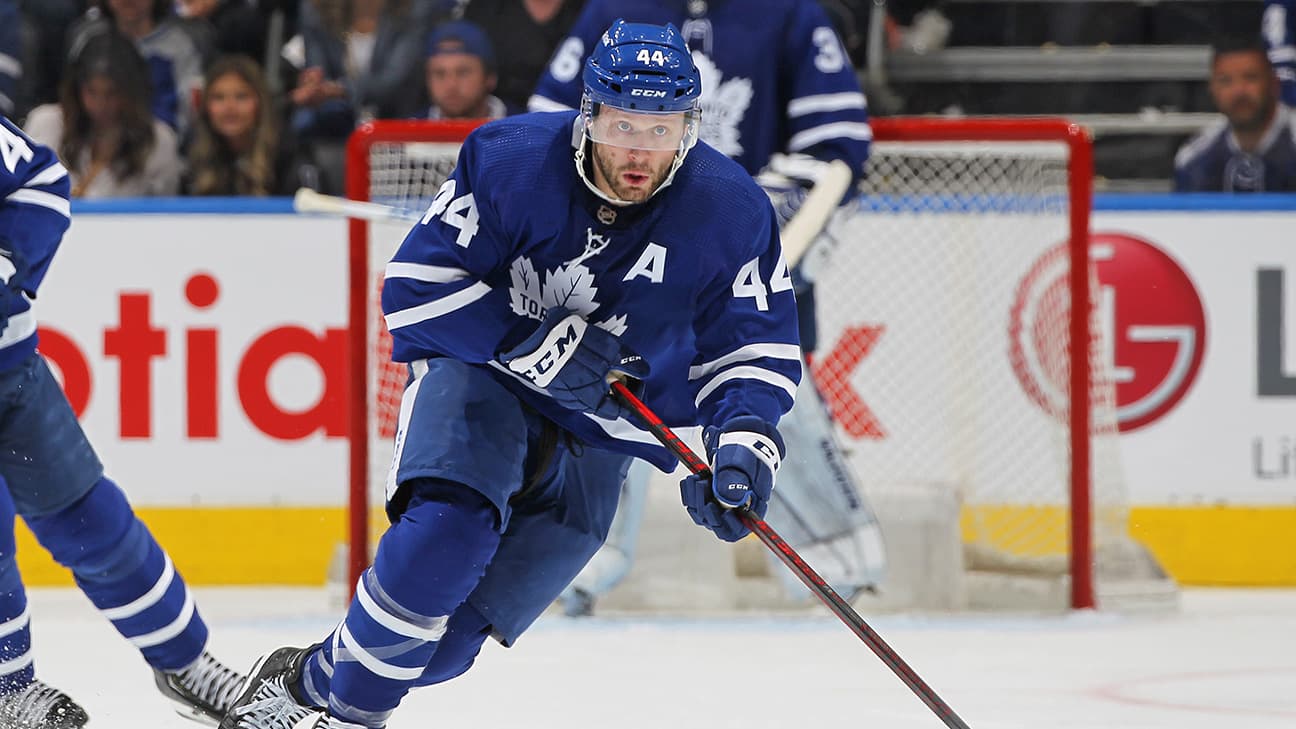
The Morgan Rielly trade market has reached the stage every summer saga eventually reaches: everyone still expects it to happen, nobody will pay for it to happen, and training camp is now close enough to see. Per Sportsnet's Elliotte Friedman, Toronto has told teams it is not paying a big price to move its longest-serving player — if a deal requires what the Maple Leafs consider too much of a sweetener, they will not do it.
That single sentence explains why nothing has moved since the draft. It is not that Rielly has no market. It is that the market's price is Toronto paying to leave, and John Chayka has decided he would rather keep a good defenceman than rent out cap space at a loss.
It is the right call, and it is also the least satisfying possible outcome for a fan base that has spent three months waiting for a resolution. Both of those things can be true at the same time.
Where the file actually stands
Rielly carries a $7.5 million cap hit with four years left on his contract and a full no-movement clause. That clause is the whole story. He does not have to go anywhere, he has not waived it, and Chris Johnston has been explicit that any report suggesting Rielly has green-lit a trade is wrong. What Rielly has done is provide a list of teams he would consider — reported at four Western Conference clubs, with Anaheim, San Jose, Seattle and Edmonton the names attached, and Nashville reported as a later addition.
That is a soft yes, not a request. It is the posture of a player who is open to a change but under no obligation to accept one, and who gets paid the same regardless of which sweater he wears.
The expectation among insiders remains that Rielly gets moved before the season. Johnston has also allowed that it could drag into camp or even into the regular season. We wrote in July that Chayka's public "I don't anticipate it" line was not the denial it sounded like, and nothing since has changed that read. The general manager is not shopping him urgently. He is answering the phone.
Why the price is the problem
Every offer Toronto has fielded reportedly comes in one of two shapes. Either the Maple Leafs retain a significant chunk of the $7.5 million, or they attach a sweetener — a pick, a prospect, a young roster player — to compensate the acquiring team for absorbing the full number.
This is what happens when a 32-year-old defenceman with four years left is judged by the market as a slight overpay rather than a bargain. Rielly is not a bad player. He ran a functional power play, he still moves the puck, and on a team that has spent the summer getting slower and heavier on the back end he is one of the few defencemen who can exit a zone under pressure. He is simply paid like a top-pairing defenceman on a contract that runs to age 36, in a league where the cap is rising fast enough that the deal will look better in three years than it does now.
That last point is the underrated one. The salary cap is $104 million this season and is headed toward $113.5 million for 2027-28. A $7.5 million cap hit that eats 7.2 per cent of the payroll today eats 6.6 per cent two years from now. Contracts that look heavy in a flat-cap world get lighter every summer in this one. Paying an asset to escape a deal that is depreciating on its own is bad business.
The cap math nobody can dodge
Here is where it gets complicated. Toronto is projected roughly $2.75 million over the $104 million ceiling, and the usual reason to move Rielly is not hockey — it is compliance. Except the Maple Leafs already have a compliance answer that costs them nothing: Max Domi.
Domi is recovering from complications following back surgery in late May. Chayka said last week that he is progressing and will report to camp, but offered no timeline, which we covered in the most carefully worded injury update of the summer. If Domi opens the season on long-term injured reserve, his $3.75 million cap hit becomes relief, and Toronto's over-the-cap problem disappears without a single trade. Add the option of sending a depth body such as Zack MacEwen and his $875,000 hit to the Marlies and the club has more than enough runway.
Teams do not have to be cap-compliant until the day before the season opens. That is September 28. Chayka has seven weeks and two mechanisms that do not require him to sell anything.
What Toronto's blue line looks like if he stays
The projected pairings have Rielly with Darren Raddysh on the top unit, Jake McCabe with Chris Tanev in the middle, and Oliver Ekman-Larsson with Troy Stecher on the third — the group we laid out in our 2026-27 projected lineup. It is a defence corps with a clear identity: heavy, defensively conscientious, and slow.
Take Rielly out and it gets slower. Emil Andrae, the 24-year-old left-shot, would likely slot into the top four, which is an interesting idea for 2028 and a frightening one for October. Ben Danford, the right-shot Toronto took 31st overall in 2024, has said his goal is to make the opening-night roster after a Calder Cup spring with the Marlies, but handing a 20-year-old minutes because you traded a veteran for a third-rounder is not a plan.
This is the argument we made in July and it holds up: the Maple Leafs are a bubble team in a division that just got harder. Subtracting a top-four defenceman for cap relief they do not need makes them worse in the only season Chayka's core is guaranteed to be intact.
The case for moving him anyway
The counter is real. Rielly turns 33 during the season. The contract runs through 2029-30. The best time to trade a declining asset is one year early, not one year late, and every month Toronto waits, the return shrinks. If a Western Conference team loses a defenceman in camp — and someone always does — the price for a proven top-four blueliner spikes overnight, and the Maple Leafs would be the first call.
There is also a roster-clarity argument. Rielly staying means Andrae waits, Danford waits, and Toronto keeps running a blue line built for 2024. At some point a team that missed the playoffs has to let the next group play.
But none of that justifies attaching a sweetener in August to a team that is doing Toronto no favours. If the Maple Leafs are going to lose value on this contract, they should lose it in February, when a contender's desperation is doing the pricing instead of a rebuilding club's leverage.
What's next
Camp opens in mid-September, the season starts September 29, and the compliance deadline is the day before. Between now and then, the realistic triggers are an injury elsewhere in the league, a rival's cap crunch forcing a defenceman onto the market at a discount, or Rielly deciding he would rather have certainty than a fifth season in a rebuild.
Until one of those happens, the honest answer is the boring one. Morgan Rielly is a Maple Leaf, he will report to camp as a Maple Leaf, and Toronto is under no obligation to make him anything else. Track the cap picture on our contracts page and the roster on our players page as camp approaches.
Frequently Asked Questions
Has Morgan Rielly been traded by the Maple Leafs?
No. As of August 10, 2026, Rielly remains under contract with Toronto. Chris Johnston has reported that Rielly has not waived his no-movement clause and that reports suggesting he approved a trade are false.
What is Morgan Rielly's contract?
Rielly carries a $7.5 million salary cap hit with four years remaining on his deal, running through the 2029-30 season. The contract includes a full no-movement clause, giving him complete control over any trade.
Why haven't the Maple Leafs traded Morgan Rielly?
Per Elliotte Friedman, Toronto has told teams it will not pay a big price to move him. Offers have reportedly required either significant salary retention or an added sweetener such as a pick or prospect, and Chayka has declined both.
Which teams are on Morgan Rielly's trade list?
Reporting through the summer has described a short list of Western Conference clubs, with Anaheim, San Jose, Seattle and Edmonton cited, and Nashville reported as a later addition. The list is a set of teams he would consider, not a trade request.
Do the Maple Leafs need to trade Rielly to become cap compliant?
No. Toronto is projected about $2.75 million over the $104 million cap, but placing Max Domi and his $3.75 million cap hit on long-term injured reserve would cover the shortfall. Teams do not have to be compliant until the day before the season opens on September 29.
Who replaces Rielly on the Maple Leafs blue line if he is traded?
The most likely internal answer is 24-year-old left-shot Emil Andrae moving into the top four, with Jake McCabe and Oliver Ekman-Larsson absorbing more left-side minutes. Prospect Ben Danford, a right shot, has said he intends to compete for an opening-night roster spot.
Could the Rielly trade talks continue into the season?
Yes. Chris Johnston has said the situation could drag into training camp or even the regular season. An in-season injury elsewhere in the league is one of the most likely triggers for the market to move.


