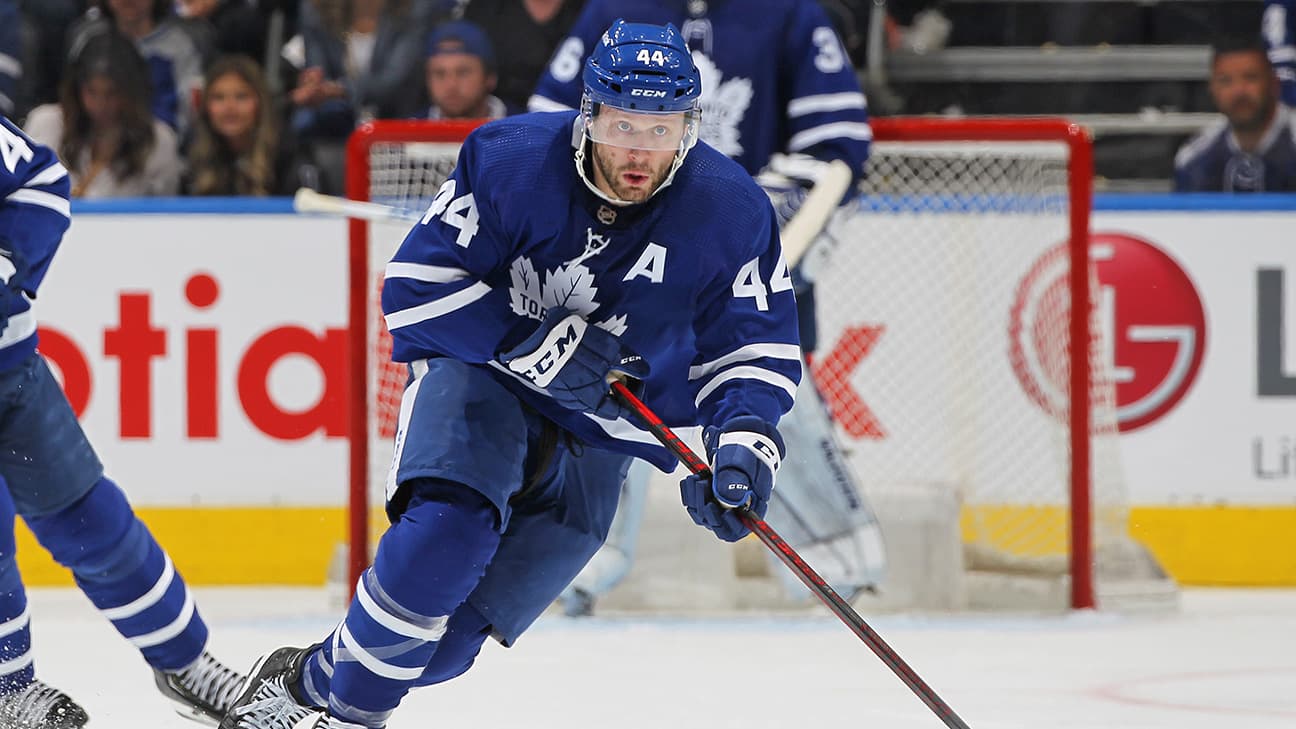
Photo: NHL.com
Maple Leafs Projected Lineup 2026-27: How Chayka's Reshaped Roster Actually Fits Together
Table of Contents
The Maple Leafs Projected Lineup for 2026-27 Is Finally Taking Shape
With free agency essentially settled and the No. 1 overall pick under contract, the Maple Leafs projected lineup for 2026-27 is close enough to sketch with real confidence. John Chayka spent the summer chasing a group that is, in his words, "deeper, faster, bigger, heavier," and the depth chart now reflects a genuine philosophy rather than a scramble to patch holes. Nothing below is a lineup card — camp, health and the unresolved Morgan Rielly situation will move pieces — but the shape of the team is set.
This is a projection, not a promise. Treat the combinations as informed guesses at how a reshaped roster fits together, not as confirmed pairings. What is confirmed is who is under contract, and that is a very different roster than the one that missed the playoffs last spring.
Read the Maple Leafs projected lineup 2026-27 as a map of Chayka's intent, not a finished product. The forwards got deeper, the goaltending got older and more accomplished, and the defence got a question mark stamped on its most familiar name. Sort those three threads and you understand the whole team.
The Top Six: Built Around a Healthy Matthews
Everything starts with Auston Matthews' knee. Assuming he arrives healthy after March MCL surgery — the expectation across the organization — the top line forms around the captain. A pairing of Matthew Knies and Matthews gives Toronto size and finish on its first unit, with the right wing the question mark. William Nylander anchors the second line as the club's most reliable scorer after a 79-point season, and the staff will decide whether to load up with the stars together or spread the scoring across two lines.
The intrigue is where the young players land. Easton Cowan and Gavin McKenna are both pushing for meaningful minutes, and one of them stealing a top-six spot in camp would change the whole calculus. John Tavares remains a middle-six option who can slide up when needed. However Jim Hiller sorts it, Toronto's top six has more paths to a goal than it did a year ago, which was the entire point of the offseason.
The Bottom Six: Chayka's Real Project
The most-changed part of the roster is the bottom six, and it is where Chayka's fingerprints are clearest. The summer additions of Colton Sissons, Teddy Blueger and Jack Roslovic, plus the trade for Nick Paul to fill the third-line centre hole, rebuilt the middle and bottom of the lineup with size and defensive reliability.
That is a deliberate answer to an old problem. Toronto's bottom six has too often been a liability in the playoffs — overmatched, outmuscled, unable to hold a lead. This group is heavier and more responsible, the kind of depth that can kill penalties, win a defensive-zone draw and not bleed chances against. If Cowan or McKenna forces his way up, a veteran slides down and the bottom six gets deeper still. Our breakdown of the free-agent forward additions covers how these pieces were assembled.
The Blue Line: Seven Under Contract, One Big Question
On defence, the Leafs have their top seven under contract for the near term: Darren Raddysh, Jake McCabe, Chris Tanev, Morgan Rielly, Oliver Ekman-Larsson, Troy Stecher and newly acquired Emil Andrae. That is a functional, veteran-heavy group with puck-movers and shutdown types — but it comes with an obvious asterisk.
The asterisk is Rielly. As long as the Rielly trade file stays open, any projected pairing is written in pencil. If he stays, he anchors the left side and quarterbacks the power play. If he goes, the minutes redistribute to McCabe, Ekman-Larsson and a bigger role for Andrae, and Toronto's blue line gets younger and cheaper but thinner on pedigree. Either way, the depth Chayka built — landing Darren Raddysh in a sign-and-trade among the key moves — is what makes a Rielly deal survivable. You can track the full cap picture on our contracts page.
The Crease: An Experienced Tandem
Goaltending got the summer's biggest bet. Sergei Bobrovsky signed a three-year, $21 million deal to pair with Anthony Stolarz, reuniting the two from their time together in Florida. It gives Toronto one of the most experienced goaltending duos in the league — a two-time Vezina winner and a proven starter — and a clear plan to manage the workload of an expanded 84-game schedule.
The obvious risk is age: Bobrovsky turns 38 before the season starts, and betting three years on a goalie in his late thirties is exactly the kind of high-variance move that can define a season in either direction. The upside is stability and a championship pedigree in the room. Between Bobrovsky and Stolarz, the Leafs should be able to split starts sensibly and keep both fresh, which matters more than ever with the longer schedule. Our look at the goaltending depth behind the tandem explains why the crease was such a priority.
The LTIR Wrinkle
One more factor shapes the roster on paper: long-term injured reserve. Toronto has leaned on LTIR to stay cap-compliant after a busy summer, with Max Domi's injury among the situations affecting the cap math. LTIR lets a team exceed the ceiling while a player is sidelined, but it is a tool with trade-offs — it complicates in-season flexibility and bonus accounting. The practical takeaway is that the roster you see is being managed dollar-by-dollar, and any injury return or trade changes the compliance picture. It is another reason the Rielly question looms so large.
How Good Is This Team, Really?
Add it up and the 2026-27 Maple Leafs look like a deeper, more balanced team than the one that missed the playoffs — provided the big bets land. The season hinges on three things: a healthy Matthews, Bobrovsky holding up at 38, and the young forwards contributing on cheap deals. Get two of those three and Toronto is a playoff team again. Get all three and the ceiling is higher than the standings suggested last spring.
The honest caveat is that this is still a projection built on health and an unresolved trade. But the direction is unmistakable. Chayka did not run it back — he reshaped the edges, changed the coach, and bet on depth over top-heavy stardom. You can follow the club's climb on our standings page once the puck drops.
What is genuinely new is the balance. For years this roster was a barbell — enormous money at the top, very little in the middle, and a bottom six that evaporated in the playoffs. The 2026-27 group is flatter and sturdier. It may not have a higher ceiling than the star-studded versions that came before, but it has a far higher floor, and floors are what win rounds in the spring. Whether that trade-off pays off is the question the season exists to answer.
What's Next
The next real information comes at training camp in September, when the projected combinations meet reality. Watch three things: how Hiller pairs the top six, whether Cowan or McKenna forces his way up, and whether the Rielly file resolves before opening night. Any one of those can redraw the depth chart.
For now, the Maple Leafs projected lineup for 2026-27 is the clearest look yet at what Chayka has built — a heavier, deeper, more balanced roster with one star returning from injury, one veteran goalie carrying a three-year bet, and one trade still hanging over the blue line. The pieces are on the board. Camp decides how they fit.
Frequently Asked Questions
What is the Maple Leafs' projected lineup for 2026-27?
The projected group is built around a healthy Auston Matthews and William Nylander up top, a rebuilt bottom six featuring Nick Paul, Colton Sissons, Teddy Blueger and Jack Roslovic, a top-seven defence corps, and a Sergei Bobrovsky–Anthony Stolarz goaltending tandem. Exact line combinations remain projections until training camp.
Who are the Maple Leafs' goalies for 2026-27?
Toronto's tandem is Sergei Bobrovsky and Anthony Stolarz. Bobrovsky signed a three-year, $21 million deal in free agency and reunites with Stolarz, his former teammate in Florida, giving the Leafs one of the NHL's most experienced goaltending duos.
Who are the Maple Leafs' defencemen for 2026-27?
The projected top seven under contract includes Darren Raddysh, Jake McCabe, Chris Tanev, Morgan Rielly, Oliver Ekman-Larsson, Troy Stecher and Emil Andrae. Rielly's status is uncertain because of ongoing trade speculation.
Will Gavin McKenna make the Maple Leafs' opening-night roster?
McKenna, the No. 1 overall pick, signed his entry-level contract and is pushing for a role. Whether he opens the season in the NHL lineup or earns his spot through camp is one of the biggest questions heading into 2026-27.
How does LTIR affect the Maple Leafs' roster?
Toronto has used long-term injured reserve to stay cap-compliant after a busy offseason. LTIR lets a team exceed the salary cap while a player is sidelined, but it limits in-season flexibility and complicates bonus and trade math.
Are the Maple Leafs a playoff team in 2026-27?
The projection points to a deeper, more balanced team than the one that missed the playoffs, but it depends on three bets: a healthy Matthews, Bobrovsky performing at 38, and cheap young forwards contributing. Hitting two of the three likely returns Toronto to the postseason.


