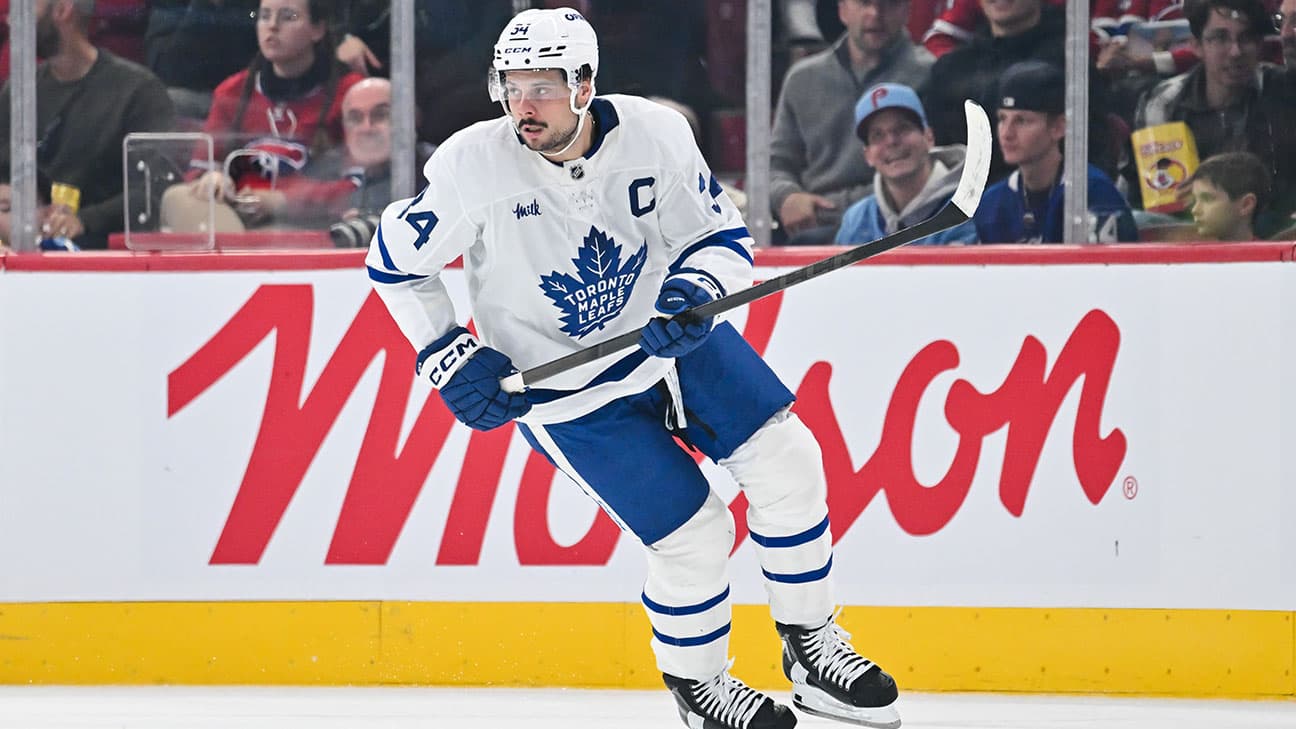
Photo: NHL.com
Auston Matthews' Knee Injury Is Behind Him — Now Comes the Bounce-Back Season Toronto Needs
Table of Contents
The Auston Matthews Knee Injury That Defined a Lost Season
The Auston Matthews knee injury that ended Toronto's 2025-26 season is finally in the rear-view mirror, and that single fact might be the most important thing the Maple Leafs have going for them this fall. Matthews underwent surgery on March 19 to repair a Grade 3 MCL tear in his left knee, an injury suffered a week earlier on a knee-on-knee collision with Anaheim's Radko Gudas. The recovery timeline was set at roughly 12 weeks, which put him back on the ice around mid-June — a full summer ahead of training camp.
For a player who spent most of last season either hurt or playing through it, that clean runway matters. The captain is expected to be ready for the puck drop of 2026-27, and after the year Toronto just endured, a healthy Matthews is not a luxury. It is the entire premise of the season.
What the Numbers Actually Said
Matthews finished 2025-26 with 27 goals and 26 assists in just 60 games. Those are fine numbers for most forwards and a disappointment for a player who has hit 60 goals in a season. The story is not the point totals — it is the games missed and the version of Matthews that showed up when he did play. Injuries robbed him of his trademark burst, and a lineup already thin on scoring never found a rhythm around him.
Contrast that with William Nylander, who quietly carried the offence as the team's most consistent scorer, leading the club with 30 goals and 49 assists for 79 points in 65 games. Nylander did his part. The gap between Toronto's ceiling and its 2025-26 reality was, in large measure, the gap between a healthy Matthews and the one the Leafs actually had.
Why a Full Offseason Changes the Math
MCL surgery is not the career-altering event a torn ACL can be, and the timeline reflects that. A Grade 3 tear is serious, but the 12-week window and the mid-June return mean Matthews gets something he did not have last year: months of unhurried rehabilitation and conditioning before hockey resumes. There is genuine confidence around the club that he will be ready at full strength for October.
The knee-on-knee mechanism is worth noting because it is bad luck rather than a chronic breakdown — this is not a soft-tissue issue that keeps recurring or a wear-and-tear problem that hangs over a player into his thirties. Matthews turns the page on a discrete, repairable injury. If the rehab has gone as reported, the athletic tools that made him a two-time Rocket Richard winner should still be there.
A Reshaped Roster Built to Support Him
The bounce-back case is not just about Matthews' knee. It is about the group around him. John Chayka spent the summer reshaping the supporting cast — adding Colton Sissons, Teddy Blueger and Jack Roslovic down the middle and on the wings, trading for Nick Paul to solve the third-line centre hole, and landing the No. 1 overall pick, Gavin McKenna, on an entry-level deal.
The idea, in Chayka's words, was a lineup that is "deeper, faster, bigger, heavier" — a group that can score beyond its top line and defend without leaning on the stars for everything. If that holds, Matthews no longer has to be a one-man life raft. He can be the finisher on a top line, play his minutes, and let a deeper forward corps carry the rest. That is the healthiest possible context for a return from injury.
The Hiller Factor
Then there is the coaching change. Jim Hiller took over the bench this offseason, and how he deploys Matthews will shape the comeback. A coach who manages the captain's workload early — protecting the knee's first months back with sensible minutes and matchups — gives Matthews the best chance to build into the season rather than break down in it.
Hiller's group has been vocal about wanting to play a faster, more structured game. For Matthews, structure is a gift. A well-defined role and reliable linemates let him hunt the areas where he is lethal — the top of the circles, the net front — without freelancing to make up for the roster's shortcomings the way he sometimes had to last year.
The 84-Game Wrinkle
There is one complicating factor worth naming: the schedule. The 2026-27 season expands to 84 games, four more than the traditional slate, which means more mileage on a surgically repaired knee over a longer grind. For a player coming off an MCL repair, load management is not a buzzword — it is a medical reality the staff will have to respect from October onward.
That cuts both ways. The extra games are more wear, but they also give Matthews margin to ease in without falling behind in a tight playoff race. A patient early workload — spotting him rest, protecting him on back-to-backs — is the sensible path, and Toronto's deeper forward group finally makes that possible. A year ago the Leafs could not afford to sit their best player. This year, in theory, they can.
What a Real Bounce-Back Looks Like
Set the bar honestly. Nobody should pencil in 60 goals off a Grade 3 MCL repair. A realistic, season-defining bounce-back looks more like 40-plus goals, 80-plus points, and — most importantly — a games-played number back in the high seventies or beyond. Availability is the metric that matters most for a player whose last two seasons were interrupted. If Matthews plays 78 games and looks like himself by December, Toronto has a different team than the one that missed the playoffs.
It is worth remembering how quickly the narrative can flip. Two seasons ago Matthews was a 60-goal scorer and the best pure finisher in the sport; one freak collision reduced him to a 27-goal season and a spring on the shelf. Health, not decline, is the variable. Nothing about the way he played before the injury suggests his tools have eroded — he is not a fading veteran, he is a star who lost a year to a knee. That distinction is the whole reason Toronto's optimism is grounded rather than wishful.
The captaincy question is settled — Matthews told the front office he is all in — so the noise around his future is quieter than it has been in a year. That clarity, paired with a clean knee and a deeper roster, is the setup for the best-case scenario. You can track how the pieces fit on our players page as camp approaches.
What's Next
The next real checkpoint is training camp in September, when Matthews is on the ice in full contact for the first time since the surgery. Watch his skating in the opening sessions — the explosiveness off the first stride is the tell for whether the knee is truly right. If he passes that eye test, the conversation shifts from "can he stay healthy" to "how good can this team be."
The 2026-27 Maple Leafs were built around a bet: that a healthy Auston Matthews, a reshaped supporting cast and a new coach add up to a return to the postseason. The knee is healed. The roster is deeper. Now the captain has to prove the bet was right.
Frequently Asked Questions
What injury did Auston Matthews have?
Matthews suffered a Grade 3 MCL tear in his left knee on a knee-on-knee collision with Anaheim's Radko Gudas on March 12, 2026. He underwent surgery on March 19 with a recovery timeline of roughly 12 weeks.
When will Auston Matthews return from knee surgery?
The 12-week timeline put Matthews back on the ice around mid-June 2026, giving him a full offseason to rehabilitate before training camp. He is expected to be ready for the start of the 2026-27 season.
How many goals did Auston Matthews score in 2025-26?
Matthews recorded 27 goals and 26 assists in 60 games during an injury-shortened 2025-26 season, well below the 60-goal peak he reached earlier in his career.
Is Auston Matthews still the Maple Leafs captain?
Yes. Matthews told the front office he is committed to Toronto, and the captaincy question was settled this offseason. He enters 2026-27 as the Maple Leafs' captain.
Who led the Maple Leafs in scoring in 2025-26?
William Nylander led Toronto with 30 goals and 49 assists for 79 points in 65 games, serving as the team's most consistent offensive player through a difficult season.
What is a realistic bounce-back season for Matthews in 2026-27?
A realistic bounce-back off a Grade 3 MCL repair is roughly 40-plus goals and 80-plus points, with the games-played total being the most important metric. Staying healthy for 78-plus games would matter more to Toronto than any single scoring number.


