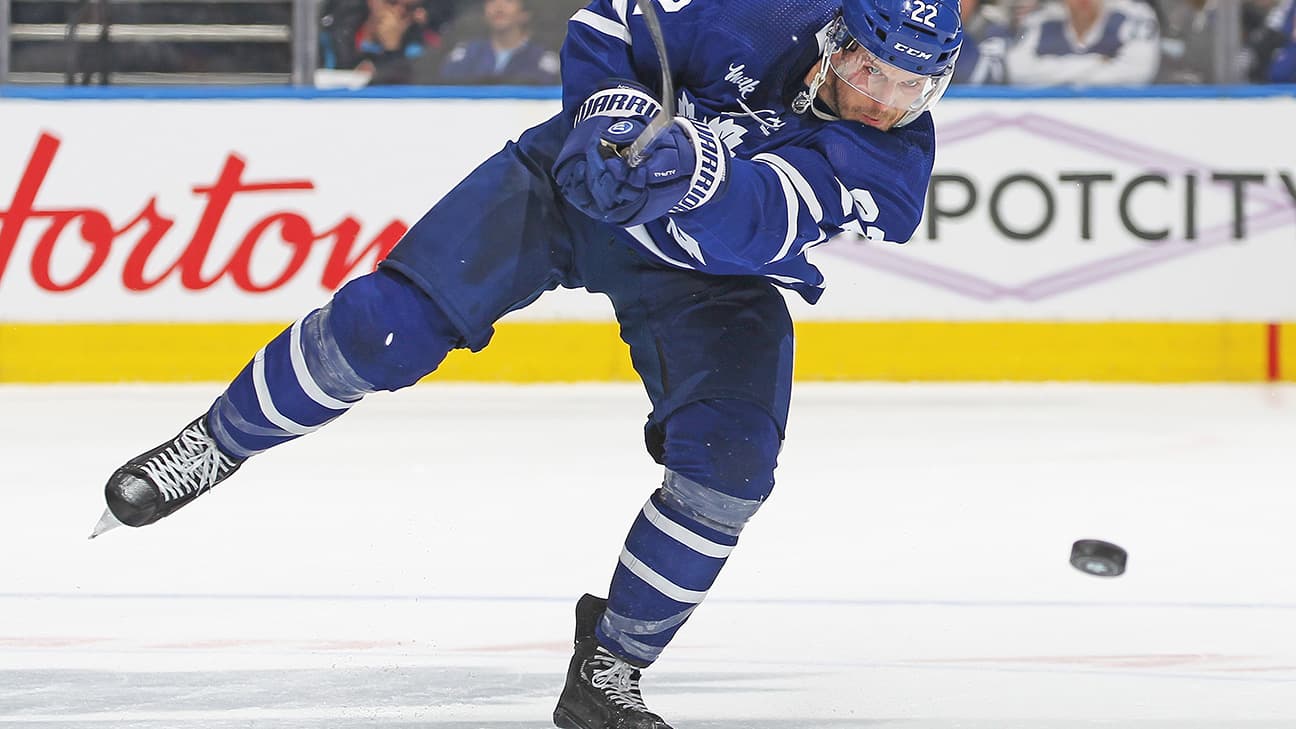
Photo: NHL.com
Jake McCabe Is the Maple Leafs' Most Important Defenceman in 2026-27
Table of Contents
Jake McCabe is the Maple Leafs' most important defenceman, and it is not close
Strip the Toronto blue line down to the question that decides the season and you land on Jake McCabe. The Maple Leafs missed on Zach Werenski, kept Morgan Rielly, bet on Chris Tanev's health and added Darren Raddysh for puck movement. Every one of those decisions rests on the same assumption: that McCabe can absorb genuine No. 1 shutdown minutes at 33 years old, on a body that has spent three seasons throwing itself in front of things.
That is a heavier load than it sounds. It is also, at a $4,513,102 cap hit, the single best contract on Toronto's defence corps by a wide margin. John Chayka inherited exactly one blue-line deal that functions as an asset rather than a constraint, and it is this one.
This is an opinion piece, so here is the opinion plainly: if McCabe has a normal season, Toronto's defence is fine and the retool holds. If he breaks down or slips, there is nothing behind him, and the whole structure sags at once.
The contract is the smartest thing the old regime did
McCabe signed a five-year, $22.55-million extension in October 2024 — the last meaningful piece of business of the previous front office. The headline number was $4.51 million a season. The interesting part was underneath it.
Toronto used deferred compensation to pull the average annual value down. Roughly $5.5 million of the deal is deferred until January 2031, split across the second and third years, which shaved the cap hit from about $4.7 million to $4.51 million. It was a small, unglamorous piece of cap engineering, and with the ceiling climbing every year it now looks like found money.
In 2026-27 specifically, McCabe earns a $1-million base salary plus a $1.5-million signing bonus. The deal runs through 2029-30, covering him to age 36. Long deals for physical defencemen in their thirties are usually where cap sheets go to die. Look at the back half of Toronto's contracts page and ask which blue-line commitment you would rather have.
What he actually does
McCabe arrived from Chicago in February 2023 as a depth stabiliser and quietly became the guy the coaching staff reaches for when the game gets hard. He plays both sides. He kills penalties. He takes the opposition's best line most nights and does it without the puck spending the whole shift in his own end.
The style is not subtle. He blocks shots, finishes checks, closes gaps early and accepts the physical cost of doing all three. Under Craig Berube that made him a coach's favourite. Under Jim Hiller, whose defensive structure leans on defencemen defending the middle of the ice rather than chasing puck carriers to the wall, it should make him a system fit rather than a system exception.
What he is not is a driver. McCabe does not tilt the ice on his own, does not generate offence at a top-pairing rate, and is not going to run a power play. He is a stopper. That is a valuable thing to be. It is not the same thing as a No. 1.
The problem is the job description, not the player
Toronto's projected top pairing is McCabe with Raddysh. That is a pairing where one player defends and the other moves the puck, and it works if both stay inside their strengths. Raddysh is a bet on power-play value; his even-strength results have never been the selling point. Which means McCabe is doing the defending for two.
Behind that, Rielly slides to a second pair alongside Tanev, and Oliver Ekman-Larsson gets a softer third-pair assignment with Emil Andrae. It is a reasonable structure. It is also a structure with exactly one player capable of handling elite competition, and Toronto plays in a division with Florida, Tampa Bay and a Senators group that reloaded after trading its captain.
We laid out why this remains the unfinished part of Chayka's summer, and the Werenski veto confirmed there is no external fix coming. McCabe is the fix, whether or not that is fair to him.
The age question is real and nobody wants to say it
McCabe turns 33 in October. Defencemen who play his way — heavy, physical, shot-blocking, high-contact — do not usually age gracefully into their mid-thirties. The skill that erodes first is the one his entire game depends on: the half-step that lets him close a gap before a forward gets to full speed.
There is no evidence yet that it has gone. But an 84-game season is four extra games of exactly the kind of mileage that wears down this player type, and Toronto has done nothing to reduce his workload. If anything, trading Brandon Carlo and Simon Benoit out of the group increased it.
That is the risk in one sentence: the Leafs added puck movers and subtracted defenders, then asked their oldest heavy-minutes defender to cover the difference.
Why he matters more than Rielly or Tanev
Rielly is the more famous player and the bigger cap hit. Tanev is the more romantic one — the warrior narrative, the shot blocks, the playoff toughness. But Toronto has already priced in decline from both. Nobody's projection for the 2026-27 Leafs assumes Rielly returns to 60-point form or that Tanev plays 82 games.
McCabe is different because the projections quietly assume he holds. Every lineup card, every pairing chart, every optimistic take about a deeper blue line starts from the premise that McCabe gives you what he gave you last year. He is the load-bearing wall, and load-bearing walls only get noticed when they fail.
There is also a leadership dimension worth naming. This is a room that lost Berube, lost Carlo and Benoit, and added six new faces. McCabe is one of a shrinking number of players who were here for the worst of last season and are still here to answer for it.
The depth chart behind him is thin
If McCabe misses time, the cascade is ugly. Rielly moves up to minutes he is no longer suited for. Tanev's usage climbs at exactly the age where it should be dropping. Ekman-Larsson gets pushed into a top four he was signed to avoid. Stecher and Andrae play more than anyone planned.
The internal answer is Ben Danford, and Danford is a 20-year-old who has never played an NHL game. He is a legitimate prospect and he has said openly he wants an opening-night job, but leaning on him as injury insurance in October is not a plan — it is a hope. The roster page shows how quickly the right side thins out once you go past the top four.
What to watch at camp
Three things will tell you whether this holds up. First, whether Hiller actually deploys McCabe-Raddysh as a first pairing against top competition in preseason, or whether he hedges and splits the shutdown load. Second, McCabe's usage in the defensive zone: if the coaching staff is starting him in his own end at the same rate as last season while also asking for a bigger share of total minutes, that is a lot to carry for 84 games.
Third, and most important, whether Chayka adds anyone. A right-shot defender who can play real minutes is the one addition that would change Toronto's outlook, and it is the one addition the summer has refused to produce.
McCabe will not be the most talked-about Maple Leaf this season. He will not be on the highlight package or the contract-extension watch list. He is just the player whose season most determines whether Toronto's defence is a functioning group or a problem the Leafs spend until February trying to trade their way out of.
Frequently Asked Questions
What is Jake McCabe's contract with the Maple Leafs?
McCabe signed a five-year, $22.55-million extension in October 2024, carrying a $4,513,102 cap hit through the 2029-30 season. The deal includes roughly $5.5 million in deferred compensation payable until January 2031, which lowered the cap hit from about $4.7 million to $4.51 million.
How old is Jake McCabe and how long is he signed for?
McCabe turns 33 in October 2026. His contract runs through 2029-30, meaning Toronto has him under contract into his age-36 season — a long runway for a physical, shot-blocking defenceman.
Who will play on the Maple Leafs' top defence pairing in 2026-27?
The projected top pairing is Jake McCabe with Darren Raddysh, with Morgan Rielly and Chris Tanev on the second pair and Oliver Ekman-Larsson alongside Emil Andrae on the third. Those pairings stay in pencil as long as the Rielly trade file remains open.
Do the Maple Leafs have a true No. 1 defenceman?
No. McCabe is the team's best defensive defenceman and plays the hardest minutes, but he is a shutdown piece rather than a play-driver. Toronto's pursuit of Zach Werenski was an attempt to fill that gap, and it failed when Werenski used his no-movement clause to stay in Columbus.
How did the Maple Leafs acquire Jake McCabe?
Toronto acquired McCabe from the Chicago Blackhawks in February 2023, in a deal that also brought forward Sam Lafferty to the Leafs in exchange for draft capital. He has since become the team's most reliable defender and a fixture on the penalty kill.
What happens to the Maple Leafs defence if Jake McCabe gets injured?
The cascade is severe. Rielly and Tanev would move into minutes that no longer suit them, Ekman-Larsson would be pushed into the top four, and Toronto would be leaning on prospect Ben Danford, who has yet to play an NHL game, far earlier than planned.
Why does deferred money lower a player's salary cap hit?
Under NHL rules, deferred compensation is discounted to present value when calculating the cap hit, so money paid years after the contract ends counts for less today. In McCabe's case, deferring about $5.5 million to January 2031 reduced his annual cap charge by roughly $200,000.


