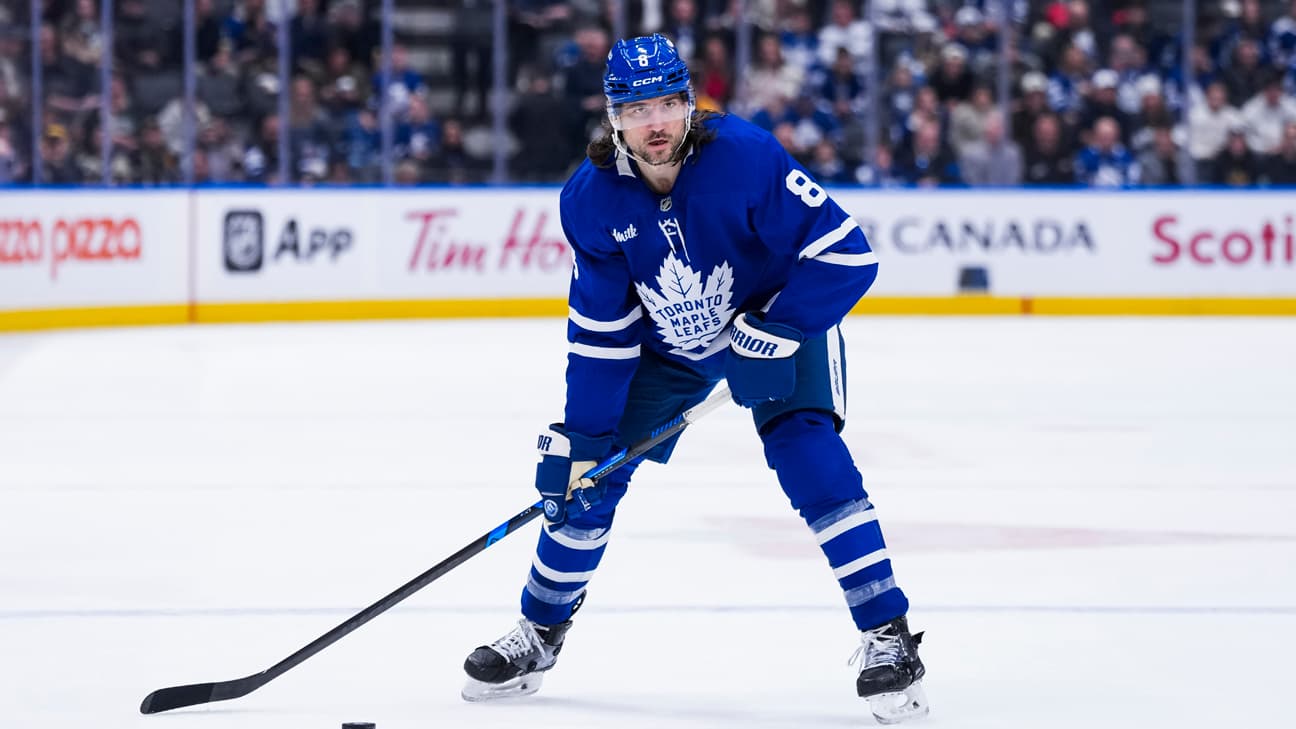
Photo: NHL.com
Chris Tanev Is Healthy Again, and the Maple Leafs' Blue Line Gets Its Anchor Back
Table of Contents
A healthy Chris Tanev changes everything on Toronto's blue line
The most important defenceman on the Maple Leafs' 2026-27 roster might be the one who barely played last season. Chris Tanev is healthy again after a core muscle surgery ended his year, and a fully fit Tanev is the single biggest reason to feel better about a Toronto blue line that leaked far too much when he was out. He is expected to be a full participant in training when camp opens in September, and the club is planning to hand him a significant top-four role. For a defence corps that spent much of last winter improvising, that is close to a lifeline.
Tanev is not a highlight-reel player and never has been. What he is — a relentless shot-blocker, a positionally flawless killer of rush chances, and one of the most trusted penalty killers of his era — is exactly what this roster missed most when injuries pulled him out of the lineup.
How bad the injury year got
Tanev's 2025-26 was a grind from the start. He was taken off the ice on a stretcher after a collision in Philadelphia on November 1 and dealt with concussion-like symptoms in the aftermath. A groin injury then wiped out the back half of his season, and he ultimately underwent core muscle surgery in New York to shut things down for good. Multiple separate injuries, one after another, turned a signing meant to stabilize the back end into a season-long absence.
The timing could not have been worse. Toronto's blue line was already thin on true shutdown minutes, and losing Tanev forced the rest of the group up the lineup into roles they were not built for. The Leafs missed the playoffs, and while no single injury explains a lost season, the collapse of the defensive structure without their best defensive defenceman was a real part of the story.
Why the surgery is actually good news
Core muscle procedures are common in hockey and, crucially, they tend to fully resolve the problem rather than linger. Reports have Tanev cleared to train normally by September, meaning he should arrive at camp without restrictions and without the compensatory issues that pile up when a player skates through a groin or abdominal injury for months. That matters for a 36-year-old defenceman whose game is built on precise timing and body position rather than raw speed — he does not need to be explosive, he needs to be right.
There is a version of this where Tanev's age and injury history are a red flag. But his style ages gracefully. He has never relied on foot speed he is now losing; he relies on reads, gaps and stick position, and those are the last things to go. A healthy Tanev at 36 can still be one of the better defensive defencemen in the Atlantic.
Where he fits in Jim Hiller's pairings
The exact configuration is still in flux, but every projection has Tanev in the top four. The most common version pairs him with a puck-mover — either right-shot addition Darren Raddysh or, on the second pair, Jake McCabe as a heavy shutdown duo — and lets Tanev do the defensive heavy lifting while his partner handles transition. Some projections have Raddysh and Morgan Rielly as the top pair with Tanev anchoring the second; others flip that. The uncertainty is partly a function of the unresolved Rielly trade situation, which will decide how the left side ultimately shakes out.
Whatever the arrangement, Tanev's value is the same: he lets the more offensive defencemen take risks because he is behind them cleaning up. You can see how the pieces slot together in our projected 2026-27 lineup, and the broader right-shot picture in our look at the blue line's right-shot push.
The Bobrovsky connection
A stabilized defensive structure is worth even more now that Toronto has bet on a new starting goaltender. Sergei Bobrovsky arrives on a three-year deal to reset the crease, and no goalie — however accomplished — thrives behind a defence that surrenders Grade-A chances off the rush. Tanev's return is quietly one of the biggest inputs into whether the Bobrovsky gamble pays off. Cut down the quality of the shots and a 37-year-old goaltender looks a lot sharper; leave him exposed and the whole plan wobbles.
This is how defence is supposed to work as a system rather than a collection of names. Tanev suppresses the dangerous stuff, the goaltender handles a cleaner workload, and the offensive players are freed to push because the safety net is real. That chain broke last year the moment Tanev went down.
The penalty kill that fell apart without him
Tanev's absence showed up most starkly on the penalty kill, where his shot-blocking and lane discipline are worth more than his even-strength numbers ever capture. Killing penalties is a craft built on anticipation — knowing where the puck is going before it gets there and getting a body or a stick in the way. Few defencemen in the league do it as reliably as a healthy Tanev, and when he was out, Toronto's kill lost its most dependable presence at exactly the moment an 84-game schedule demands more special-teams reps than ever.
Restoring that piece has a cascading effect. A functional penalty kill keeps games close, protects leads, and takes pressure off the goaltender in the highest-danger situations on the ice. It also lets Hiller deploy his other defencemen in roles that suit them rather than stretching everyone up a rung to cover for the missing minutes. When your best penalty killer returns, the whole special-teams structure gets to reset to its intended shape instead of improvising around a hole.
What Toronto needs from him
Nobody is asking Tanev to score. The Maple Leafs need availability and shutdown minutes — roughly 20 hard, thankless minutes a night against top competition, plus a heavy penalty-killing load. If he plays 70-plus games, this defence has a spine. If the injuries return, Toronto is right back to papering over a hole it could not fill last season. The margin is that stark, and it is why his health has quietly become one of the most consequential storylines of the summer.
There is also a leadership dimension. Tanev is exactly the kind of veteran a retooling room leans on — a professional who blocks shots in October like it is Game 7 and sets the standard for how the group defends. That example was missing for most of last season.
What's next
The real test is September, when Tanev goes from cleared-to-train to actually banging in camp battles. Watch for how Hiller pairs him early and whether he draws the toughest matchup assignment out of the gate — that would signal the staff trusts the body fully. If Tanev is on the ice for the opener and skating his usual shutdown shift, the Maple Leafs will have quietly solved one of last year's biggest problems without spending a dollar in free agency. Track his camp status and the rest of the defensive picture on our players page as the season approaches, and keep an eye on the standings once the games that hinge on this blue line begin.
Frequently Asked Questions
Is Chris Tanev healthy for the 2026-27 season?
Yes. Tanev underwent core muscle surgery that ended his 2025-26 season and is now reported to be fully healthy. He is expected to be a full participant in training when Maple Leafs camp opens in September and to play a significant top-four role.
What surgery did Chris Tanev have?
Tanev had core muscle surgery in New York after a season derailed by multiple injuries. He was taken off on a stretcher following a collision in Philadelphia on November 1 with concussion-like symptoms, then a groin injury ended his year in late December before the procedure shut him down.
How old is Chris Tanev and what is his contract?
Tanev is 36 and turns 37 in December 2026. He signed a six-year contract with the Maple Leafs in 2024 carrying a $4.5-million cap hit, a deal built around his shutdown defending and penalty-killing rather than offence.
Who will Chris Tanev be paired with in 2026-27?
It is still in flux. Projections have Tanev in the top four alongside a puck-mover — either Darren Raddysh or Jake McCabe in a shutdown role — with the final arrangement partly depending on whether Morgan Rielly is traded. Whatever the pairing, Tanev is expected to handle the defensive heavy lifting.
Why is Chris Tanev's return important for the Maple Leafs?
Toronto's defensive structure sagged without him last season, contributing to a missed playoff spot. A healthy Tanev suppresses Grade-A chances off the rush, lightens the workload on new starter Sergei Bobrovsky, and frees the offensive defencemen to push, restoring the system that broke when he got hurt.
How many games does Chris Tanev need to play to matter?
Availability is the whole question. If Tanev plays 70-plus games and logs his usual 20 shutdown minutes a night, the Leafs' blue line has a spine. If the injuries return, Toronto is back to papering over the same hole it could not fill in 2025-26.


