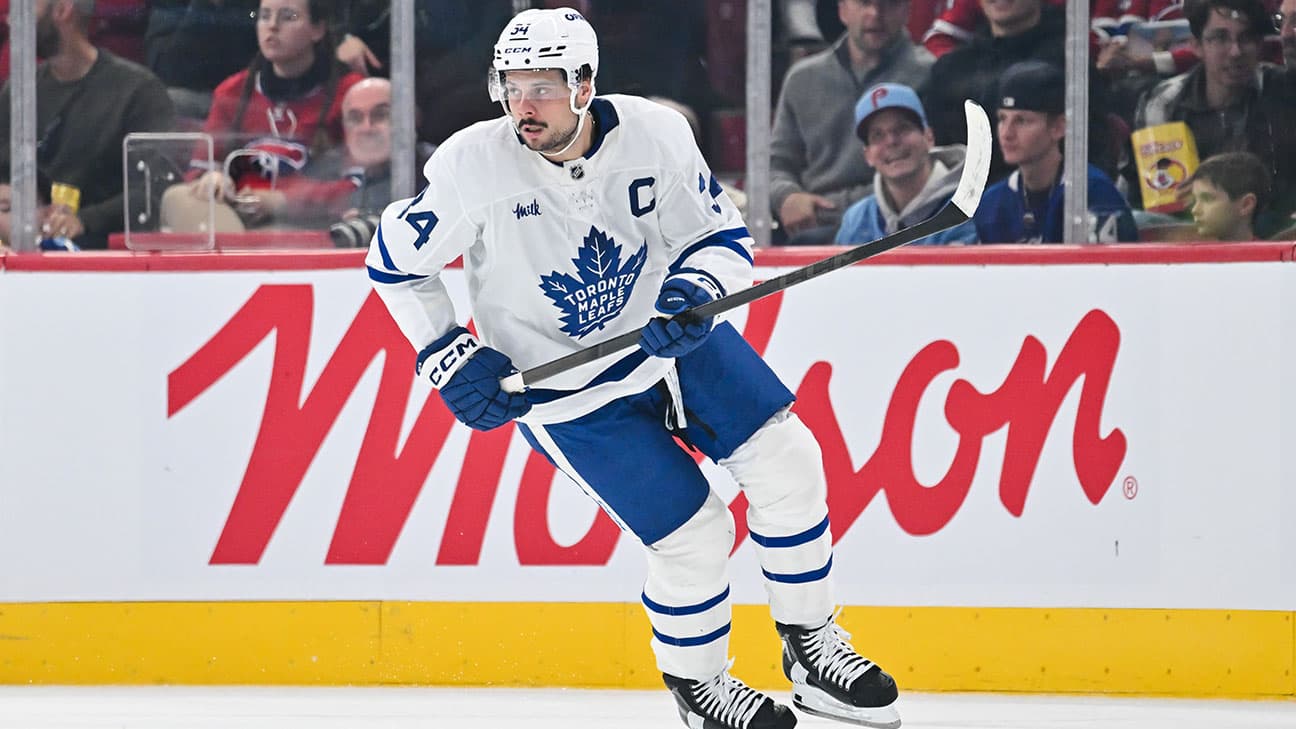
Photo: NHL.com
Auston Matthews' Maple Leafs Commitment Holds as the Mid-July Deadline Quietly Passes
Table of Contents
The Auston Matthews commitment question just got its quiet answer
The Auston Matthews commitment question that hung over the Maple Leafs all offseason has resolved the way John Chayka needed it to: no change. Back in the spring, word surfaced that the captain intended to take a wait-and-see approach — watching what the reshaped front office did through the draft and free agency before deciding how he felt about his future in Toronto. That soft, mid-July checkpoint has now come and gone, and by every reported account Matthews is staying put, engaged, and bought into the direction. There was no trade request, no leverage play, no public drama. Just a captain who looked at the summer's work and decided it was enough to keep building around.
For a franchise that spent the last three months tearing at the edges of its roster, that is the single most important outcome of the entire offseason. Everything else — the goaltending overhaul, the new bottom six, the McKenna era beginning — only matters if the man at the centre of it wants to be here.
Where the wait-and-see actually came from
This was never a contract standoff in the traditional sense. Matthews is signed through the 2027-28 season on a deal that carries a $13.25-million cap hit, so there was no free agency clock forcing anyone's hand. The uncertainty was about intent. After Toronto missed the playoffs and cleaned house — firing Brad Treliving, parting with head coach Craig Berube on May 13, and handing the baseball to a new-look front office led by Chayka with Mats Sundin as senior adviser — the fair question was whether the captain still believed the plan around him could win.
Reports in early May framed it plainly: Matthews would monitor the moves before committing his heart to the rebuild-on-the-fly. That is not disloyalty. It is a 28-year-old franchise player, one of the best goal-scorers of his generation, asking the organization to show him a roster worth staying for. The mid-July marker was less a hard ultimatum than a reasonable window for both sides to take stock once the summer's biggest dominoes had fallen.
What Chayka built to earn the yes
The answer Chayka gave was a summer of buying, not selling. He signed Sergei Bobrovsky to reset the crease on a three-year, $21-million deal, a bet on experience over the status quo that we broke down in our look at the Bobrovsky gamble. He landed right-shot defenceman Darren Raddysh in a sign-and-trade out of Tampa — a 22-goal, 70-point blueliner locked up long term. He remade the middle of the lineup with Nick Paul, Jack Roslovic, Colton Sissons and Teddy Blueger, and he won the draft lottery to add Gavin McKenna, the most hyped prospect to enter the league in years.
None of those moves are subtle signals. They are the actions of a general manager telling his captain the window is open now, not three years from now. As one longtime observer put it, a lot of the summer's work felt aimed — sometimes in roundabout ways — at making Matthews' life easier: more support down the middle, a real starting goaltender behind him, and a genuine offensive weapon to eventually skate on his wing. You can trace the intended fit in our projected 2026-27 lineup.
Chayka's read on his captain
Chayka has never sounded worried in public. Speaking to reporters earlier in the offseason, the GM described a "happy captain" who "wants to win in Toronto," and his roster construction has matched the rhetoric. There is a version of this summer where a rebuilding executive quietly gauges the trade market for a superstar and stockpiles futures. Chayka did the opposite. He spent, he added term, and he pushed his chips toward contending — the clearest possible tell that he expected Matthews to be at the centre of it.
That alignment matters because the alternative was catastrophic. A Matthews trade request would have detonated the retool, forcing a full-scale teardown and handing the rest of the Atlantic a gift. Instead, Toronto keeps its franchise cornerstone, its captaincy stays stable, and the McKenna era gets to begin alongside an established superstar rather than in the rubble of one leaving.
The bounce-back season that has to follow
Commitment is the floor, not the ceiling. The harder part is the hockey. Matthews is coming off a season interrupted by a nagging knee issue that sapped his explosiveness and cost him games, a stretch we covered in detail when we looked at his recovery and the bounce-back Toronto needs. A healthy, motivated Matthews is a 60-goal threat and the engine of a contender. A diminished one turns this whole retool into a very expensive coin flip.
The good news is that a locked-in captain tends to show up in September ready to lead. With the noise about his future now settled, Matthews can spend the summer training rather than fielding questions, and the room around him can plan without an asterisk hanging over its best player. That clarity is worth more than any single signing.
What the commitment does to the rest of Chayka's summer
A settled captain also frees the front office to finish the job on its own terms. Toronto still has cap housekeeping to do — the club has been over the ceiling and is working through the math, as we laid out in our breakdown of the likeliest cap-clearing move and the ongoing Morgan Rielly trade file. But those are optimization problems, not existential ones. When your superstar has already told you he is in, you get to make cap decisions from a position of strength instead of desperation.
It also changes the calculus on McKenna. Fast-tracking an 18-year-old into a top-six role is far less risky when the veteran anchor beside him is committed and healthy. Matthews staying is what makes the aggressive McKenna plan sensible rather than reckless.
What a committed captain is worth in this division
Context matters here, and the Atlantic is unforgiving. Florida remains the standard, Tampa Bay refuses to fade, and the rest of the division is deep enough that no retooling club gets a soft runway. Toronto's path back to contention runs directly through its stars producing at a superstar level — and that math only works if the best of them is fully invested. A captain who has publicly and privately reaffirmed he wants to win in Toronto is not a luxury in that environment; it is the precondition for everything else the front office is trying to do.
There is also the intangible cost of the alternative. Trade requests from franchise players do not stay quiet, and the mere perception that Matthews had one foot out the door would have poisoned free-agent recruiting, unsettled the room, and handed rivals a narrative to exploit. By settling the question before camp, the Maple Leafs removed the one storyline that could have swallowed their entire season. That clarity lets Chayka sell the vision to everyone else — players weighing Toronto, veterans deciding whether to buy in, a young McKenna arriving into a stable environment rather than a soap opera.
What's next
The reported deadline has passed without incident, which in Toronto counts as a win in itself. The next real checkpoint is training camp in September, when the words become skating and the projected lines become real ones. Watch for whether the club and Matthews' camp eventually open dialogue on an extension that would take him past 2027-28 — that would be the ultimate confirmation of everything the summer implied. For now, the Maple Leafs have their captain, their plan, and a clean runway into the season. After a spring of upheaval, a quiet mid-July that ended in "no change" is exactly the boring outcome this franchise needed. Keep an eye on the contract picture as camp approaches, because the next domino is financial, not philosophical.
Frequently Asked Questions
Did Auston Matthews commit to the Maple Leafs?
By all reported accounts, yes. Matthews had taken a wait-and-see approach through the offseason and set a rough mid-July checkpoint to evaluate the club's moves. That deadline passed with no trade request and no change — he is staying and bought into Toronto's direction for 2026-27.
Is Auston Matthews under contract with the Maple Leafs?
Yes. Matthews is signed through the 2027-28 season on a deal carrying a $13.25-million cap hit. The offseason uncertainty was never about free agency; it was about whether he intended to stay long term rather than seek a move.
Why was there doubt about Auston Matthews' future in Toronto?
After the Maple Leafs missed the 2025-26 playoffs and overhauled the front office and coaching staff, reports in early May said Matthews would wait to see what moves the team made before committing. It was a reasonable pause from a franchise player, not a public trade demand.
What did John Chayka do to keep Auston Matthews?
Chayka spent the summer buying, not selling. He signed Sergei Bobrovsky, acquired Darren Raddysh in a sign-and-trade, added Nick Paul, Jack Roslovic, Colton Sissons and Teddy Blueger, and drafted Gavin McKenna first overall. Chayka publicly described a happy captain who wants to win in Toronto.
Could the Maple Leafs still trade Auston Matthews?
There is no indication they will. Chayka's roster construction — adding term and NHL talent rather than stockpiling futures — points the other way. A Matthews trade would have forced a full teardown, and both sides have reportedly reaffirmed their commitment.
What does Auston Matthews' commitment mean for Gavin McKenna?
It makes Toronto's aggressive plan to fast-track McKenna into the top six far more sensible. Slotting an 18-year-old alongside a committed, healthy Matthews is a calculated bet rather than a gamble born of a rebuild, and it keeps the McKenna era starting from a position of strength.


