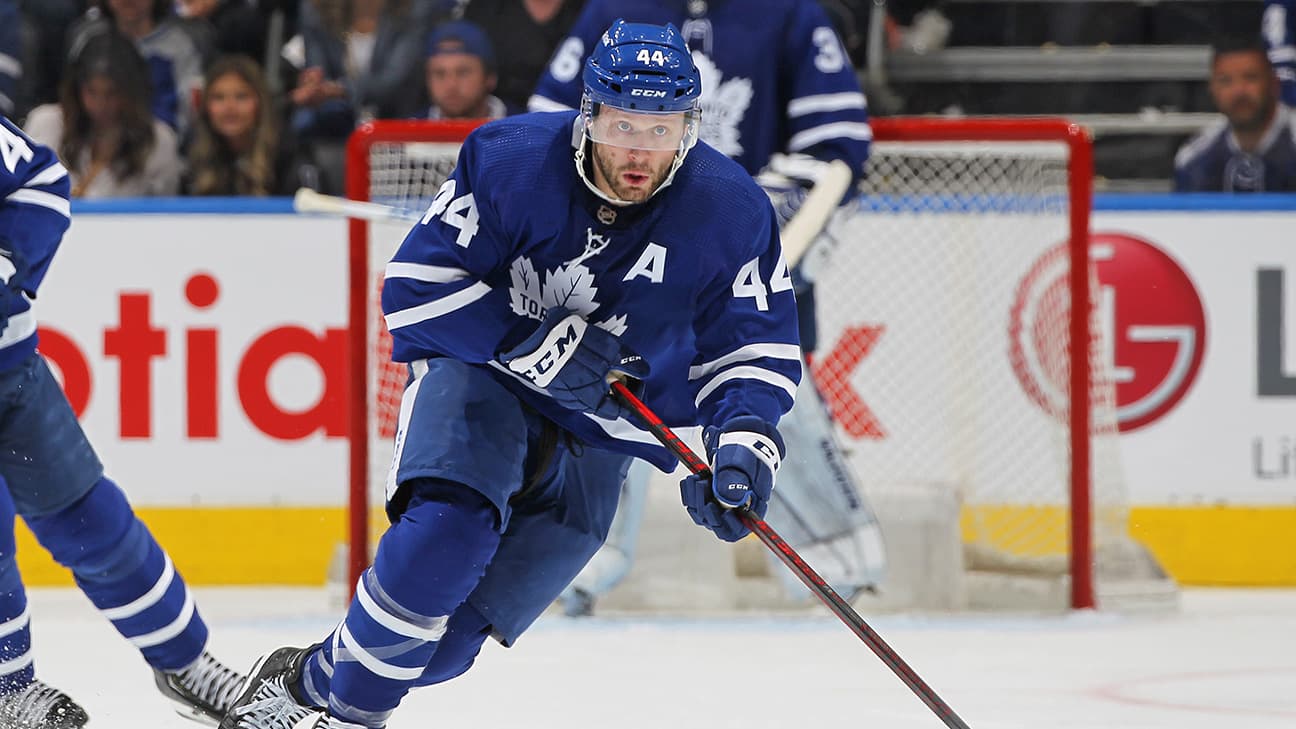
Photo: NHL.com
Bruce Boudreau Says the Maple Leafs Defence Will Cost Them the Playoffs
Table of Contents
Boudreau's call, stated plainly
Bruce Boudreau does not think the Maple Leafs defence is good enough to get Toronto back into the playoffs, and he said so on The Leafs Morning Take. His reasoning was not vague and it was not a shot at any individual: the group is old, the season is 84 games, and he expects that combination to grind them down. He was careful to add that he wants Toronto to make it. He just does not believe it will happen.
It is easy to file this under "former coach says thing on podcast" and move on. Do not. Boudreau spent 1,000-plus games behind an NHL bench in Washington, Anaheim, Minnesota and Vancouver, he has been generous about Chayka's other moves — he publicly endorsed the Brandon Duhaime signing — and his critique is specific enough to be tested. The Maple Leafs defence he is describing is a real group with real birth certificates, and the schedule he is describing is a real change to the sport.
So let us test it, honestly, rather than reflexively defending a team that finished last in the Atlantic four months ago.
The Maple Leafs defence is exactly as old as he says
This is the part where the argument is airtight. Here is Toronto's projected defence corps for 2026-27, by age at the start of the season:
- Chris Tanev — 36, turns 37 in December
- Oliver Ekman-Larsson — 35
- Jake McCabe — 32, turns 33 in October
- Morgan Rielly — 32
- Darren Raddysh — 30
- Emil Andrae — 24
Boudreau's specific claim was that Andrae is the only blueliner on the roster under 30. That is correct. Raddysh turned 30 in February. Every other regular is in his thirties, and two of them are on the wrong side of 35. Add both goaltenders — Sergei Bobrovsky turns 38 this month, Anthony Stolarz is 32 — and the entire defensive half of Toronto's roster skews older than almost anything else in the league.
There is no clever counter to this. It is a fact about the roster, and it is a fact Chayka chose. We laid out the full ledger in our look at Toronto's defence spending and again when examining the age profile of the whole roster. Boudreau is not making anything up.
Where he is most right: the 84-game grind
The schedule change is the sharpest part of his argument and the part Leafs fans are most likely to wave away.
The NHL moves to 84 games in 2026-27, its first expansion since 1993-94, with each club playing 42 home and 42 road dates. The preseason is capped at four games. The season opens September 29 and is built to award the Cup by mid-June. Every team absorbs two extra games, but two extra games are not distributed equally in cost. A 24-year-old absorbs them. A 36-year-old defenceman coming off core muscle surgery absorbs them differently.
Toronto's blue line also cannot rely on last year as evidence it can handle a workload, because last year it did not handle any workload at all. Tanev played 11 games before surgery ended his season. The unit that was left behind conceded 2,660 shots against, the most in the NHL, roughly 32.4 per game, and 299 goals. A group that failed at 82 games with a healthy-ish version of itself is now being asked to succeed at 84 with a year added to everyone.
Boudreau's framing — tough sledding — is, if anything, polite.
Where the argument gets thin: age is not the diagnosis
Here is where this site parts ways with him, and it is a distinction that matters.
Toronto's blue line did not collapse in 2025-26 because it was old. It collapsed because it was thin at the top and then lost its best defensive defenceman in October. Those are different failures with different fixes. Tanev at 36 was not the problem; Tanev at 11 games was. Rielly's worst two-way season — 36 points and a minus-18 across 78 games — was not caused by turning 32, it was caused by being asked to carry matchup minutes he has never been suited to carry, on a team with no one else to give them to.
Chayka's answer was not to get younger. It was to add a genuine right-shot puck-mover in Darren Raddysh and a mobile depth option in Emil Andrae, and to change how the whole thing is deployed. That second part is doing most of the work. Under Jim Hiller's projected pairs, McCabe becomes the de facto shutdown defender with Raddysh alongside him, Rielly drops to a second pair with less defensive responsibility and more licence to attack, and Ekman-Larsson runs a sheltered third pair. Rielly, who stayed after a summer of trade talk, is the single biggest swing: give him the right assignment and a minus-18 becomes an entirely different number without him getting any younger.
Hiller's track record is the reason to believe deployment can move the needle. He went 93-58-24 in parts of three seasons with Los Angeles running structured, low-event hockey before being fired in March 2026, and his teams there were consistently harder to play against than their raw talent suggested. We broke down what his system asks of a blue line when he was hired. The short version: it asks for discipline and shape, not for a 24-year-old with wheels.
The real hole is the top four, not the birth years
If you want to worry about Toronto's defence — and you should — worry about the correct thing.
The Maple Leafs still do not have a true number-one defenceman. McCabe is an excellent second-pair player being asked to be a first-pair anchor. Raddysh arrives with real offensive tools and legitimate defensive questions; nobody has yet proven he holds up against top competition over a full season. Tanev is superb when healthy, and the phrase "when healthy" is now doing a great deal of work. We argued in July that Chayka's summer left the top four unfinished, and nothing since has changed that.
Age is a proxy for that problem, not the problem itself. A 34-year-old genuine number one would fix more than a 25-year-old fifth defenceman would. Boudreau is pointing at the smoke. The fire is that Toronto never got the top-pair defender it spent the spring chasing.
The one genuine youth answer on the roster is Emil Andrae, and he is a 24-year-old on a third pair, not a solution. If he takes a real step this season the whole conversation gets easier. That is a hope, not a plan.
What would change the forecast
Three things, in order of likelihood.
Health. Tanev playing 65 games instead of 11 is worth more to this defence than any trade Chayka could realistically make in September. The club has spent the summer attacking exactly this — the Andy O'Brien performance hire in August, and a reshaped medical department this week. If those moves buy back 100 man-games, Boudreau's forecast ages badly.
Goaltending. A defence corps this old needs its goalies to bail it out, and Toronto's plan is a 38-year-old Bobrovsky and a Stolarz coming off a fractured season. That is the highest-variance bet on the roster. If it hits, 2,660 shots against becomes survivable. If it does not, none of the deployment cleverness matters.
A midseason addition. Toronto is tight to the cap and running Max Domi's situation through LTIR just to be compliant on opening night, so the January market is more realistic than the September one. The contract picture does not leave Chayka much room before then.
The verdict
Boudreau is right about the inputs and, in this space's view, too confident about the output. The defence is old, the schedule is longer, and the top four is unresolved. All true. But he is treating a group that lost its best defensive defenceman in October as though last season was a fair sample of what it is, and he is not crediting the two biggest changes — a coach who builds defensive structure for a living, and an availability overhaul aimed directly at the reason last season fell apart.
The honest position is that Toronto is a bubble team whose range of outcomes is enormous. Healthy, with Bobrovsky holding up and Rielly deployed sensibly, this is a wild-card team that nobody wants to draw. Unhealthy, it is exactly what Boudreau described, and the 84-game schedule turns a bad November into a lost season faster than 82 ever did.
That is not a defence of the roster. It is a warning that the margin is thin enough that a former coach's blunt August assessment is a completely reasonable thing to say out loud.
What's next
Camp opens in the second half of September, with prospect games in Gatineau on September 12-13 and the preseason starting September 19. The pairs Hiller runs in those exhibitions are the first real evidence: whether McCabe and Raddysh are stapled together, whether Rielly gets the sheltered offensive role the projections assume, and whether Andrae is treated as a regular or as the seventh man.
Then it is Montreal on September 29 and a 16-game October that gives Toronto no runway at all. Boudreau's prediction will be substantially settled by American Thanksgiving, as most of them are. Keep an eye on the standings — and on the injury report, which is where this particular argument will actually be decided.
Frequently Asked Questions
What did Bruce Boudreau say about the Maple Leafs?
Speaking on The Leafs Morning Take, the former NHL head coach said he does not believe Toronto will make the playoffs in 2026-27, while adding that he wants them to. His stated reason was that the Maple Leafs defence is old and will struggle across an 84-game schedule.
How old is the Maple Leafs defence in 2026-27?
Very. Chris Tanev is 36, Oliver Ekman-Larsson is 35, Jake McCabe and Morgan Rielly are both 32, and Darren Raddysh turned 30 in February 2026. Emil Andrae, 24, is the only projected regular under 30, which is exactly what Boudreau pointed to.
Who are the Maple Leafs' projected defence pairings for 2026-27?
The most commonly projected alignment is Jake McCabe with Darren Raddysh on the top pair, Morgan Rielly with Chris Tanev on the second, and Oliver Ekman-Larsson with Emil Andrae on the third. Nothing is settled until Jim Hiller runs them in preseason games beginning September 19.
How bad was the Maple Leafs' defence in 2025-26?
Toronto allowed 299 goals and a league-leading 2,660 shots against, roughly 32.4 per game, finishing 32-36-14 with a minus-46 goal differential. Chris Tanev played only 11 games before core muscle surgery ended his season.
Did Morgan Rielly get traded this summer?
No. Toronto explored the market extensively through the offseason and Rielly, who holds trade protection, provided a limited list, but no deal materialised. He reports to training camp as a Maple Leaf after a 2025-26 season in which he posted 36 points and a minus-18 in 78 games.
Why is the 84-game NHL season a problem for older teams?
The 2026-27 season expands from 82 to 84 games, the first increase since 1993-94, with 42 home and 42 road dates and a preseason capped at four games. The added workload lands in a similar calendar window, which raises the injury and fatigue cost for rosters built around players in their thirties.
What is Jim Hiller's coaching record?
Hiller went 93-58-24 across parts of three seasons as head coach of the Los Angeles Kings before being fired in March 2026. Toronto named him the 41st head coach in franchise history on June 17, 2026, replacing Craig Berube, who was fired May 13.


