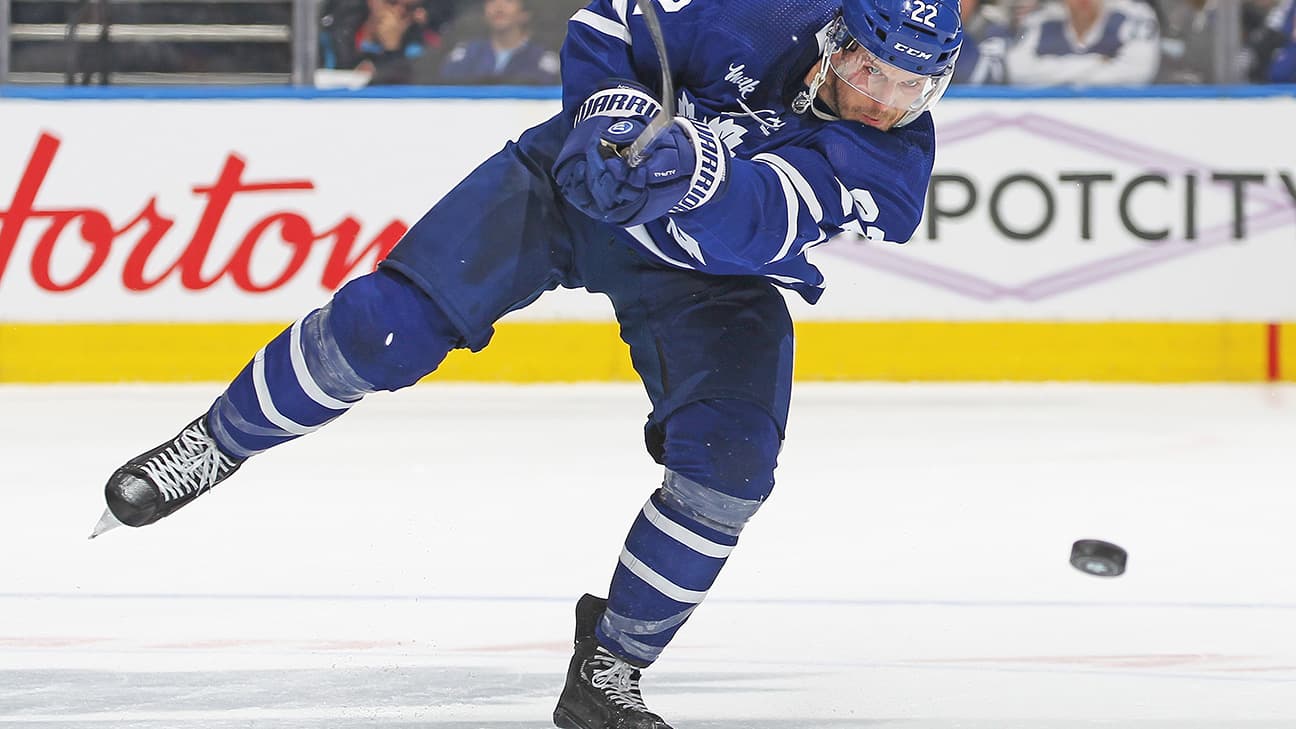
Photo: NHL.com
Maple Leafs Defence Pairings: Darren Raddysh Needs Jake McCabe
Table of Contents
The Maple Leafs defence pairings puzzle starts with an $8.5-million question
Every conversation about the Maple Leafs defence pairings for 2026-27 eventually arrives at the same fork: who plays with Darren Raddysh? John Chayka acquired him from Tampa Bay in a sign-and-trade for a 2026 fifth-round pick and immediately handed him eight years and $68 million, a $8.5-million cap hit that runs to 2034. When you pay a defenceman that, you do not build the blue line around tradition or seniority. You build it around him.
The obvious answer — Raddysh with Morgan Rielly, Toronto's two best puck-movers together — is the wrong one. Jonas Siegel of The Athletic has flagged it as a pairing the Leafs need to avoid, and the reasoning holds up. Two defencemen whose value is offensive, neither of whom is a natural defensive anchor, is how you turn an expensive top pair into a liability by American Thanksgiving.
The right answer is Jake McCabe, and getting there requires Jim Hiller to break up the pairing his roster has leaned on for two years.
What actually made Raddysh work in Tampa
Raddysh's breakout did not happen in a vacuum. He played most of it beside J.J. Moser, a mobile, positionally sound defenceman whose job was to handle the defensive side of the pairing so Raddysh could activate. Moser put up seven goals and 29 points in 79 games last season — useful, but nobody signed him to run a power play. He was the ballast.
That partnership let Raddysh do the thing Toronto is paying for: get to the offensive blue line, shoot, and keep pucks alive. He scored 10 power-play goals for the Lightning, which is the single most concrete reason the Leafs wanted him. Toronto's man advantage was the worst in the NHL through the first half of last season, cost assistant coach Marc Savard his job in December, and only clawed back to roughly league-average by April. A right-shot point shot was the specific missing piece, and we broke down how much of this contract is a power-play bet when it was signed.
But the bet only pays if the five-on-five arrangement lets him play the way he did in Tampa. Put him with a partner who also wants to join the rush and you get a pair that generates chances and surrenders them at the same rate. That is not what $8.5 million buys.
Why Raddysh with Rielly is the trap
Rielly is 32, coming off a summer in which his name lived permanently in the rumour mill, and by his own account expects to be a Maple Leaf on opening night. He remains a genuinely skilled passer and transition player. He has also spent most of the last five seasons being asked to do defensive work he is not built for, and the results have been predictable.
Pairing him with Raddysh compounds the problem twice over. It exposes Rielly's weaknesses in a top-matchup role, and it removes the structure Raddysh needs to be worth his contract. It is the pairing that looks best on a whiteboard and worst on a scoresheet.
There is a second-order issue. If Raddysh and Rielly play together, both are on the ice for the toughest matchups, which means Toronto's best defensive defencemen are deployed against third lines. That is backwards, and over 84 games it compounds.
The case for breaking up McCabe and Tanev
Here is the uncomfortable part. McCabe and Chris Tanev have been Toronto's most trusted shutdown pairing, and they have earned that reputation honestly. Splitting them is a real cost, and any coach would hesitate.
Do it anyway. McCabe is the closest thing on the roster to what Moser gave Raddysh — a left-shot defenceman who defends hard, moves well enough to keep up with an activating partner, and does not need the puck to be useful. Siegel identified him as the best available approximation, and that reading is correct.
The gain is that Toronto's most expensive defenceman gets deployed in the configuration that made him worth signing. The cost is that Tanev needs a new partner. That is a solvable problem. Oliver Ekman-Larsson had a quietly excellent season and remains, as we argued last week, the most underrated defenceman on the roster. A Tanev-Ekman-Larsson second pair is a legitimate NHL shutdown unit with a left-right balance and enough puck skill to exit the zone.
Chris Tanev at 36 and the load problem
Tanev turned 36 in December and had core muscle surgery in March that ended his season. He is expected to be ready for camp, and we looked at what a healthy Tanev means for this blue line in the summer. But the schedule is now 84 games, up two per team from divisional expansion, and Tanev's game has always been built on blocking shots and absorbing physical contact.
Reducing his minutes is not a demotion, it is asset management. If Tanev plays 20 minutes a night in a second-pairing role instead of 22 in a top-pairing role, Toronto is far more likely to have him in April, which is the only month that has ever mattered for this franchise.
The same logic applies to Rielly. A third pair with Emil Andrae, acquired in the Joseph Woll trade with Philadelphia, gives Rielly softer matchups, offensive-zone starts and the freedom to do what he is still good at. It also gives Andrae a runway to prove he belongs.
The pairings I would open with
McCabe-Raddysh. Ekman-Larsson-Tanev. Rielly-Andrae.
That gives Toronto a left-right balance on all three pairs, puts the two best defenders in front of the goaltender in matchup situations, and lets the $8.5-million man play with the safety net that made him a $8.5-million man. Raddysh runs the first power-play unit. Rielly runs the second, which is a role he can still fill without carrying five-on-five matchup minutes.
It also leaves Troy Stecher, Philippe Myers and Ben Danford competing for the seventh spot, which is where the roster math gets ugly. Toronto has more NHL defencemen than places to put them, and somebody has to clear waivers. We laid out that waiver crunch on the back end earlier this week, and it is the most likely trigger for a September trade.
What would change my mind
Two things. If Rielly is traded — and the file has never fully closed — the entire structure shifts, because McCabe becomes the only defensively reliable left shot and splitting him from Tanev gets much harder. Any pairing projection written while the Rielly situation is unresolved is written in pencil.
The second is Andrae. If he cannot handle third-pairing NHL minutes in the preseason, Toronto has to slide Ekman-Larsson down to stabilize Rielly, and then Tanev is back on the top pair by necessity. The four-game exhibition schedule gives Hiller almost no time to find out, which is its own problem heading into a season with playoff expectations.
What's next
Veterans report in the second week of September, and the preseason opens with split-squad games against Montreal on September 19. Watch the first practice line rushes — coaches reveal their real thinking in the pairings they use on day one far more than in anything they say at a podium.
The tell will be simple. If McCabe is skating beside Raddysh on the first day of camp, Hiller has decided to optimize around his new contract. If Rielly is there instead, Toronto is about to spend two months learning the same lesson the hard way. Full projected combinations are in our 2026-27 lineup breakdown, and you can follow the cap implications of every blue-line move on the Leafs contracts page.
Frequently Asked Questions
Who should play with Darren Raddysh on the Maple Leafs?
Jake McCabe is the best fit. Raddysh's breakout in Tampa came alongside J.J. Moser, a defensively sound partner who let him activate offensively, and McCabe is the closest approximation Toronto has. The Athletic's Jonas Siegel has made the same argument.
Why shouldn't the Maple Leafs pair Raddysh with Morgan Rielly?
Both are offensive defencemen whose value comes from moving the puck, not defending. Pairing them puts two players with defensive limitations in Toronto's toughest matchup minutes while removing the structure Raddysh needs to play his game.
What is Darren Raddysh's contract with the Maple Leafs?
Raddysh signed an eight-year, $68-million extension with Toronto after arriving from Tampa Bay in a sign-and-trade that cost the Leafs a 2026 fifth-round pick. The cap hit is $8.5 million per season.
Is Chris Tanev healthy for training camp?
Tanev underwent core muscle surgery in March 2026 that ended his season and is expected to be ready when camp opens in September. He is 36 and heading into an expanded 84-game schedule, which is an argument for reducing his workload.
How many defencemen do the Maple Leafs have under contract?
Toronto went into September with eight NHL defencemen for seven roster spots — Raddysh, McCabe, Tanev, Rielly, Oliver Ekman-Larsson, Emil Andrae, Troy Stecher and Philippe Myers — with prospect Ben Danford also pushing. At least one will have to clear waivers or be traded.
Will the Maple Leafs trade Morgan Rielly?
Rielly has said he expects to remain in Toronto, but the file has stayed open all summer. Any trade would reshape the pairings entirely, since McCabe would become the only reliable defensive left shot on the roster.
Did Darren Raddysh fix the Maple Leafs power play?
That is the bet. Raddysh scored 10 power-play goals for Tampa Bay last season, giving Toronto the right-handed point shot it lacked. The Leafs had the NHL's worst power play through the first half of 2025-26 — a slump that cost assistant coach Marc Savard his job in December — before recovering to roughly league-average by season's end.


