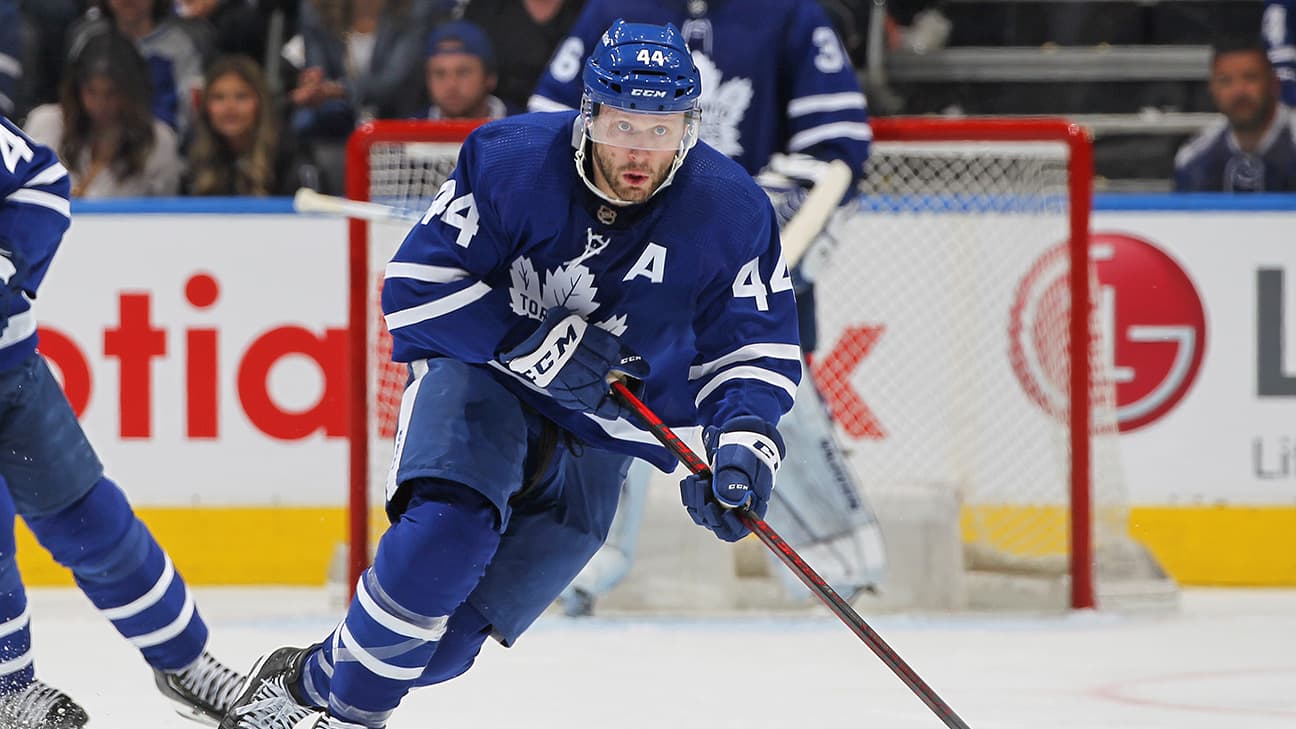
Photo: NHL.com
Maple Leafs Premium Asset Report: Who Counts as a Difference-Maker on D
Table of Contents
The Maple Leafs premium asset report
The Maple Leafs are prepared to spend a premium asset on defence, but only for a player who changes the blue line. That was the core of Elliotte Friedman's report on Hockey Night in Canada's Saturday Headlines on Oct. 17: Toronto is not interested in a "band-aid solution" while Chris Tanev is hurt, and has told teams it will not move what it considers A-level assets for a B-level defenceman.
Friedman added two details that matter. The Leafs would consider moving an older player for a younger one, and on the 32 Thoughts podcast he said the hope is to play through this week and see where the team stands before acting. Friedman did not name a target or the assets on the table.
The report landed hours before a 4-1 home loss to the Islanders dropped Toronto to 3-4-2 and last in the Atlantic. That loss raises the stakes on the standard Chayka has set. LeafsLurker's take: the standard is right. The hard part is being honest about who meets it and what it costs.
Why the Leafs need a difference-maker, not a body
Tanev was hurt on Oct. 10 in Colorado after five shifts and 3:29 of ice time, and Toronto placed him on injured reserve with what the team has called a week-to-week upper-body injury. He reportedly skated on his own on Oct. 17, which is good news, but he turns 37 in December. Any plan that depends on him playing 20 minutes a night through April is a plan that has already failed once this month.
The rest of the group explains why a stopgap would not be enough. Darren Raddysh is the highest-paid defenceman on the roster at $8.5 million through 2033-34. Morgan Rielly ($7.5 million through 2029-30) has reportedly been moved off the top pair. Behind them sit Jake McCabe, Oliver Ekman-Larsson, Troy Stecher and Nick Blankenburg, who got his chance when Tanev went on IR. William Villeneuve is out after knee surgery.
That is a group of competent NHL defencemen without a true shutdown player when Tanev is out. Adding another third-pair veteran would not fix the rush chances and inside-ice coverage that have cost Toronto all month. Adding a younger top-four defenceman who can kill plays and move the puck would.
What counts as a Maple Leafs premium asset
Friedman did not list the assets, so this part is analysis, not reporting. Going by the pick sheet and the prospect pool, Toronto's realistic premium pieces are short in number. The team's own 2027 first is owed to Boston and its 2028 first to Philadelphia, per the LeafsLurker draft-pick tracker, so the first-round capital is limited to what Toronto acquired.
| Asset | What it is | Status |
|---|---|---|
| Colorado's 2027 1st | From the Nicolas Roy trade (Mar. 5, 2026) | Owned; Toronto's only 2027 first |
| Toronto's 2029 1st | Own pick | Owned |
| Ben Danford | Defenceman, 31st overall in 2024 | Marlies; won the Calder Cup last spring |
| Easton Cowan | Winger, 28th overall in 2023 | On the NHL roster; entry-level deal through 2027-28 |
Gavin McKenna is not on that list for obvious reasons. Kirill Marchenko, acquired on Sept. 29 and already signed to a six-year extension, is not either. That leaves the Colorado pick and Danford as the most movable premium pieces, with Cowan as the one that would change the conversation.
Our line: the Colorado pick and Danford first, Cowan only for a No. 1
We argued in August that Easton Cowan is the one asset Chayka shouldn't deal, and nothing in nine games has changed that. He is a cheap, productive top-nine forward on a contract that runs two more seasons. On a cap sheet that already carries Auston Matthews, William Nylander and Marchenko's extension, that kind of value is hard to replace.
The Colorado first and Danford are a different matter. Danford is a good prospect at the one position where Toronto needs help now, which is exactly why he is valuable to a seller and less valuable to a team that needs a top-pair defenceman in October. The Colorado first is likely to land in the back half of the round given the Avalanche's strength. Packaged together, they are a real offer for a young top-four defenceman.
Cowan should only go into a deal for a defenceman who would be Toronto's best for the next five years. If the target is a No. 3 or No. 4, the A-for-B line Friedman described should hold, and LeafsLurker would rather see Chayka walk away.
The older-for-younger angle points at Rielly
Friedman's note that Toronto would consider moving an older player for a younger one is the most interesting part of the report. The Leafs' defence is old: Tanev is 36, Ekman-Larsson 35, McCabe 33 (he turned 33 on Oct. 12), Rielly and Stecher 32. Outlets reading the report have pointed to Ekman-Larsson, McCabe and Stecher as the obvious candidates.
Rielly is the bigger question. He has a full no-movement clause, and late in September he told reporters Toronto is his home. Reports during the summer said his camp identified a handful of Western Conference teams he would consider, and Chayka did not find a deal. Chris Johnston has reported that Rielly has neither waived his clause nor approved a trade. Speculation has picked up again since his slow start, including a Hockey Patrol trade proposal involving Carolina's Alexander Nikishin, but that is a pitch, not a report.
Our view: if Rielly is willing, moving his $7.5 million for a younger defenceman would be the most efficient way to meet Friedman's description. It frees cap room, lowers the average age and does not cost Cowan. It also requires Rielly's consent, which is the reason it has not happened yet.
Why waiting a week is fine, and waiting a month is not
We said earlier this month that Chayka was right to wait, but not for long. That still holds. The sellers' market for defencemen is thin in October, and the team that pays a premium now usually overpays. Two names we looked at, Simon Edvinsson and Zach Whitecloud, show the problem: Detroit shut down Edvinsson talks, and no Whitecloud deal has materialized.
The schedule makes the next few days useful. Toronto hosts San Jose on Oct. 19, visits Columbus on Oct. 20, hosts the Rangers on Oct. 22 and visits Edmonton on Oct. 24. If Tanev is close to returning and the team gets out of its skid, the urgency fades. If the Leafs are still near the bottom of the Atlantic standings by November, waiting stops being discipline and starts being a mistake.
What's next
Watch three things this week: Tanev's practice status, whether Rielly's name shows up in insider reports with something firmer than speculation, and whether Toronto keeps losing the inside-ice battle. The cap math is workable, with roughly $7 million in space on the LeafsLurker contracts page as of early October, though any acquisition that adds salary has to fit around Tanev's eventual return.
Friedman's report tells us the Leafs know what they need. The test is whether Chayka holds the line on what he will pay. A young top-four defenceman for the Colorado first and Danford is a trade Toronto should make today. Cowan for a stopgap is one it should never make.
Frequently Asked Questions
What did Elliotte Friedman report about the Maple Leafs and defence?
On Oct. 17, 2026, Friedman reported that Toronto would move a premium asset only for a difference-maker on defence and is not interested in a band-aid solution while Chris Tanev is injured. He also said the Leafs would consider moving an older player for a younger one.
What premium assets do the Maple Leafs have to trade?
Toronto's most movable premium pieces are Colorado's 2027 first-round pick, its own 2029 first, defence prospect Ben Danford and forward Easton Cowan. Toronto's own 2027 and 2028 first-round picks are owed to Boston and Philadelphia.
Is Chris Tanev injured?
Yes. Tanev was hurt on Oct. 10, 2026 in Colorado and was placed on injured reserve with an upper-body injury the team called week-to-week. He reportedly skated on his own on Oct. 17.
Can the Maple Leafs trade Morgan Rielly?
Only with his consent. Rielly has a full no-movement clause on a contract with a $7.5 million cap hit that runs through 2029-30, and Chris Johnston has reported that he has not waived it.
Who is Ben Danford?
Danford is a defenceman Toronto drafted 31st overall in 2024. He turned pro with the AHL's Toronto Marlies and helped them win the Calder Cup last spring.
How much cap space do the Maple Leafs have in 2026-27?
The 2026-27 salary cap is $104 million, and Toronto's sheet showed about $7 million in space as of early October, per the LeafsLurker contracts page. That figure depends on LTIR and changes with every roster move.


