Photo: Adam Bishop, Wikimedia Commons (BY-SA-4.0)
Nine Maple Leafs Debuts on Opening Night Show How Much Chayka Actually Replaced
Table of Contents
Nine Maple Leafs debuts is not a retool. It is a gut renovation.
When Toronto hosts Montreal on Sept. 29, as many as nine Maple Leafs debuts could happen in a single game. Gavin McKenna headlines the list, but the No. 1 overall pick is the least surprising name on it. The other eight — Nick Paul, Colton Sissons, Jack Roslovic, Teddy Blueger, Brandon Duhaime, Darren Raddysh, Emil Andrae and Sergei Bobrovsky — are the actual story.
Nine debuts out of a dressed lineup of 20 means roughly 45 per cent of the players on the ice on opening night were not in this organization a year ago. That is not the churn of a team adjusting at the margins. That is a team that was taken apart.
What John Chayka actually did in his first summer
Chayka took over as general manager in May 2026 after Brad Treliving was fired, inheriting a club that had missed the playoffs with 78 points and then won the draft lottery. He had a mandate and he used it.
Out went Joseph Woll, Simon Benoit and Brandon Carlo via trade. In came Paul by trade and Sissons, Blueger, Roslovic and Duhaime as free-agent signings, with Bobrovsky as the headline addition on a three-year deal reported at $21 million. Raddysh and Andrae arrived to reshape a defence group that had been static for years.
Read that list of arrivals and a philosophy falls out of it. Sissons and Blueger are faceoff men and penalty killers. Duhaime and Paul are heavy forwards who can play in a bottom six without being a liability. Roslovic is a finisher. None of them are stars, and none of them were signed to be.
The theory behind the bottom six
Toronto's 2025-26 problem was not that Auston Matthews and William Nylander stopped scoring. It was that the team could not survive the 40 minutes a night when neither was on the ice, and it could not kill penalties, and it lost faceoffs in its own end in the situations that decide one-goal games.
Every single one of Chayka's forward additions addresses one of those three failures specifically. That is either a coherent plan or an expensive collection of fourth-liners, and which one it turns out to be is the season's second-biggest question behind Matthews' health.
The goaltending debut is the one with the most riding on it
Bobrovsky at 37 on a $7 million average annual value through his 40th birthday is the boldest thing Chayka did all summer, and it is the move that will define his tenure if it goes badly. Trading Woll and betting the crease on an ageing goaltender with a long track record is a decision you can defend on paper and cannot un-make.
The public projections have not been kind. One widely circulated model put Toronto near the bottom of the league in projected goals saved above expected, which is the polite statistical way of saying the tandem is expected to cost the team games.
The counterargument is workload. Toronto has visibly structured the pre-season around rationing Bobrovsky — he took a half-game against Montreal and did not dress for the finale, while Anthony Stolarz carried the heavier exhibition load. The entire logic of the contract is preservation, and a 45-start Bobrovsky is a meaningfully different projection than a 60-start one.
The defence turnover is quieter and just as large
Raddysh and Andrae are not household names in Toronto and both are about to play significant minutes. Hiller has signalled that the Rielly-Raddysh pair will get heavy offensive-zone deployment, which is a real role with real expectations attached, not a third-pair audition.
Losing Carlo and Benoit removed two defencemen who played hard, defensive minutes. Replacing them with more mobile, puck-moving options is a deliberate stylistic pivot toward getting out of the zone faster rather than defending longer. Whether it survives contact with the Atlantic Division — a division containing Florida, Tampa Bay and a Montreal team that has locked down its core — is an open question.
The risk of this much turnover
Here is the honest downside. Teams that replace nine roster players in one offseason usually take two months to look like a team. Systems take repetition. Defensive-zone coverage depends on knowing where your partner will be without looking. New penalty-kill units leak goals in October.
Toronto does not have a spare two months. In a division this deep, a 4-8-2 start ends the season in the first week of November, and the club has to be in the race in April for any of this to have mattered. The 91-point, high-30s playoff probability consensus is essentially a bet that the integration cost eats the talent upgrade.
How this compares to the last Leafs teardown
Toronto has done versions of this before, and the comparison is instructive because the previous attempts failed for a reason worth naming.
The last several summers followed a pattern: keep the four expensive forwards, replace everyone around them with whichever bargain-bin depth pieces the cap allowed, and hope the supporting cast was different enough to change a playoff outcome. It never was, because the changes were always at the edges. A new fourth-line winger does not alter what a team is.
What makes 2026 different is that the changes reach the crease and the top four on defence. Replacing a goaltender and two regular defencemen in the same summer is a structural decision, not a cosmetic one. You cannot half-commit to it, and Chayka did not.
That is the case for optimism and it is also the case for alarm, depending on your read of the specific players involved. If Bobrovsky is finished, there is no fallback. If Raddysh cannot handle top-four minutes, the defence has no depth behind him. The upside of a real teardown is that it can work; the downside is that there is nothing to fall back on when it does not.
The thing that would make this look smart in April
A penalty kill in the top ten. That is it. Toronto's special teams collapse was the single most legible cause of its 2025-26 finish, and the entire bottom-six rebuild — Sissons, Blueger, Paul, Duhaime — was assembled from penalty killers. If that unit is genuinely good, the club is a playoff team and the offseason gets graded as a success regardless of what the goaltending numbers say.
Why McKenna is the easiest of the nine
The irony of a nine-debut opening night is that the 18-year-old is the least complicated case. McKenna has been at left wing with John Tavares and Nylander since the first days of camp, he picked up his first preseason point on a Tavares goal in the finale, and he is being brought along on the second power-play unit rather than thrown into the deep end.
Everything about his deployment says an organization that has done this before and knows what a rushed rookie looks like. He will have bad nights. He is not being asked to carry anything.
The players carrying weight are the ones with a decade of NHL games and no Toronto history. That is where this season gets decided.
What's next
The roster has to be submitted by 5 p.m. ET on Sept. 28, with two spots still genuinely open — the sixth defenceman and the 13th forward. Depending on how those resolve, the debut count could land anywhere from seven to nine.
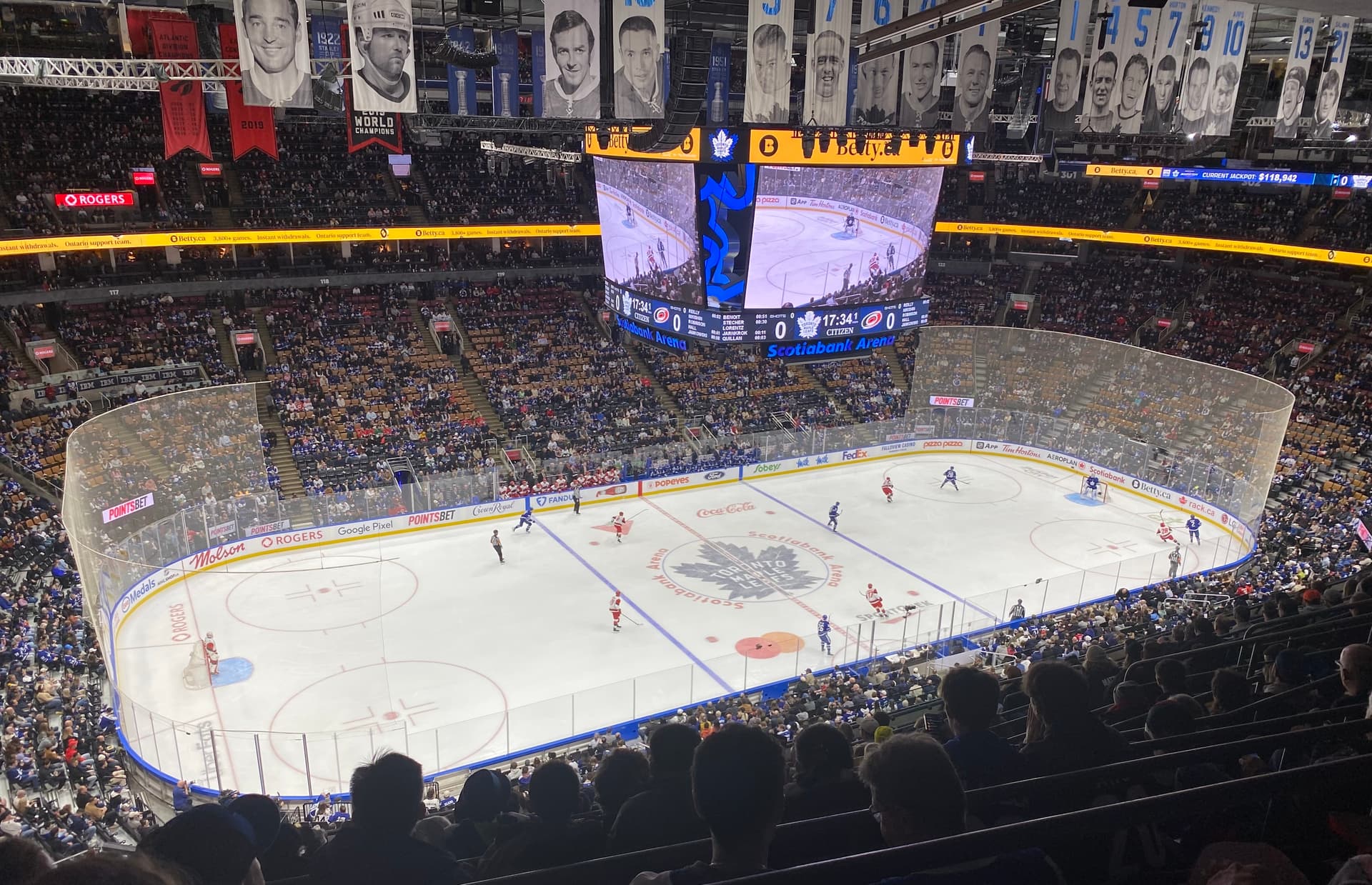
Then Montreal, Tuesday, 7 p.m. ET, Scotiabank Arena. Watch the second and third lines, not the first. The first line will be fine. Whether the bottom six Chayka built can actually kill a penalty and win a defensive-zone draw is the thing worth watching, and you will know something real about it by mid-October. Follow the roster on our players page, the cap on contracts, and the results on standings.
Frequently Asked Questions
How many Maple Leafs players will make their team debut on opening night 2026?
As many as nine. Gavin McKenna headlines the group, alongside Nick Paul, Colton Sissons, Jack Roslovic, Teddy Blueger, Brandon Duhaime, Darren Raddysh, Emil Andrae and Sergei Bobrovsky. The final count depends on how the last two roster spots are settled.
Who did the Maple Leafs sign in the 2026 offseason?
John Chayka signed Colton Sissons, Teddy Blueger, Jack Roslovic and Brandon Duhaime as free agents, added Sergei Bobrovsky on a three-year deal reported at $21 million on July 1, and acquired Nick Paul by trade. Sissons' cap hit was reported at $4.25 million on a two-year term.
Who did the Maple Leafs trade away in 2026?
Chayka moved goaltender Joseph Woll and defencemen Simon Benoit and Brandon Carlo in separate deals, clearing both salary and roster space to reshape the defence group and the crease.
Who is the Maple Leafs general manager?
John Chayka, hired in May 2026 after Brad Treliving was fired. Mats Sundin serves as a senior executive adviser. Chayka previously ran the Arizona Coyotes.
Why did the Maple Leafs sign Sergei Bobrovsky?
To stabilize a crease that lost Joseph Woll, and to pair a proven playoff goaltender with Anthony Stolarz in a managed tandem. The contract runs three years at a reported $7 million average annual value, taking him to his 40th birthday, and the logic depends on limiting his regular-season starts.
Who is the Maple Leafs head coach for 2026-27?
Jim Hiller, who took over after Craig Berube was fired on May 13, 2026. He has rebuilt the power play around zone retrievals and faceoff wins and has given Auston Matthews more structural freedom in the offensive zone.
What line is Gavin McKenna playing on for the Maple Leafs?
Left wing with John Tavares at centre and William Nylander on the right, an alignment that has held since the opening days of training camp. He is on the second power-play unit rather than the first, a deliberate decision to avoid overloading an 18-year-old.
Are the Maple Leafs expected to make the playoffs in 2026-27?
Public models put Toronto around 91 points with a playoff probability in the high 30s, up from 78 points in 2025-26 but short of a berth. The projections essentially bet that the cost of integrating nine new players offsets the talent the club added.