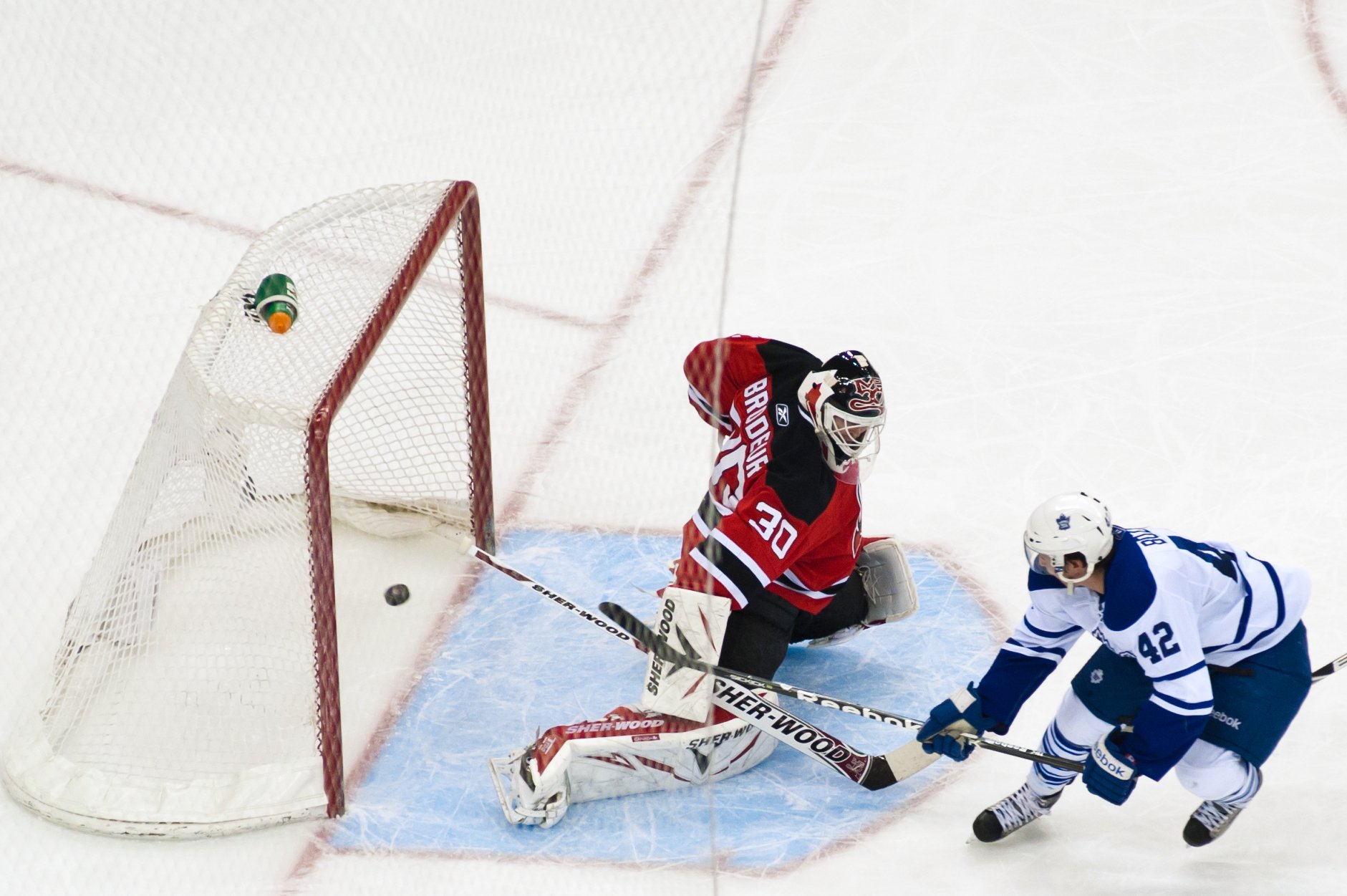
Photo: James DiBianco, Wikimedia Commons (BY-SA-2.0)
Auston Matthews Knee: Three Points in the Finale Closes the MCL File
Table of Contents
The Auston Matthews knee question got its last exhibition answer
The Auston Matthews knee has been the most-scrutinized joint in Canadian sport since last spring, and on Wednesday night it produced a goal and two assists. Matthews put four shots on net in Toronto's 6-1 preseason win over Ottawa, the last exhibition game of a camp that existed, in large part, to find out whether he is the same player he was before the MCL injury that ended his 2025-26 season.
He is. Or at least, nothing available to the public suggests otherwise, and at this point the burden of proof has shifted. He has practised in full. He has played. He has hit the speed thresholds. He has now produced against an NHL opponent, in the last game before the games count. There is no remaining piece of pre-season evidence anyone could ask for.
That matters more than a three-point line in an exhibition game normally would, because the entire 2026-27 projection for this hockey club is built on a single load-bearing assumption.
Why the Auston Matthews knee is the whole season
Toronto missed the playoffs in 2025-26 and finished with 78 points. The public models now put the club somewhere around 91 points with a playoff probability in the high 30s. That improvement is not primarily about the bottom-six signings or the goaltending change. It is about games played by the first-line centre.
A healthy Matthews is a 60-goal threat who drives a line, kills a power play by his presence alone, and takes the hardest matchup every night. A Matthews who misses 25 games is a team that finishes 12th in the Eastern Conference. The gap between those two outcomes is larger than any move John Chayka made this summer, and it is not close.
This is why the 91-point consensus projection is, in our view, slightly pessimistic in one specific direction: most public models regress a player's games-played forecast toward his recent history. Two straight seasons interrupted by injury drags that forecast down. If Matthews plays 78 games, the model is wrong by several points in the standings.
What an MCL injury actually is
The medial collateral ligament runs along the inside of the knee and resists the joint buckling inward. For a skater, that is the ligament under load on a hard inside edge, a crossover under pressure, and a cut back against the grain — which is to say, roughly every meaningful movement a centreman makes in the offensive zone.
The good news about MCL injuries relative to the alternatives is that they generally heal without reconstruction, and the recovery curve is measured in weeks rather than the better part of a year. The bad news is that athletes returning from them frequently protect the joint without meaning to: they favour one side on turns, they take contact differently, they stop initiating along the wall.
That protective behaviour is what a coaching staff watches for, and it is what nobody has seen from Matthews in this camp.
The three pieces of evidence, in order
First came clearance. Chayka gave the green light for a full training-camp participation back on Sept. 14, with no restrictions attached — which, from a first-year general manager with every incentive to be cautious, was itself a statement.
Second came the tracking data. Earlier this week the reported top-speed figure of roughly 35 km/h landed in the same neighbourhood as his healthy career baseline. Speed in a straight line is not the whole picture, but a knee that is compensating rarely produces a top-end number.
Third, and most important, came Wednesday. Matthews took pucks to the net. He did not route around traffic. He finished a scoring chance and set up two more. The eye test and the production agreed for the first time this month.
What Hiller has been doing with him
Jim Hiller has given Matthews something closer to structural freedom in the offensive zone than the previous staff did, a shift we wrote about earlier in camp. The idea is less rigid low-to-high routing and more read-and-react, with Matthews permitted to float into soft ice rather than occupy an assigned spot.
That system change interacts with the knee in an interesting way. A player with full freedom takes fewer forced collisions and creates more of his own separation. If the plan is partly load management dressed up as tactics, it is a smart version of it.
Hiller also, per pre-game reporting, wanted more from the Matthews line specifically in the finale. He got it. Jack Roslovic posted three points from the right side and looks to have settled the top-line winger question that dominated the first two weeks of camp.
The part nobody can promise
Here is the honest limit of everything above: no amount of September evidence prevents an October injury. MCL recoveries do not carry a meaningfully elevated re-injury risk the way some soft-tissue injuries do, but hockey is a sport where a knee-on-knee in the neutral zone ends a season regardless of medical history.
The 84-game schedule — up two games from last year under the new collective bargaining agreement — does not help. Neither does the reality that Matthews is 29 and has played a heavy-minute, heavy-contact role since he was 19. The cumulative bill on that usage comes due eventually.
What Toronto can control, it appears to be controlling. The goaltending workload is being rationed. The bottom six was rebuilt with penalty killers and faceoff men specifically so the top line does not have to play 22 minutes a night to win games. Those are the moves of an organization planning around a durability question rather than pretending it does not exist.
What a healthy Matthews changes about the Atlantic
The Atlantic Division got harder this summer, not easier. Montreal locked down its core and added Chris Kreider. Ottawa has Tim Stutzle and Brady Tkachuk is now in Florida, which sounds like subtraction for the Senators until you remember it means the defending-contender Panthers added a power forward to a lineup that already had Aleksander Barkov healthy. Detroit is in flux with an interim general manager and a captaincy mess. Buffalo has been circling a goaltending upgrade all month.
In a division that deep, a wild-card spot is decided by four or five points. Four or five points is roughly what one healthy season from a first-line centre is worth relative to a 57-game version of him. That is the entire argument for why this one medical question outweighs every roster move Toronto made.
It also explains why the club structured its summer the way it did. Signing depth centres who take faceoffs and kill penalties is not glamorous, and it does not move a projection much on its own. What it does is reduce the number of nights the first line has to play 22 minutes to salvage a game. Reduce that number and you change the injury math for the player the whole season depends on.
The number to track in October
Ignore the goals. Watch time on ice. If Matthews is averaging over 21 minutes a night through the first ten games, the depth signings did not do their job and the durability plan is already failing. If he is between 19 and 20 with the same production rate, Hiller and Chayka have built what they said they were building.
What his contract situation adds to this
Matthews is signed through 2027-28 at a $13.25 million cap hit, and the conversation about what comes next has already started — including some uncomfortable speculation about how long he intends to play. A healthy, productive 2026-27 quiets all of it. A third consecutive interrupted season makes the extension negotiation the single hardest problem on Chayka's desk.
The cap ceiling is $104 million this season and climbing. Toronto's flexibility opens up meaningfully in 2028. Both of those facts are only useful if the franchise centre is available to take advantage of them. You can see the full picture on our contracts page.
What's next
Montreal, Sept. 29, at Scotiabank Arena. Matthews will centre a line with Matthew Knies and Roslovic against a Canadiens team that added Chris Kreider and still has Cole Caufield on the wing, and he will draw the matchup against Nick Suzuki for most of the night.
Watch the first shift after the first hard hit he takes. That is the only test left, and it cannot be administered in September.
Frequently Asked Questions
What injury did Auston Matthews have last season?
Matthews suffered an MCL injury that ended his 2025-26 campaign prematurely. The medial collateral ligament runs along the inside of the knee and resists the joint buckling inward, and it is under load on almost every hard edge a centreman takes.
Is Auston Matthews healthy for the 2026-27 season?
By every available public indicator, yes. He was cleared for full training camp participation in mid-September with no restrictions, reportedly hit a top skating speed near 35 km/h, and posted a goal and two assists in the Sept. 23 preseason finale against Ottawa.
How long does an MCL injury take to heal?
MCL injuries generally heal without surgical reconstruction, and recovery is typically measured in weeks rather than months, depending on grade. The bigger concern for athletes is unconscious protective movement after return, which is what coaching staffs watch for.
What is Auston Matthews' cap hit and contract length?
Matthews carries a $13.25 million cap hit on a deal running through the 2027-28 season. The NHL salary cap ceiling for 2026-27 is $104 million, and Toronto's meaningful long-term flexibility opens up starting in 2028.
Who plays on Auston Matthews' line for the Maple Leafs in 2026-27?
Matthews is projected to centre Matthew Knies on the left side and Jack Roslovic on the right. Roslovic posted three points including a power-play goal in the preseason finale, which appears to have settled the top-line right wing competition.
How many games do NHL teams play in 2026-27?
Teams play an 84-game regular season in 2026-27, up from 82, under the collective bargaining agreement that took effect Sept. 16, 2026. The longer schedule adds two more games of wear for high-usage players like Matthews.
Did the Maple Leafs make the playoffs in 2025-26?
No. Toronto missed the playoffs and finished with 78 points, then won the 2026 draft lottery and the No. 1 overall pick, which they used on Gavin McKenna. Matthews' injury-shortened season was a central factor in the finish.