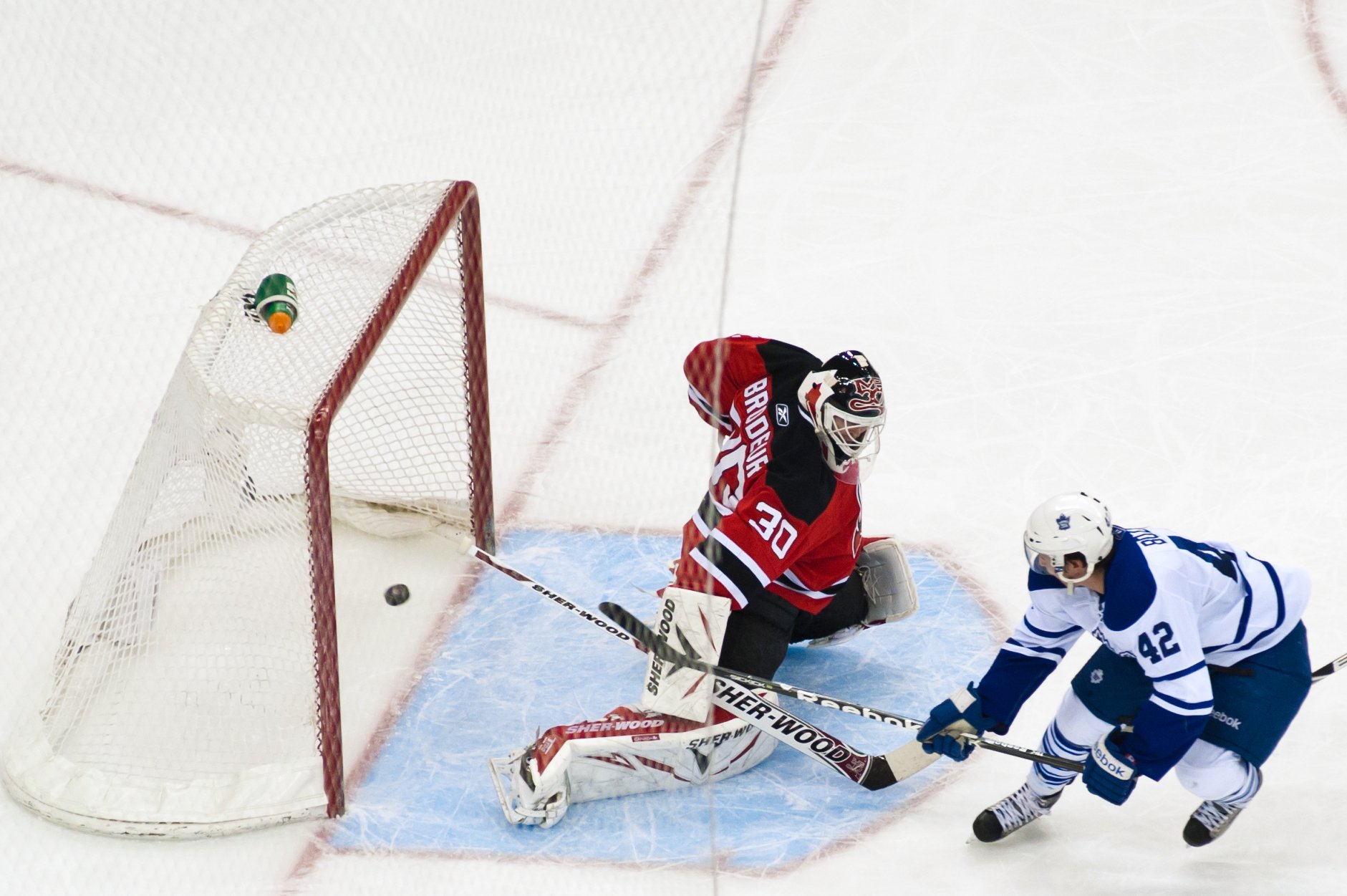
Photo: qmnonic, Flickr (BY-2.0)
Maple Leafs Goaltending Projects 30th in the NHL. That Is the Whole Season.
Table of Contents
The Maple Leafs Goaltending Projection Is the Worst in the League
Every public model that has looked at the 2026-27 Toronto Maple Leafs has arrived at the same uncomfortable split, and the Maple Leafs goaltending projection is the reason. One recent Atlantic Division preview from Ocelot Analytics put numbers on it that are hard to argue with: Toronto had the second-best skater offseason in the NHL, gaining a net +23.8 in skater goals above replacement, while simultaneously losing 16.5 goals saved above expected in the crease.
The same work rates Sergei Bobrovsky’s recent goaltending input at roughly minus-21.5 GSAx, which places Toronto 30th in the league in projected goaltending and makes it, by that measure, the worst goaltending line any club took on this summer.
Read that again, because it is the entire season in two sentences. John Chayka built one of the two best skater groups of anyone’s offseason and paid for it with the crease.
How the Leafs Got Here
The sequence was deliberate. Joseph Woll was traded to Philadelphia on June 16, clearing both a contract and a roster spot. On July 1, Toronto signed Bobrovsky to a three-year deal to be the No. 1, reuniting him with Anthony Stolarz, who backed him up during Florida’s 2023-24 Stanley Cup run.
The argument for it was never statistical. It was about a two-time Vezina winner and two-time Cup winner walking into a room that has not won a playoff round in most of its core’s careers, and about a coach in Jim Hiller who would rather have a goaltender who has been through it than a goaltender who has not. That is a real argument. It is also an argument that the models cannot see and do not credit.
What the models see instead is a 38-year-old goaltender whose expected-goals performance has declined, on a team that gave up a lot of dangerous chances last season, behind a blue line whose top pair is now built for offence rather than suppression. We have made the case that the Bobrovsky signing is the highest-variance bet of Chayka’s summer, and this projection is the bear case in numerical form.
The Skater Group Is Genuinely Good
Buried under the goaltending alarm is something Leafs fans have not been able to say honestly in a while: the skater group improved a lot.
Toronto added Nick Paul in a trade with Tampa Bay, signed Jack Roslovic, Colton Sissons, Brandon Duhaime and Teddy Blueger to fill out a bottom six that had been a punchline, and brought in Darren Raddysh to give the blue line a second genuine puck-mover. Gavin McKenna, the No. 1 pick in the 2026 draft, is not even included in most of these offseason ledgers because he has no NHL history to project from. He is, plausibly, a further gain on top of the +23.8.
The same analysis puts Toronto’s roster strength at a +0.16 z-score, 12th in the NHL, while the record component sits at minus-0.59, which is 25th. In plain language: the model likes this roster more than it likes the team’s recent results, and the drag on the projection is history rather than talent. That is a meaningfully more optimistic framing than the 78-point season Toronto just endured would suggest.
Why the Blue Line Makes the Crease Worse
Goaltending projections do not exist in isolation. A goaltender’s expected-goals workload depends on what happens in front of him, and Toronto has spent this camp signalling that it intends to play a more aggressive, offence-first structure on the back end.
Hiller has put Morgan Rielly and Darren Raddysh together as the top pair and said openly that he wants them starting in the offensive zone and playing with the top six. That decision, which we broke down separately, is a bet that Toronto can win possession battles rather than survive them. When it works, Bobrovsky faces fewer shots. When it does not, he faces better ones — odd-man rushes and second chances off failed pinches are precisely the shot types that punish a declining goaltender.
Jake McCabe and Chris Tanev are the counterweight, and both are on the wrong side of 33 with heavy mileage. Asking a 36-year-old to suppress the chances a 38-year-old goaltender can no longer absorb is not a plan so much as a hope that two aging players hold up simultaneously across 84 games.
What 91 Points Actually Buys You
Where these inputs land is somewhere around 91 points and a playoff probability in the high thirties, with Toronto projected fourth in the Atlantic — ahead of Buffalo, behind Tampa Bay, and well behind a Florida team that added Brady Tkachuk. That would be a 13-point improvement on last season and still not enough to guarantee a postseason berth.
Ninety-one points is a bubble team. It is a team that is alive in March and whose season is decided by a handful of one-goal games in February. It is also, for a franchise that just missed the playoffs and won the draft lottery, not obviously a failure — the 2026-27 Maple Leafs were never going to be a contender, and a competitive bubble year while McKenna develops is a defensible outcome.
The problem is that the distribution around 91 is unusually wide, and almost all of the width comes from one position. If Bobrovsky plays like the model expects, Toronto finishes closer to 85 and misses again. If he plays like his career norms rather than his recent form, the skater improvement shows up on the scoreboard and 97 points is live. We covered a similar spread when one outlet called this team both a top-five improver and a possible tire fire.
The 84-Game Schedule Changes the Math
One factor the projections have to account for that nobody has lived through: the schedule is 84 games this season under the new collective bargaining agreement that took effect Sept. 16. That is two more games than the league has played since 1994-95.
For most teams it is a rounding error. For a team relying on a 38-year-old starting goaltender it is not. Two extra games is roughly one extra start over a full season, but the compressed calendar and the additional back-to-backs matter more than the raw total. Toronto is going to need somewhere between 25 and 35 starts from Stolarz, which means Stolarz’s health becomes a load-bearing element of the season.
That is a lot of weight on a goaltender who has never played a full starter’s workload. It is also why the decision to keep Artur Akhtyamov in the AHL as a starter rather than as an NHL third goalie was the right one — Toronto is going to need a fourth and fifth goaltender to be sharp at some point this winter.
Our Take
LeafsLurker is not in the business of pretending a projection is a prophecy. Models were wrong about Florida, wrong about Winnipeg, and are frequently wrong about goaltenders specifically, because goaltending is the noisiest position in professional sport.
But the direction of this one is correct even if the magnitude is not. Chayka made a large number of good, defensible, incremental decisions on the skater group and one enormous swing in the crease, and the swing is the only decision that can single-handedly end the season. A team cannot be 30th in goaltending and 12th in roster talent and expect the 12th to win the argument.
The honest position is this: the 2026-27 Maple Leafs are a better hockey team than the 2025-26 Maple Leafs by a wide margin, and they may well finish with a similar record anyway. That is an infuriating sentence to write, and it is the most likely version of this season.
What’s Next
Toronto opens the regular season against Montreal at Scotiabank Arena on Sept. 29, with opening-night rosters due Sept. 28. Bobrovsky has already made his preseason debut. The first real data point arrives in October, and the number to watch is not his save percentage but his goals saved above expected over the first 15 starts.
For the division context, see our look at how the Atlantic reloaded this summer, and follow the standings and contracts pages through the season.
Frequently Asked Questions
How is Maple Leafs goaltending projected for 2026-27?
Public analytics work ahead of the season rates Toronto's goaltending around 30th in the NHL, driven by a projected loss of roughly 16.5 goals saved above expected relative to last season. It is the weakest projected crease of any team that changed goaltenders this summer.
Who is the Maple Leafs starting goalie in 2026-27?
Sergei Bobrovsky, who signed a three-year contract with Toronto on July 1, 2026. Anthony Stolarz is the backup, and Artur Akhtyamov is the organization's third goaltender and the Marlies' expected starter.
Why did the Maple Leafs trade Joseph Woll?
Toronto traded Woll to the Philadelphia Flyers on June 16, 2026, clearing a contract and a roster spot ahead of free agency. Bobrovsky was signed two weeks later to take the No. 1 job.
How many points are the Maple Leafs projected to get in 2026-27?
Public models cluster around 91 points with a playoff probability in the high thirties, and generally project Toronto fourth in the Atlantic Division. That would be a 13-point improvement on the 78 points the Leafs managed in 2025-26.
Did the Maple Leafs improve this offseason?
By skater talent, substantially. One analysis rated Toronto's skater offseason as the second-best in the NHL at a net gain of +23.8 goals above replacement, from additions including Nick Paul, Darren Raddysh, Jack Roslovic, Colton Sissons, Teddy Blueger and Brandon Duhaime.
How many games are in the 2026-27 NHL season?
Eighty-four, up from 82, under the collective bargaining agreement that took effect Sept. 16, 2026. It is the longest NHL regular season since 1994-95 and adds workload considerations for older starting goaltenders.
What is GSAx in hockey?
Goals saved above expected measures how many goals a goaltender prevented compared with what an average goaltender would have allowed on the same shots, adjusting for shot location, type and traffic. A negative figure means the goaltender allowed more goals than the chances warranted.