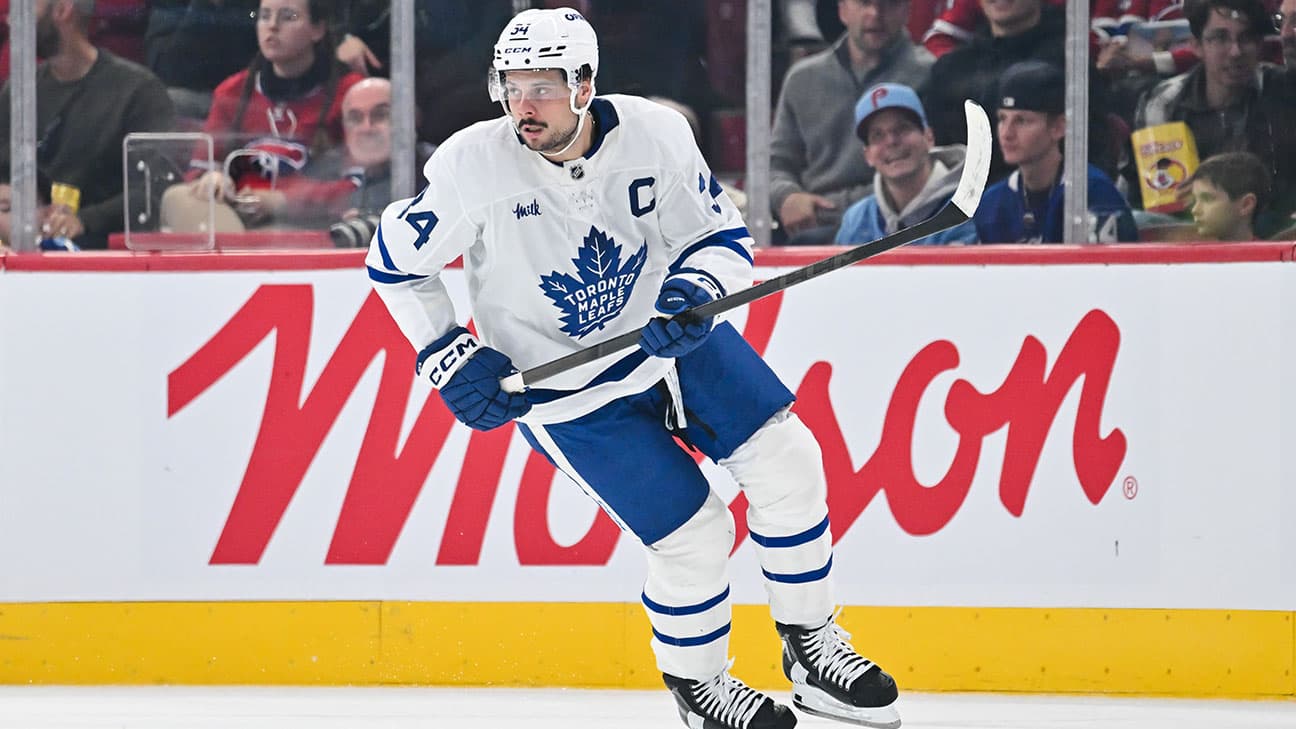
Photo: NHL.com
Maple Leafs 2026-27 Projection: Most Improved, or a Tire Fire?
Table of Contents
The Maple Leafs 2026-27 projection is the widest in hockey, and that is the point
No Maple Leafs 2026-27 projection published this summer has been confident, and the most honest one came from Daily Faceoff's Matt Larkin, who wrote that Toronto "could be one of the NHL's great redemption stories or a tire fire" and added that "literally no result would surprise me." Weeks later, the same writer named the Maple Leafs one of the five most improved teams in the league.
Those are not contradictory positions. They are the same position stated twice. A team that finished last in its division at 78 points and then replaced its general manager, its coach, its starting goaltender, its top-pair addition and five bottom-six forwards has, by definition, an enormous error bar around it.
Our view: the range is real, but it is not evenly distributed, and most of the variance sits with two people.
What Larkin actually argued, both times
The "most improved" piece grouped Toronto with Washington, Nashville, Utah and Florida. Larkin's reasoning was concrete rather than vibes-based: the arrival of first overall pick Gavin McKenna, the Sergei Bobrovsky signing, Darren Raddysh on the blue line, trades for Emil Andrae and Nick Paul, a new front office and a new coaching staff. He singled out foot speed as the clearest year-over-year gain, and characterised the summer as "Operation 'Appease Auston Matthews'" in full swing.
The wide-range piece came at the question from the other end: a team that was bad last season, whose competitive window arguably closed when Mitch Marner left, and whose new pieces have never played a shift together.
Both readings are defensible from the same roster sheet, which is why the projection industry has effectively thrown up its hands on Toronto this year.
The case for most improved
Start with the goaltending. Toronto's crease in 2025-26 was a problem it never solved. Joseph Woll went 15-16-7 with a .899 save percentage and a 3.31 goals-against average, a clear step back from the previous season, and a rookie third-stringer ended up playing 20 games. Chayka traded Woll and Simon Benoit to Philadelphia in June, then signed Bobrovsky on July 1 for three years and $21 million, reuniting him with Anthony Stolarz from their Florida tandem.
Whatever you think of paying a goaltender in his late thirties, that tandem is a substantial upgrade on last season's actual results.
Then the bottom six. Colton Sissons, Brandon Duhaime, Nick Paul, Teddy Blueger and Jack Roslovic all arrived to do specific jobs — penalty killing, faceoffs, forechecking, defensive-zone starts. It is not an intimidating group, and Pro Hockey Rumors described it fairly as "safe" rather than fearsome. But last year's version could not defend, and this one can.
And then McKenna, who is the best prospect in hockey by most public rankings and arrives on an entry-level deal with a plausible path to the top line. The nine-game entry-level slide decision is the first real call of Jim Hiller's tenure.
The case for the tire fire
Toronto finished eighth in the Atlantic. Not seventh in a strong division — eighth, behind a Florida team that lost its captain in training camp and never recovered. That is the baseline, and 78-point teams do not usually become playoff teams on depth signings.
The division also got harder, not easier. Florida added Brady Tkachuk and gets Alexander Barkov back. Buffalo won the division at 109 points. Montreal reached the Eastern Conference Final. Tampa finished on 106. We went through every Atlantic rival's summer, and the honest conclusion is that Toronto's realistic target is Detroit and Boston, not the top of the table.
There is also the coherence question. Chayka has assembled a roster in three months from parts that have never shared a room, under a coach hired in May, with a front office still being staffed. The market has priced this accordingly — we wrote about Toronto's long Stanley Cup odds and did not argue the number was wrong.
The variance is not evenly spread. It is two players.
Here is where we part company with the "anything could happen" framing. The outcome distribution for this team is not diffuse. It is bimodal, and it hinges on Auston Matthews' knee and Sergei Bobrovsky's age.
Matthews suffered a Grade 3 MCL tear and a quad contusion on March 12 in a knee-on-knee collision with Anaheim's Radko Gudas, had surgery, and faced a 12-week recovery. The summer information has been thin and indirect: footage from HC Davos in Switzerland shooting pucks with Joe Thornton, and a chiropractor telling the public he is "ready to go." There has also been a report of a consultation with a back specialist in Arizona. We wrote about the information vacuum around his recovery, and it has not meaningfully closed since.
A healthy, top-form Matthews plus McKenna plus William Nylander is a playoff top-six. A Matthews who plays 60 games at 80 per cent is not, and no amount of fourth-line penalty killing compensates.
Bobrovsky is the second lever. He has been to three straight finals and won two of them, and he is also a goaltender whose age curve is now the most-discussed thing about him. Three years at $7 million is a bet that the decline arrives after this contract rather than during it.
Every other question on this roster — where Easton Cowan slots, whether Raddysh fixes the power play, what Max Domi's role is — moves the needle by two or three points in the standings. Those two move it by fifteen.
The floor rose more than the ceiling, and that is the correct outcome
This is our actual position, and it is less exciting than either pole of Larkin's range.
What Chayka did this summer was overwhelmingly floor-raising work. Five defensively competent forwards. A goaltender who will not lose you games in November. A right-shot defenceman with real shot volume. None of that is ceiling work. Ceiling work is Matthews returning to MVP form and McKenna being an instant star, and neither is something a general manager can buy.
For a team in year one of a reshaped build, that is the right order of operations. A club with no expiring contracts on its projected roster for two seasons does not need to win 105 games in 2026-27. It needs to establish that it is not a lottery team, get McKenna 84 games of NHL development, and find out what Matthews still is.
The tire-fire scenario is genuinely available if Matthews' knee does not hold. The redemption-story scenario requires two career-arc reversals in the same season. The wide middle — a bubble team that plays meaningful hockey in March — is where the probability mass actually sits.
What a realistic season looks like
An 84-game schedule complicates every historical comparison, so think in rate rather than totals. Toronto's 78 points came at roughly 0.95 points per game. A club that fixes its goaltending and its defensive-zone depth without a healthy top-line centre gets to maybe 1.05. With a healthy Matthews, 1.15 is reachable, and over 84 games that is a playoff team.
That is the whole season in one sentence: the difference between the two projections Larkin published is one player's medicals.
What's next
Training camp opens in mid-September, and the first genuinely informative day of this season is whenever Matthews takes full contact. Preseason begins September 19 against Montreal; the opener is September 29 against Montreal as well.
The other thing worth watching is whether Chayka adds. Elliotte Friedman has reported the club is still hopeful to land another difference-maker, though the cap sheet makes a large August move unlikely. Follow it on our standings page once the games start.
Larkin is right that no result would be shocking. He is right in both directions, which is unusual and slightly maddening. Our call: 88 to 94 points, a wild-card fight, and a season judged on McKenna's development rather than the final standing.
Frequently Asked Questions
What is the Maple Leafs' projection for the 2026-27 season?
Projections are unusually split. Daily Faceoff's Matt Larkin named Toronto one of the five most improved NHL teams for 2026-27, alongside Washington, Nashville, Utah and Florida, while separately writing that the Maple Leafs "could be one of the NHL's great redemption stories or a tire fire" and that no result would surprise him.
How many points did the Maple Leafs have in 2025-26?
Toronto finished with 78 points, eighth and last in the Atlantic Division. Buffalo won the division with 109, Tampa Bay and Montreal each had 106, Boston 100, Ottawa 99, Detroit 92 and Florida 84.
Is Auston Matthews healthy for the 2026-27 season?
Not confirmed. Matthews suffered a Grade 3 MCL tear and quad contusion on March 12, 2026 in a knee-on-knee collision with Anaheim's Radko Gudas and underwent surgery with a 12-week recovery timeline. His chiropractor has said publicly he is ready, and he was filmed shooting pucks at HC Davos in Switzerland, but the club has not issued a definitive update. Training camp will be the real test.
Why did the Maple Leafs sign Sergei Bobrovsky?
Toronto's goaltending was its clearest weakness in 2025-26. Joseph Woll went 15-16-7 with a .899 save percentage and 3.31 goals-against average before being traded to Philadelphia in June. Bobrovsky signed a three-year, $21 million deal on July 1 and reunites with Anthony Stolarz, his tandem partner in Florida.
Which players did the Maple Leafs add in the 2026 off-season?
First overall pick Gavin McKenna, goaltender Sergei Bobrovsky, defencemen Darren Raddysh and Emil Andrae, and forwards Nick Paul, Colton Sissons, Brandon Duhaime, Teddy Blueger and Jack Roslovic. Jim Hiller replaced Craig Berube as head coach under new GM John Chayka.
How many games will the Maple Leafs play in 2026-27?
Eighty-four. The NHL expands to an 84-game regular season in 2026-27 under the new CBA, which makes direct point-total comparisons with prior seasons misleading. Toronto's 78 points in 2025-26 came at roughly 0.95 points per game.
Are the Maple Leafs a playoff team in 2026-27?
It is realistically a bubble question. The upgrades are concentrated in goaltending and bottom-six defensive play, which raise the floor more than the ceiling, and the Atlantic got stronger with Brady Tkachuk joining Florida. A wild-card fight is the most probable outcome, contingent on Auston Matthews' health.


