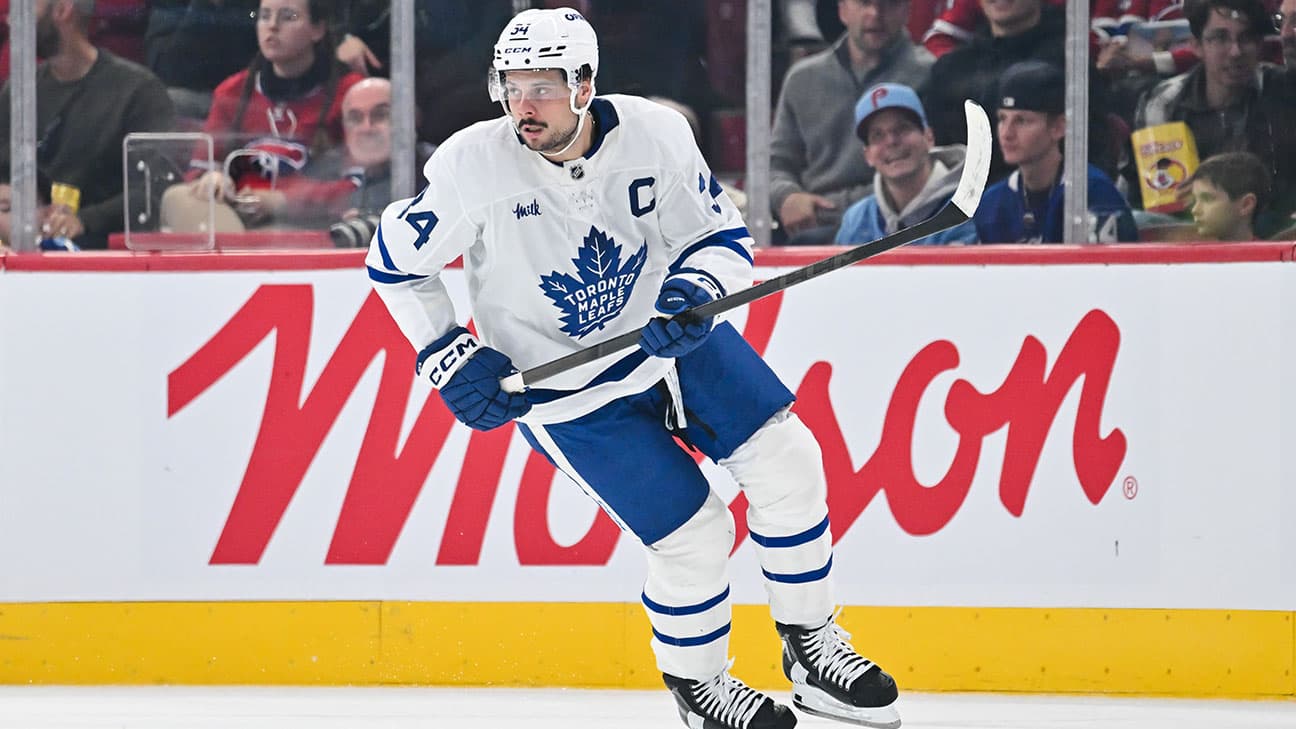
Photo: NHL.com
The Best Auston Matthews Injury Update Came From His Chiropractor
Table of Contents
The Auston Matthews injury update Toronto has been waiting for came from outside the building
The most detailed Auston Matthews injury update of the entire summer did not come from the Toronto Maple Leafs, from John Chayka, or from Matthews himself. It came from his chiropractor, Shawn Robek, who spoke publicly after a photo of the two of them circulated online and said Toronto's captain is energetic, feeling good, and on track with no expected delay for the start of the 2026-27 season.
That is genuinely good news, and Leafs fans should take it as such. It is also, on reflection, a strange way for the most important health story in the organization to reach the public — and the reaction to it exposed something about how thinly Toronto has communicated on a file that determines its entire season.
What actually happened to Matthews
Start with the confirmed facts, because they have been blurred by five months of speculation.
Matthews suffered a Grade 3 MCL tear and a quadriceps contusion in his left leg on March 12 against the Anaheim Ducks, after a knee-on-knee collision with defenceman Radko Gudas. He did not play again. The Maple Leafs announced on March 19 that he had undergone surgery with a recovery timeline reported at roughly 12 weeks.
A Grade 3 MCL tear is a complete tear of the medial collateral ligament. Twelve weeks from mid-March lands in early June, which means Matthews has had the entire summer to rebuild strength and function — and reporting through July indicated he had progressed to shooting pucks again. We covered that milestone when it cleared.
Everything about the public timeline says a player who should be ready for camp. Nothing about the public timeline came from the Maple Leafs.
Why a chiropractor's comments became a story
Robek's remarks got attention for two reasons. The first is simply that they were the most specific thing anyone connected to Matthews had said in months. The second is that at least one reporter suggested the comments went beyond what the club has acknowledged publicly, characterizing part of the discussion as touching on more than the knee.
We are not going to run with that. Toronto has not confirmed any additional issue, Matthews has not addressed one, and there is a meaningful difference between a practitioner describing the general demands of an athlete's body and a disclosure of an undisclosed injury. Treating the second as established because the first happened is exactly how bad information enters the ecosystem — and this fan base has already had one fabricated story run unchecked this summer.
But the fact that the speculation had somewhere to go is the point. When an organization says nothing for four months, every fragment gets over-read, because fragments are all anyone has.
The pattern is not just Matthews
Toronto has been consistently vague on health all summer, and it has not been limited to the captain.
Max Domi had back surgery in late May and has been labelled out indefinitely. When Chayka was asked about it in early August, he said Domi was progressing and offered no timeline. That is a defensible answer in isolation. It is also convenient, because Domi's $3.75-million cap hit on long-term injured reserve is the mechanism that makes Toronto cap-compliant despite sitting roughly $2.75 million over the ceiling.
Nobody is accusing anyone of anything here. Vagueness about injuries is standard NHL practice, and clubs have legitimate competitive and medical-privacy reasons for it. But there is a cost, and Toronto is paying it: the two health files that most directly determine this season's outcome and this season's cap sheet are both being managed by silence.
Why this matters more than usual this year
In most seasons an ambiguous injury update is background noise. This year it is load-bearing.
Toronto finished last in the Atlantic Division at 32-36-14 for 78 points, missing the playoffs for the first time in a decade. Chayka replaced the coach, the goaltending and a third of the forward group, then told the public this roster has a two-year window. That message asks fans to believe the team is closer than last season suggested.
The single largest input into whether that is true is whether Matthews plays 80 games. Not whether he is healthy on opening night — whether he holds up across an 84-game schedule on a surgically repaired knee, taking the hardest matchups in the league. As we argued when projecting William Nylander's ceiling for 2026-27, almost every optimistic scenario for this team routes through Matthews absorbing the opposition's best defenders.
A franchise asking for that much faith might reasonably be expected to say more than nothing.
What a Grade 3 MCL tear actually means for a centre
It is worth being precise about the injury, because "knee surgery" covers an enormous range of outcomes and the specifics here are relatively encouraging.
The medial collateral ligament stabilizes the knee against forces pushing it inward. A Grade 3 tear is a complete rupture, but MCL injuries generally have a better recovery profile than the two injuries hockey fans reflexively fear — an ACL tear or significant meniscus damage — because the ligament has good blood supply and tends to heal well. Recovery timelines in the range of three months are consistent with an isolated MCL injury rather than a multi-ligament one.
The quadriceps contusion is the part that gets underrated. Deep thigh bruising in combination with a knee injury complicates rehabilitation, because the quad is the muscle you rely on to protect the joint while the ligament heals. Rebuilding that strength is slow work and it is the reason a 12-week surgical timeline does not translate directly into a 12-week return to hockey shape.
None of that argues Matthews is at risk. It argues that the honest answer to "is he fine?" is more textured than yes or no, and that a five-month gap between the last club update and training camp was always going to produce noise.
What Toronto should say, and probably will not
The bar here is low. It is not a demand for medical records. It is a general manager, once, on the record, saying whether his captain is expected to be a full participant in training camp.
That single sentence would end the speculation cycle, and it costs the organization nothing competitively — every opponent already knows Matthews tore his MCL in March. The reason clubs avoid it is not strategy, it is habit: saying nothing can never be wrong, and saying something can be.
Chayka has been more direct than his predecessor on most subjects this summer. He has talked openly about the roster's timeline, about what he was trying to build, about why he made specific moves. Health is the one place the new transparency has not reached.
What's next
The answer arrives quickly. NHL training camps open in the second week of September, the preseason runs Sept. 19-26 under the new shortened format, and the regular season begins Sept. 29. Matthews either skates on day one of camp in a full session or he does not, and no amount of summer briefing changes that.
Watch three things when camp opens. Whether Matthews participates in full-contact drills rather than being managed in a separate group. Whether Jim Hiller says anything specific about his availability for the preseason. And whether Toronto gives him meaningful preseason minutes at all — a shortened eight-day exhibition slate gives the club very little room to ease him in, which is a real complication nobody has discussed.
Until then, the best available information on the most important player on the Toronto Maple Leafs comes from a chiropractor responding to a photo. The news is good. The process is not, and the club could fix it with one sentence.
Frequently Asked Questions
What is the latest Auston Matthews injury update?
Matthews' chiropractor, Shawn Robek, said publicly this month that Matthews is energetic, feeling good and on track with no expected delay for the 2026-27 season. The Maple Leafs have not issued their own detailed update, and Robek's comments remain the most specific public information available.
What injury did Auston Matthews suffer in 2025-26?
He suffered a Grade 3 MCL tear and a quadriceps contusion in his left leg on March 12 against the Anaheim Ducks, following a knee-on-knee collision with defenceman Radko Gudas. He missed the remainder of the season.
Did Auston Matthews have knee surgery?
Yes. The Maple Leafs announced on March 19, 2026 that Matthews had undergone surgery, with a recovery timeline reported at roughly 12 weeks. That timeline pointed to a return to full activity in early June, well ahead of training camp.
Will Auston Matthews be ready for training camp?
All public signals point to yes, but Toronto has not confirmed it on the record. Reports through July indicated he had progressed to shooting pucks, and his chiropractor has said there should be no delay. The definitive answer comes when camps open in the second week of September.
Does Auston Matthews have a back injury?
There is no confirmation of one. Some coverage suggested his chiropractor's public remarks touched on more than the knee, but the Maple Leafs have not acknowledged any additional issue and Matthews has not addressed one. Treat unconfirmed reports of a second injury with caution.
What is Max Domi's injury status?
Domi had back surgery in late May and has been labelled out indefinitely. Asked about it in early August, John Chayka said Domi was progressing but gave no timeline. Domi's $3.75-million cap hit on long-term injured reserve is how Toronto becomes cap-compliant.
When does the 2026-27 NHL season start?
The regular season opens Tuesday, Sept. 29, 2026 on an 84-game schedule. Training camps open in the second week of September, and the preseason is a shortened eight-day, 65-game slate running Sept. 19-26 under the new collective bargaining agreement.


