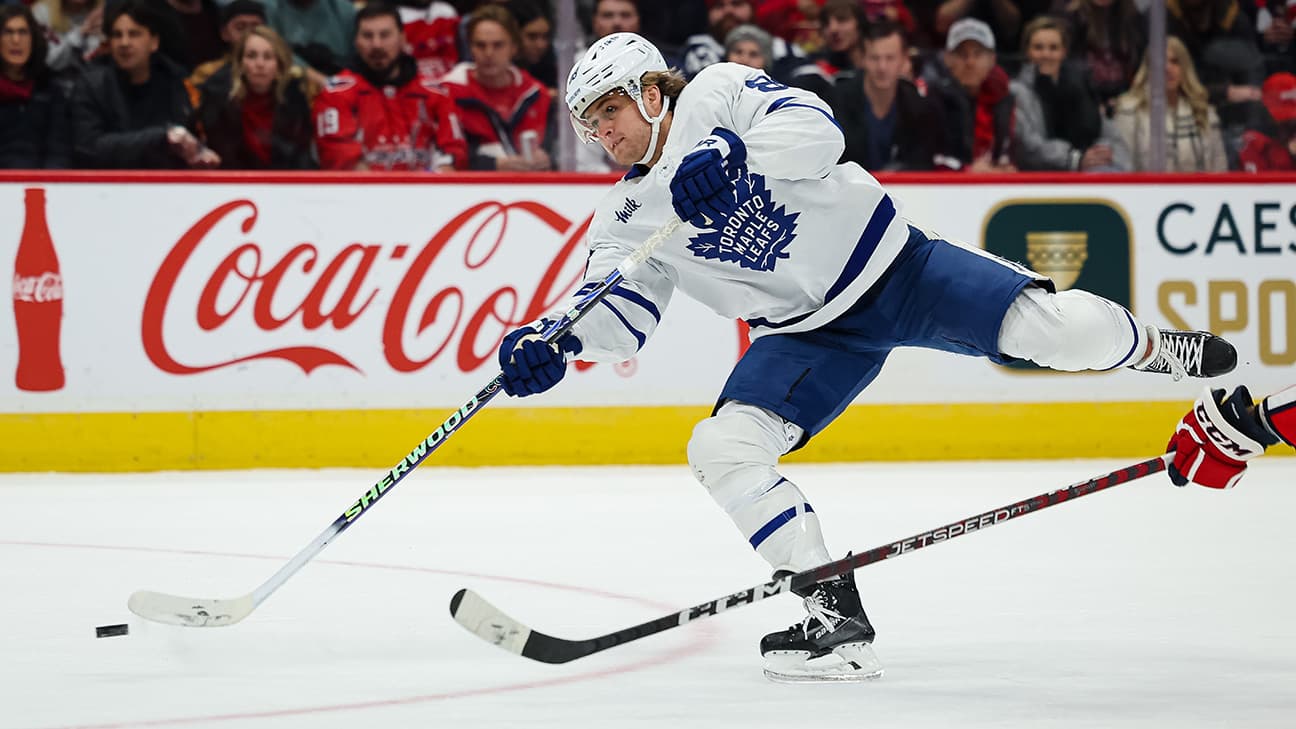
Photo: NHL.com
William Nylander 50 Goals: The Math That Actually Gets Him There
Table of Contents
William Nylander 50 goals is the least ridiculous bold take in Toronto
William Nylander 50 goals has become the most repeated bold prediction of Toronto's summer, pushed most prominently by Leafs Morning Take's Nick Alberga, who picked it on the grounds that Nylander has already proven he can score 45 and now has a new offensive opportunity in front of him. Bold predictions are usually where reasonable analysis goes to die. This one is different, because the arithmetic is closer than it looks.
It is also harder than it looks, and both things can be true. Here is what actually has to happen.
Where Nylander is starting from
Two seasons ago, Nylander scored 45 goals in 82 games — a career high, the first 45-goal season by a Maple Leaf since Mats Sundin, and second in the entire NHL that year. That is the ceiling he has already touched.
Last season was stranger. Nylander posted 30 goals and 49 assists for 79 points in 65 games. He led Toronto in both assists and points, put up a team-high 22 power-play points, and produced at 1.22 points per game — the best full-season rate of his career, on a team that finished last in the Atlantic Division with 78 points.
The gap between those two seasons is not decline. It is 17 missed games. Nylander was better per minute in 2025-26 than in his 45-goal year; he simply was not on the ice enough to bank the counting stats.
The actual math
Run the rates and the target sharpens.
Nylander scored at 0.46 goals per game last season. Over the NHL's new 84-game schedule, that pace produces roughly 39 goals — right in line with the more conservative public projections, one of which has him at 38 goals and 97 points in 79 games.
In his 45-goal season, he scored at 0.55 goals per game. Extended across 84 games, that is about 46 goals. So even his career-best rate, applied to a longer schedule and perfect health, lands short of 50.
To reach 50 in 84 games, Nylander needs to score at roughly 0.60 goals per game. That is about eight per cent better than the best goal-scoring rate he has ever produced, sustained across a full season, at age 30. It is not a small ask. It is also not a fantasy — plenty of forwards have posted a 0.60 goal rate, and Nylander has beaten 0.55 before.
The honest summary: 50 requires his best-ever scoring rate plus a career-best games-played total plus a small step forward. Any two of those three gets him to 44 or 45. All three gets him to 50.
The variable nobody controls: Auston Matthews' knee
The single biggest input here is not Nylander. It is whether Auston Matthews plays 80 games.
Matthews suffered a Grade 3 MCL tear and a quadriceps contusion in his left leg on March 12 against Anaheim, after a knee-on-knee collision with Radko Gudas, and had surgery with a recovery timeline reported at roughly 12 weeks. The signals this summer have been positive, but positive summer signals are not the same as 80 games.
A healthy Matthews changes everything for Nylander's goal total, and not in the obvious direction. It is not simply that playing with Matthews generates more looks — though we have argued the two should start the season together. It is that a healthy Matthews absorbs the opposition's best defensive pairing every night, and Nylander's finishing has always been sharper against second-pairing defencemen than against shutdown units.
If Matthews misses 25 games again, Nylander becomes the matchup target, his own line's primary driver, and his shot volume goes up while his quality of look goes down. That is a recipe for 38 goals and 95 points, not 50 and 100.
What Jim Hiller can actually change
The second lever is deployment, and this is where the new coach matters.
Nylander's power-play production has been consistently excellent — the 22 power-play points last season led the team — but Toronto's man advantage has been structurally stale for years, built around perimeter puck movement and a one-timer that opposing penalty kills have long since solved. Hiller's system changes are the most underrated storyline of the offseason, and the addition of Darren Raddysh as a genuine puck-moving quarterback gives the unit a look it has not had.
The other lever is simpler: shoot more. Nylander has never been a high-volume shooter relative to his goal totals; his efficiency has carried him. Efficiency-driven goal scorers are more volatile year to year than volume-driven ones, which is exactly why 45 turned into a 30-goal, 65-game season without anything actually going wrong.
If Hiller pushes him toward more attempts from the interior — and if Toronto's forecheck actually generates the second chances Chayka's "deeper, faster, bigger, heavier" summer was meant to produce — the volume floor rises and the variance drops.
The case against, stated fairly
The strongest argument against 50 has nothing to do with Nylander's ability. It is that he turned 30 in May, and 30 is where goal-scoring curves start bending down rather than up for most forwards. Players do post career-high goal totals at 30 and 31. It is simply not the way to bet.
The second argument is roster context. Toronto scored enough last season to be respectable and still finished last in the Atlantic at 32-36-14. Chayka's summer rebuilt the bottom six with Colton Sissons, Teddy Blueger, Jack Roslovic, Nick Paul and Zack MacEwen — a group assembled for structure, penalty killing and forecheck rather than for scoring. Depth signings of that profile raise a team's floor. They do not usually raise a top winger's goal total, because they do not generate power-play time or high-danger looks for him.
The third is Gavin McKenna. If the first overall pick makes the team and plays significant minutes, some of the offensive-zone deployment that would otherwise flow to Nylander's line gets redistributed. That is good for Toronto and slightly bad for Nylander's counting stats, which is a trade-off worth making but should be named.
Why this matters beyond the number
There is a business case buried in this too. Nylander is signed long-term, and his contract has quietly become one of the better values on the roster as the cap climbs toward $113.5 million in 2027-28. A 50-goal season on that deal would make it one of the best contracts in the league.
More immediately, Toronto's +6000 Stanley Cup odds are built on the assumption that this team scores enough to hide a mediocre blue line. That assumption requires someone to score 45-plus. Matthews coming off knee surgery is not a safe bet to be that player. Matthew Knies is trending up but is not there yet. It has to be Nylander.
The prediction
Our number is 43 goals in 79 games.
That assumes Nylander misses some time — he has played all 82 exactly once in the last four years — and that his rate lands between last season's 0.46 and his career-best 0.55. It also assumes Matthews plays 70-plus games and takes the hard matchups off Nylander's plate for most of the season.
Forty-three is a very good season. It is also five short, and that is the honest gap between a strong bold prediction and a likely outcome. The path to 50 exists and runs through the trainer's room more than the coach's whiteboard.
What's next
Camp opens in the second week of September, with preseason games Sept. 19-26 and the regular season starting Sept. 29 on an 84-game schedule. Two things to watch immediately: which line Hiller opens with, and whether Nylander gets the first power-play unit alongside Raddysh.
Then watch October. Toronto plays 16 games before Halloween, and a fast start is not optional for this roster. If Nylander has eight or nine goals through those 16 games, 50 is genuinely on the board. If he has five, it is a 40-goal season and everyone should say so out loud in November rather than pretending in March.
Frequently Asked Questions
Has William Nylander ever scored 50 goals?
No. His career high is 45 goals, set in 2024-25 across 82 games. That was the first 45-goal season by a Maple Leaf since Mats Sundin and it ranked second in the NHL that year. He has also had a 40-goal season, in 2022-23.
What were William Nylander's stats in 2025-26?
Nylander recorded 30 goals and 49 assists for 79 points in 65 games. He led Toronto in assists and points and posted a team-high 22 power-play points. His 1.22 points per game was the best full-season rate of his career despite the Leafs finishing last in the Atlantic.
How many goals per game does Nylander need to reach 50?
About 0.60 goals per game across the NHL's 84-game schedule. For comparison, he scored at 0.55 per game during his 45-goal season and 0.46 per game last year. Reaching 50 requires roughly an eight per cent improvement on his best-ever rate plus near-perfect health.
Does the 84-game schedule help Nylander reach 50 goals?
Marginally. Two extra games at his career-best rate adds about one goal — roughly 46 instead of 45. The longer schedule matters far less than games played, and Nylander has appeared in all 82 games only once in the last four seasons.
How does Auston Matthews' health affect Nylander's goal total?
Significantly. Matthews had surgery after a Grade 3 MCL tear and quadriceps contusion suffered March 12 against Anaheim, with a reported 12-week recovery. A healthy Matthews draws the opposition's shutdown pairing every night, which historically improves the quality of look Nylander gets.
What is a realistic William Nylander projection for 2026-27?
Our projection is 43 goals in 79 games, assuming he misses some time and scores at a rate between last season's 0.46 and his career-best 0.55 per game. Other public projections have landed near 38 goals and 97 points in 79 games.
Who quarterbacks the Maple Leafs power play in 2026-27?
Darren Raddysh is the most likely first-unit quarterback after Toronto acquired him from Tampa Bay and committed to an eight-year contract. That matters for Nylander, whose power-play production has been elite but has run through a unit opposing penalty kills had largely solved.


