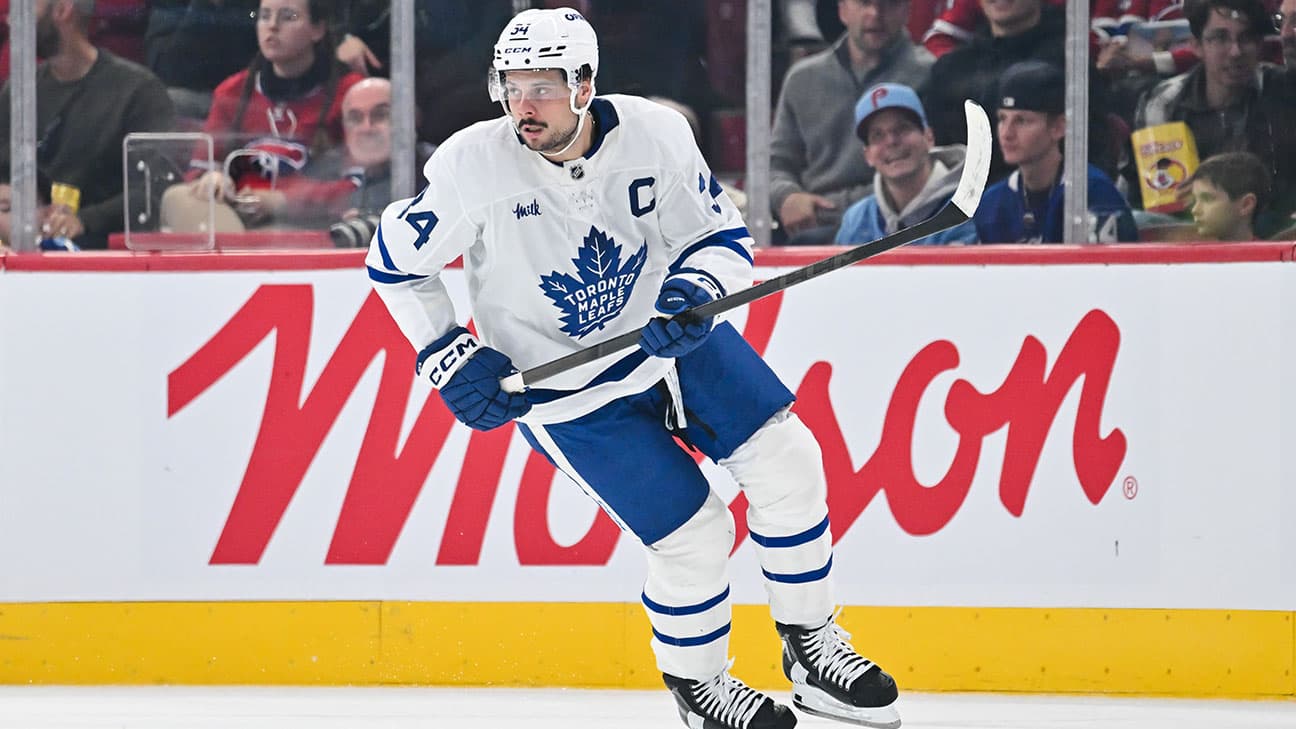
Photo: NHL.com
Opinion: The Maple Leafs Should Reunite the Matthews-Nylander Line
Table of Contents
The Matthews-Nylander line is the easiest decision Jim Hiller has
Put them back together. The Matthews-Nylander line is the single highest-leverage lineup decision available to Toronto's new head coach, the historical evidence supporting it is unusually strong, and the reasons Toronto has spent recent seasons keeping Auston Matthews and William Nylander apart no longer apply to this roster. Jim Hiller should open training camp with them on the same line and stop treating it as an emergency lever.
This is an opinion piece, so here is the position stated plainly: Toronto has spent four years optimising for lineup balance and it has produced four years of first-round exits followed by a season with no playoffs at all. The balance argument has been tested. It failed. Try loading the top line.
The evidence Hiller already has
Hiller does not need to take this on faith. He was on the Maple Leafs bench as an assistant for three of Matthews's early seasons, and per the data cited in Maple Leafs Hot Stove's 2026 offseason review, Matthews and Nylander played roughly 1,342 minutes together at five-on-five during that stretch. Only Zach Hyman logged more time with Matthews.
The result: they outscored opponents 76-47, which is a goal share of nearly 62 per cent. That is not a small sample and it is not a soft-minutes mirage. Over a full season, a top line controlling 62 per cent of the goals is a legitimate championship-calibre driver.
There is a real objection here, and it deserves stating: those were younger versions of both players, in a different league, under different coaches. Fair. But the underlying reason the pairing worked has not changed — Matthews generates the most dangerous shot volume of any centre alive, and Nylander is the best pure puck-retrieval-and-entry winger Toronto has. That is a fit rooted in skill sets, not in a particular season's context.
Why Toronto stopped doing it
The case for splitting them was always about depth. Put Nylander with John Tavares, the argument went, and Toronto rolls two lines that opponents cannot match against. Give the second line a genuine scoring threat and the top line still has Matthews, who is good enough to drive play with anyone.
It is a coherent argument and it produced coherent results — regular-season results. Toronto won a lot of games in the regular season with that structure. What it never produced was a playoff series where the Maple Leafs' best players decided the outcome. In tight April and May hockey against teams that could match lines, the balanced approach diluted Toronto's only true structural advantage: having two of the ten or so most dangerous offensive players in the world on the same team.
The counterargument I take seriously is the Tavares one. Nylander has made Tavares's late-career production possible, and our breakdown of why Tavares is still a bargain as the second-line centre depends partly on that pairing. Break it up and Tavares's numbers likely dip.
My answer: that is an acceptable cost, and this is the first summer in years where Toronto has an obvious replacement.
Gavin McKenna changes the maths
The reason this argument works now and did not work in 2024 is that Toronto drafted first overall. Gavin McKenna gives Hiller a top-six-calibre winger to put on Tavares's flank, which is exactly what the balanced-lineup approach required and Toronto never had.
Several published projections have gone the other direction, slotting McKenna alongside Matthews and leaving Nylander with Tavares. I understand the appeal — you protect an 18-year-old by putting him with the best player on the team. I think it is backwards. McKenna is a driver, not a passenger; his junior production came from creating offence himself, not finishing someone else's. Pairing him with Tavares, a centre who thrives playing off skilled wingers, gives him the puck more often and gives Toronto three lines that can score instead of two.
We have argued elsewhere that McKenna belongs on the roster from day one, and that has not changed. What has changed is where he should play. Put him with Tavares. Give Matthews his best winger back.
The rest of the lineup can absorb it
This only works if the bottom six holds up, and this is the first Toronto team in a while where that is a defensible assumption. John Chayka spent his summer adding functional depth forwards rather than stars: Nick Paul arrived from Tampa Bay on a three-year deal at $3.15 million to centre the third line, and Toronto added penalty-kill-capable pieces underneath him.
Matthew Knies is the other piece that makes this viable. He has established himself as a legitimate top-line winger, and a Matthews line with Knies on one side and Nylander on the other is the most dangerous forward unit Toronto has iced since 2022. It also solves the long-running problem of what to do with Knies, who has never looked right away from Matthews.
That leaves Easton Cowan, Jack Roslovic and the depth group to fill out the third and fourth lines, with Cowan pushing for middle-six minutes after a Calder Cup run. Our look at Cowan's top-six audition covers where he realistically fits.
What Hiller has said, and what he actually has to solve
Hiller has been careful in public, talking about versatility and chemistry rather than committing to combinations before camp. That is the correct posture for a first-year head coach in July and it tells us nothing.
What we do know is what he inherited: a team that missed the playoffs, a defence corps rebuilt around Darren Raddysh's puck movement, and a goaltending tandem in Sergei Bobrovsky and Anthony Stolarz that should be better than last season's. The structural work — the defensive-zone coverage, the neutral-zone setup — is covered in our piece on the system Hiller is installing.
But systems are the slow work. Line combinations are the fast lever, and Hiller has one obvious one available. Nylander is coming off a career-best 1.22 points per game, a 99-point pace over a full season. Matthews is coming off the least productive full season of his prime after an injury-disrupted year. The most efficient way to fix the second of those problems is to attach it to the first.
What's next
Training camp opens in September and the first meaningful signal will be the opening-day line rushes, which in Toronto are treated as a policy announcement. If Hiller opens with Knies-Matthews-Nylander, he has decided to lead with his best. If he opens with McKenna-Matthews-Nylander, he has decided that balance is a luxury he cannot afford yet. If he opens with Nylander next to Tavares again, he has chosen the structure that has already been tried.
Nothing about this is a guaranteed fix. Loading the top line concentrates risk: if Matthews's knee flares up again, Toronto's offence goes from top-heavy to hollow overnight, and our piece on Matthews's health being the season's swing factor makes that case in full.
But the Maple Leafs are past the point where hedging is the responsible choice. They missed the playoffs, fired the coach, changed general managers, rebuilt the blue line and drafted a generational forward. Every other part of the organisation has accepted that the cautious version of this team did not work. The lineup should catch up. Check the standings page in six months and we will know.
Frequently Asked Questions
How did Auston Matthews and William Nylander perform together?
Per data cited in Maple Leafs Hot Stove's 2026 offseason review, the two played roughly 1,342 five-on-five minutes together during Jim Hiller's three seasons as a Toronto assistant and outscored opponents 76-47 — a goal share close to 62 per cent. Only Zach Hyman logged more five-on-five time with Matthews in that stretch.
Who will play on the Maple Leafs' top line in 2026-27?
Nothing is settled. Published projections have varied between Matthew Knies and Jack Roslovic flanking Matthews, and Gavin McKenna riding shotgun with Nylander on the right side. Jim Hiller has publicly emphasised versatility rather than committing to combinations before training camp opens in September.
Why did the Maple Leafs split up Matthews and Nylander?
The reasoning was lineup balance — pairing Nylander with John Tavares gave Toronto two lines opponents could not easily match against. It produced strong regular-season results but no playoff series where Toronto's stars decided the outcome, and the team missed the playoffs entirely in 2025-26.
What were William Nylander's numbers last season?
Nylander scored at a career-best 1.22 points per game in 2025-26, a pace equivalent to roughly 99 points over a full season. He was Toronto's most productive forward on a team that missed the playoffs for the first time since 2016.
Is Jim Hiller the Maple Leafs head coach?
Yes. John Chayka hired Hiller in June 2026 as the 41st head coach in franchise history, after interviewing more than 25 candidates to replace Craig Berube. Hiller previously coached the Los Angeles Kings to a 93-58-24 record over parts of two seasons and was a Toronto assistant under Mike Babcock from 2015 to 2019.
Where will Gavin McKenna play for the Maple Leafs?
McKenna signed his three-year entry-level contract and is expected to compete for a top-six role at training camp. Reports have suggested he could play primarily with Auston Matthews and John Tavares, though the exact deployment will be decided in September.
Who is the Maple Leafs' third-line centre in 2026-27?
Toronto acquired Nick Paul from Tampa Bay in July 2026 for goaltender Dennis Hildeby and two draft picks. Paul carries a $3.15 million cap hit with three years remaining and projects into the third-line centre role behind Auston Matthews and John Tavares.


