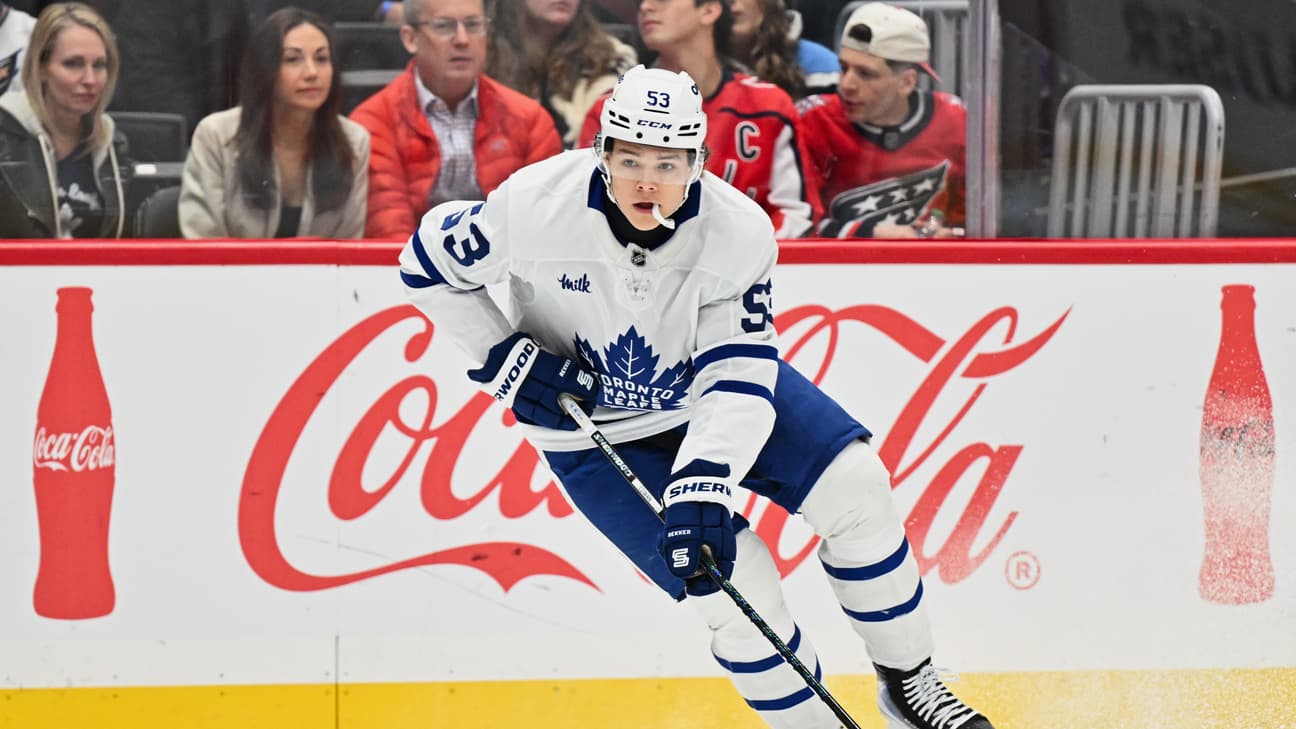
Photo: NHL.com
Easton Cowan Is the Maple Leafs' Cheapest Fix for a Real Problem
Table of Contents
Easton Cowan arrives at camp as Toronto's highest-leverage unknown
Easton Cowan turned 21 in May, finished a full NHL rookie season, then went to the American Hockey League and helped win a Calder Cup. He told TSN this week that there is a buzz around Toronto heading into camp and that he cannot wait to start. That is the sort of quote a young player gives every September. What makes it worth paying attention to this year is that the Maple Leafs genuinely need him to be better, and they need it for reasons that have nothing to do with his development curve.
John Chayka spent the summer rebuilding the bottom six, the goaltending and the blue line. He did not solve the top six. Toronto still does not have a settled scoring winger alongside Auston Matthews, and after the Luke Evangelista trade priced a 56-point winger at a first and a second, the external market closed. The internal answer is Easton Cowan, and whether he is ready is the single largest swing factor on this roster.
What the rookie season actually showed
Cowan played 66 NHL games in 2025-26 and produced 11 goals and 29 points. Read that coldly and it is a fourth-line stat line. Read it in context and it is more encouraging than the raw numbers suggest.
He was eased in, on a team that spent the first half of the season in freefall, under a coaching staff that lost its power-play assistant in December and its head coach in May. He did not get sheltered offensive-zone deployment with a scoring centre. He was a 20-year-old winger asked to survive, and he mostly did — he rarely looked overwhelmed, which for a first-year player in this market is not nothing.
The concern is the finishing. Eleven goals in 66 games is a 13-goal pace over a full season, and Cowan's junior reputation was built on offensive creation, not grinding. Toronto does not need him to be defensively responsible. It has bought five forwards to do that. It needs him to score.
The Calder Cup run was the more useful evidence
The Marlies won the 2026 Calder Cup — the franchise's second, after 2018 — closing out Chicago 4-3 in Game 5 at a sold-out Coca-Cola Coliseum to take the series 4-1. Artur Akhtyamov won the Jack A. Butterfield Trophy as playoff MVP. Toronto became one of only six teams in league history to win a Calder Cup after surviving as many as four elimination games.
Cowan put up eight goals and 18 points in 22 playoff games on that run. Against grown men, in a tournament where checking tightens every round, he was a driver rather than a passenger. That is a materially different data point than 29 points in a lost NHL season, and it is the reason the organization is comfortable penciling him into a real role. We tracked that run closely, including the three-games-to-none stranglehold in the final, and Cowan was the most consistent forward in it.
The counterargument is honest and worth stating: the AHL playoffs are not the NHL. Dominating the American League at 21 is what a good prospect is supposed to do. It confirms he is not a bust. It does not confirm he is a top-six NHL winger.
The problem he is being asked to solve
Auston Matthews played 60 games last season, scored 27 goals and added 26 assists, and missed the final 16 after MCL surgery. It was his second consecutive injury-shortened year. Chris Johnston has reported that Matthews' usage is forecast to change under Jim Hiller, and the additions of Nick Paul, Colton Sissons, Teddy Blueger and Brandon Duhaime exist largely to make that possible.
Changing Matthews' deployment only helps if the players around him can finish. William Nylander can, and there is a real argument for simply putting Matthews and Nylander together permanently. But that leaves the other line short, and it leaves Toronto with one scoring unit for an 84-game schedule. Matthew Knies handles the left side. The right side beside Matthews is open, and Patrik Laine remains unsigned in September for a reason.
So the job description is specific: a right-side winger who can play at pace, retrieve pucks, and shoot. Cowan is a left shot, which is a genuine complication, though plenty of left shots play the off wing effectively. He also has the one attribute Toronto cannot buy this year — he costs nothing against the cap that the Leafs have not already spent.
The second-year jump is not automatic
The optimistic version of this story writes itself. Twenty-one-year-old wingers who show well in an AHL championship run frequently take a step. The pessimistic version is more common than fans remember: young players who were sheltered as rookies get harder minutes in year two, the league adjusts, and the point totals stay flat while everyone waits.
Cowan will face harder matchups this season, not easier ones. If he plays with Matthews he draws the opposition's best defence pair every night. If he plays on the third line he gets soft minutes but limited ice time. There is no version of this where he gets a comfortable path to 45 points.
The honest projection is somewhere between 35 and 45 points across 84 games, with the top of that range requiring power-play time that will be contested by Gavin McKenna. That is not a top-six winger. It is a good young player becoming one, which is a different thing and takes longer than a Toronto news cycle allows.
Where he fits in Hiller's lineup
The cleanest fit is second-line right wing beside John Tavares and Knies, with a promotion clause: if Matthews' line stalls in October, Cowan moves up. That gives him real minutes without betting the season on him, and it keeps McKenna's runway separate rather than pitting two young forwards against each other for the same slot.
The riskier version puts him on Matthews' right wing from day one. There is a case for it — the fastest way to find out whether a player can handle top-six minutes is to give him top-six minutes — but with a four-game preseason schedule, Hiller has almost no evaluation runway before the September 29 opener against Montreal. Our full projected 2026-27 lineup works through both arrangements.
Either way, the argument for keeping him is now stronger than it was in August. We wrote then that Chayka should not deal Cowan as a trade sweetener. The Evangelista price tag made that case for us: if a first-round pick and a second buy you one year of a 56-point winger, then a cost-controlled 21-year-old with a Calder Cup run behind him is worth considerably more to Toronto than to anyone Toronto would trade with.
What a successful season looks like
Set the bar at three things. Eighteen to 20 goals, which would represent a genuine step from 11 and put him in the range of a legitimate top-nine scorer. Regular second-power-play usage by December. And no stretch where he is scratched or sent down — the point of year two is that the roster spot stops being a question.
Clear those and Toronto has solved its winger problem for free, in a summer when solving it any other way was going to cost a first-round pick the Leafs do not comfortably own. Miss them and Chayka is back in the market at the deadline with worse leverage and less cap space.
What's next
Toronto's prospects play the NHL Prospect Challenge in Gatineau on September 12 and 13 against Ottawa, Montreal and Winnipeg — the first time four Canadian clubs have run the event together. Cowan has outgrown that tournament and will almost certainly skip it; the more interesting question there is whether McKenna plays.
Cowan's season starts with the veterans, and the first meaningful signal is which line he takes reps with on the opening day of camp. Follow his usage and production through the year on our Leafs player pages, and track how the top six settles on the standings page as the Atlantic race takes shape.
Frequently Asked Questions
How many points did Easton Cowan score as a rookie?
Cowan had 11 goals and 29 points in 66 games during his rookie NHL season in 2025-26. He then added eight goals and 18 points in 22 games during the Toronto Marlies' Calder Cup championship run.
Did the Toronto Marlies win the Calder Cup in 2026?
Yes. The Marlies beat the Chicago Wolves 4-3 in Game 5 at a sold-out Coca-Cola Coliseum to win the series 4-1 and claim the 2026 Calder Cup, the franchise's second title after 2018. Goaltender Artur Akhtyamov won the Jack A. Butterfield Trophy as playoff MVP.
Will Easton Cowan play in the NHL in 2026-27?
Yes. Cowan is expected to spend the full season with the Maple Leafs rather than the Marlies. The open question is role — whether he opens on the second line with John Tavares or gets a look on Auston Matthews' right wing.
How old is Easton Cowan?
Cowan is 21. He completed his first full NHL season at age 20 in 2025-26 before the Marlies' Calder Cup run, which makes his production curve more encouraging than the raw point totals suggest.
Why do the Maple Leafs need Easton Cowan to break out?
Toronto has no settled scoring winger for Auston Matthews and cannot buy one. The Luke Evangelista trade in September established that a 56-point winger costs a first- and second-round pick, and the Leafs' 2027 and 2028 first-rounders are already owed to Philadelphia and Boston.
Should the Maple Leafs trade Easton Cowan?
No. Cost-controlled young wingers are exactly what the current trade market values most, and Toronto's need for cheap top-nine scoring is more acute than its need for any single roster upgrade. Cowan is worth more to the Leafs than the return he would generate.
Is Easton Cowan playing at the 2026 NHL Prospect Challenge?
He is not expected to. The tournament runs September 12 and 13 in Gatineau with prospects from Ottawa, Toronto, Montreal and Winnipeg, and Cowan has outgrown that level after a full NHL season and an AHL championship.


