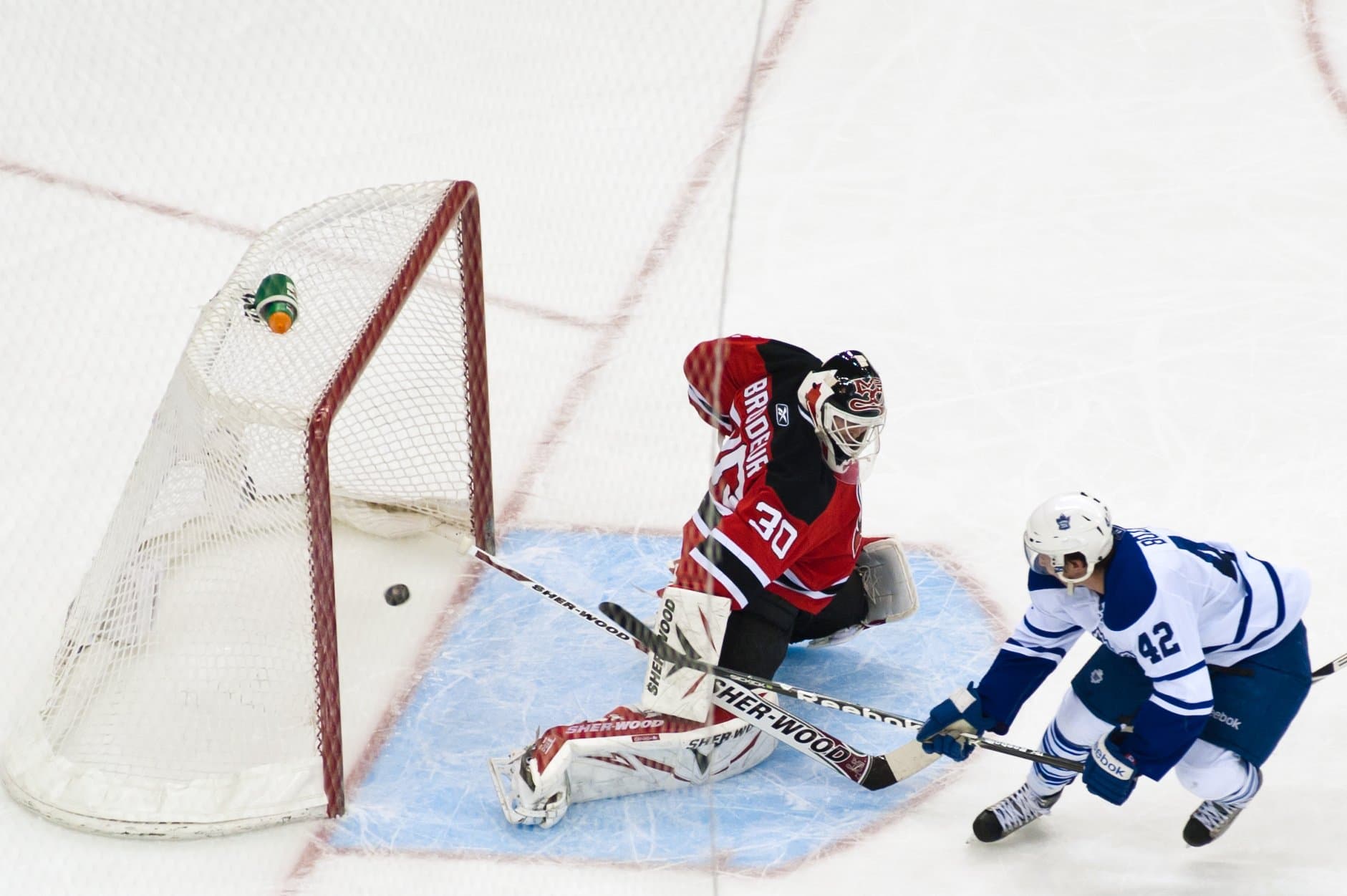
Photo: James DiBianco, Wikimedia Commons (BY-SA-2.0)
Nick Robertson and the Maple Leafs' Qualifying-Offer Deadline: Term, Trade, or Walk?
Table of Contents
The Nick Robertson qualifying offer is the Maple Leafs' next deadline
With the draft and free agency dominating the headlines, the Nick Robertson qualifying offer has quietly become the next item on John Chayka's to-do list. The Maple Leafs have until the late-June qualifying-offer deadline — reported as June 29 — to tender Robertson a one-year offer worth $1.825 million and keep his rights as a restricted free agent. If they let the date pass, the 24-year-old winger walks to unrestricted free agency for nothing. That is the simple part. The complicated part is everything that comes after the offer is made.
Robertson is a restricted free agent for the third straight summer, and for the third straight summer his future in Toronto is an open question rather than a settled one. The difference this year is that the man making the call is new, the cap has jumped, and Robertson himself appears done playing the one-year game.
What the qualifying offer actually is
A qualifying offer is the mechanism that preserves a team's restricted free agent rights. For Robertson, whose expiring deal carried a $1.825-million cap hit, the required qualifying offer matches that figure: a one-year contract at $1,825,000. Tender it, and Toronto keeps him as an RFA with the right to match any offer sheet and the right to take him to salary arbitration. Decline to tender it, and he becomes a full unrestricted free agent able to sign anywhere on July 1.
The catch is that a qualifying offer is exactly that — an offer the player can accept. Robertson could, in theory, sign the $1.825-million qualifier and force the Leafs to either keep him at that number or trade him. But by every indication, he has no intention of doing so.
A career year that changes the math
Robertson is coming off the best season of his career. He played 78 games in 2025-26 and posted 16 goals and 16 assists for 32 points — modest counting numbers on their face, but a full, healthy season from a player whose career to that point had been defined by injuries and short samples. For a winger who has fought to stay in the lineup since being drafted 53rd overall in 2019, durability was the missing piece, and he finally delivered it.
That production matters because it strengthens his case in arbitration. Robertson holds arbitration rights this summer, which means if the Leafs qualify him and the two sides can't agree on a number, an arbitrator can be asked to set one — and a 16-goal, 78-game season is the kind of body of work that pushes an award above the qualifying figure. The career year that Leafs fans wanted to see is also the leverage Robertson can now use.
Why Robertson won't just sign the qualifier
Robertson has spent his entire NHL career on short-term deals, bouncing between the press box, the Marlies, and the top nine. He has made clear, through reporting around his camp, that he is looking for a longer-term contract for the first time — a deal that gives him security and a defined role rather than another prove-it season. That is a reasonable ask for a 24-year-old who just played a full schedule, and it is the crux of the standoff.
From Toronto's side, the question is whether Robertson is a long-term piece of a forward group in transition or a useful trade chip whose value will never be higher. The Leafs have already reshaped the roster around them this summer, and the bottom-six picture is fluid. Committing multiple years to a 16-goal scorer is not a slam dunk when the centre depth behind Auston Matthews remains the franchise's real problem, a gap we broke down in our look at the Maple Leafs' centre problem in a bone-dry UFA market.
The trade angle nobody can ignore
For two years now, Robertson's name has surfaced in trade chatter more than almost any other Leafs forward, and he has been widely described as Toronto's most moveable asset — a cost-controlled, NHL-proven scorer young enough to interest a rebuilding team. Qualifying him does not commit the Leafs to keeping him; it protects an asset they can move.
That is the most likely path here. Chayka tenders the qualifying offer to preserve the rights, then uses the window before and during the draft to gauge the market. A sign-and-trade — the same tool Chayka used to land Darren Raddysh from Tampa, which we covered in our breakdown of the Raddysh sign-and-trade — is very much on the table. So is simply qualifying him, going to arbitration if needed, and keeping a useful, cheap winger on a roster that needs goals.
The bigger RFA picture
Robertson is the headline, but he is not the only decision. Toronto has a cluster of restricted free agents to sort before the deadline, including depth forwards and goaltending prospect Dennis Hildeby, plus pending UFA decisions on players the team may choose not to qualify. Pontus Holmberg is the most prominent name in the latter group — a versatile bottom-six centre the Leafs are not expected to qualify, in part because his own arbitration rights make a qualifier risk more than it's worth. Letting Holmberg reach the open market would thin the middle of the ice even further.
Every one of these calls runs through the same filter: a roster being rebuilt move by move under a first-year GM. Newly acquired goaltender Samuel Ersson, who came over in the Joseph Woll trade with Philadelphia, is himself a qualifying-offer question mark, which is why the deadline is about more than one winger.
The cap context
The good news for Toronto is that money is not the obstacle it once was. The NHL salary cap rises to $104 million for 2026-27, an $8.5-million jump, and the Leafs entered the summer with meaningful room even after the Raddysh extension — a picture we laid out in our piece on the team's cap space after the Raddysh deal. A multi-year Robertson contract in the $2.5-to-$3.5-million range, if that is where the two sides land, is comfortably affordable.
The constraint is not dollars; it's roster logic. Toronto has to decide who is part of the next core and who is a trade piece, and Robertson sits squarely on that line. The cap space gives Chayka the freedom to keep Robertson if he wants to — and the freedom to move on without it being a financial decision. You can track every Leafs commitment on our contracts page and the broader roster on the players page.
What's next
Expect the Leafs to tender Robertson his qualifying offer before the deadline — declining to qualify a 24-year-old coming off a 32-point season for nothing would be indefensible asset management, and Chayka has shown he understands value. From there, the draft becomes the natural backdrop for any Robertson trade talk, with the actual contract resolution likely pushed toward arbitration or a negotiated multi-year deal in July.
The Nick Robertson qualifying offer is a small line item next to a No. 1 overall pick and a Morgan Rielly trade saga. But it is a clean test of how Chayka values a homegrown asset, and how he balances a player's desire for security against a roster that is still very much under construction.
Frequently Asked Questions
What is Nick Robertson's qualifying offer with the Maple Leafs?
Robertson's required qualifying offer is a one-year contract worth $1,825,000, matching the cap hit of his expiring deal. Toronto must tender it by the late-June qualifying-offer deadline to retain his restricted free agent rights, or he becomes an unrestricted free agent.
When is the NHL qualifying offer deadline in 2026?
Teams must submit qualifying offers to their restricted free agents by the late-June deadline, reported as June 29 at 5 p.m. ET. Players who are not tendered a qualifying offer become unrestricted free agents able to sign with any team.
How many points did Nick Robertson score in 2025-26?
Robertson posted 16 goals and 16 assists for 32 points in 78 games during the 2025-26 season. It was the first fully healthy NHL campaign of his career and a personal best in games played.
Does Nick Robertson have arbitration rights?
Yes. Robertson holds salary arbitration rights this summer, which means if the Maple Leafs qualify him and the sides can't agree on a contract, either party can file for arbitration to have a salary set by a neutral arbitrator.
Will the Maple Leafs trade Nick Robertson?
A trade is realistic. Robertson has been described as Toronto's most moveable asset — a cost-controlled, NHL-proven scorer — and a sign-and-trade is possible. The most likely path is the Leafs qualifying him to protect his value, then gauging the trade market around the draft.
Why didn't the Maple Leafs qualify Pontus Holmberg?
Holmberg is expected to reach unrestricted free agency because he holds arbitration rights, which makes tendering a qualifying offer riskier than the team wants for a bottom-six role player. Letting him go would further thin Toronto's centre depth.


