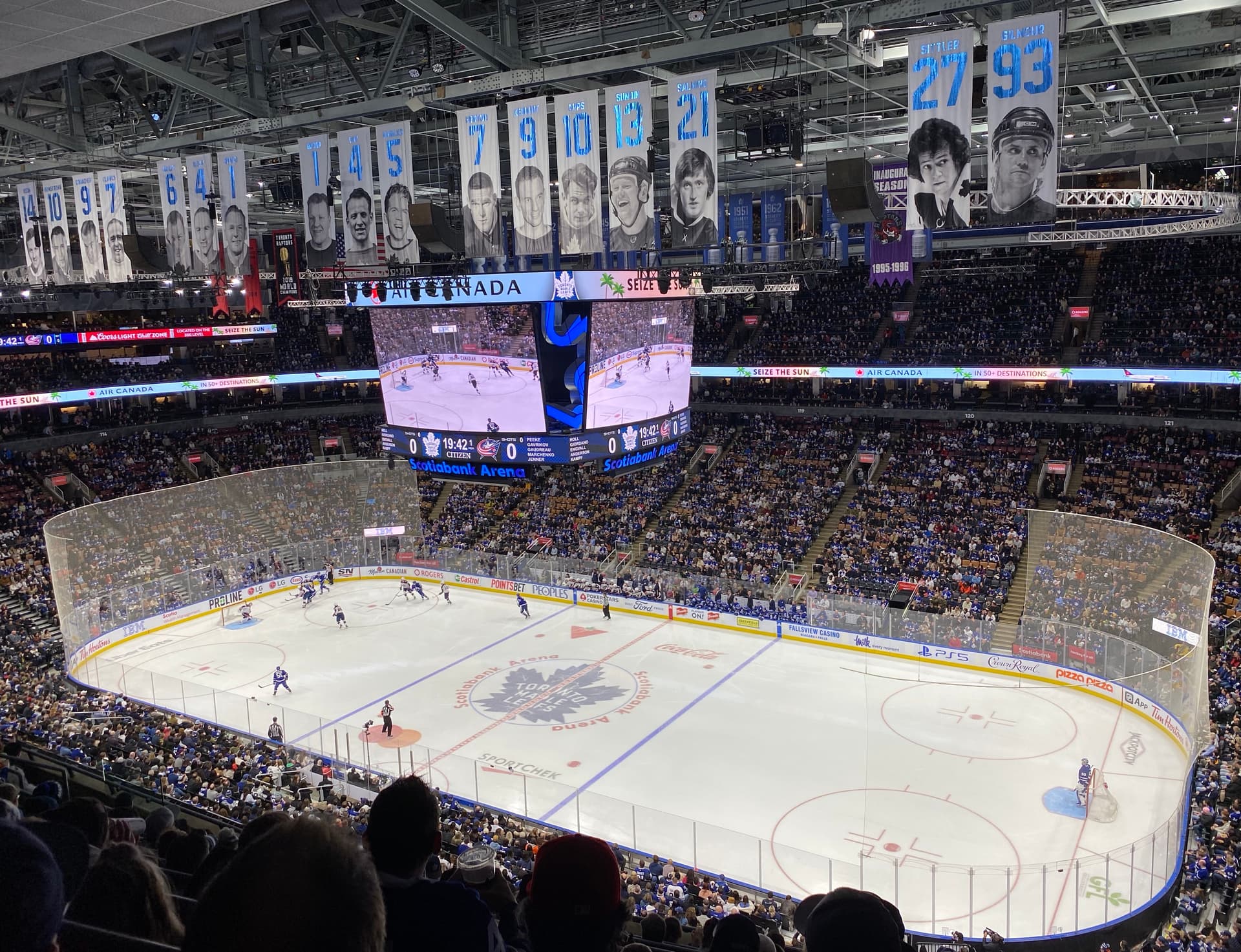
Photo: Adam Bishop, Wikimedia Commons (BY-SA-4.0)
Boone Jenner and the Maple Leafs' Centre Problem in a Bone-Dry UFA Market
Table of Contents
The Hole Chayka Still Has to Fill
The most pressing Maple Leafs centre target this summer might be the least glamorous name on the board: Boone Jenner. With Charlie Coyle off the market after re-signing in Columbus, Jenner is now widely regarded as the best unrestricted free agent centre available on July 1 — the No. 1 pivot in what evaluators are calling a bone-dry class. For a Toronto team with a clear hole down the middle and roughly $18.8 million in cap space, that makes the 32-year-old Blue Jackets captain a name worth taking seriously, even if he does not move the needle the way a fan base raised on star hunting wants.
John Chayka has been candid that the middle of the lineup is unfinished business. Auston Matthews anchors the top, but the depth behind him is thin and aging, and the easy fixes have evaporated. We laid out the math after the Darren Raddysh signing — plenty of room, a centre-sized gap — and the free-agent market is doing nothing to make the solution obvious. See our breakdown of the Leafs' cap space and centre hunt for the full picture.
Why the Market Is Bone-Dry
The 2026 free-agent class was supposed to be loaded a year out. It is not, because so many of the best players re-signed before reaching July 1. Alex Tuch headlines the forward group, and beyond him the centre position in particular thinned out fast. Coyle, a reliable two-way pivot who would have been a sensible Toronto target, signed a six-year, $36 million deal to stay in Columbus in early May. That removed arguably the cleanest fit and left the cupboard nearly bare.
That is the backdrop for every Maple Leafs centre target conversation right now. When a 32-year-old coming off a down year is the top option, you are not shopping in a buyer's market — you are choosing between an expensive trade and a flawed free agent. We covered this dynamic when we wrote about the thinnest UFA class in years pushing Chayka toward trades, and nothing in the past two weeks has loosened it up.
Who Boone Jenner Actually Is
Jenner is the Blue Jackets captain, a 32-year-old who has spent his entire career in Columbus and built a reputation as a hard, defensively responsible, physical centre. He is the kind of player who wins faceoffs in his own end, kills penalties, and finishes checks — the connective tissue a contender needs in its bottom six, not a player who is going to drive a second line on his own.
The contract context matters. Jenner is finishing a four-year, $15 million deal that carried a $3.7 million cap hit, and he is coming off a quiet, injury-affected season of eight goals and 19 assists in 42 games. He recently changed agents as free agency approached, a move that usually signals a player understands his value on the open market. Columbus, having already locked up Coyle long term, may not bring him back — which is exactly why his name has drifted toward Toronto.
It is worth remembering what Jenner looks like in full health. In his prime he was a dependable 20-goal, two-way contributor who played the game hard every shift and earned the captaincy of a young Columbus group. That is the version Toronto would be betting on — not the diminished, injured one from last season. The gamble is whether, at 32, the body still allows that player to show up for 80 games. Leadership and compete level travel; durability at this stage of a career does not always come with them.
The Fit — and the Risk
On fit, Jenner makes sense as a third-line centre who lets Matthews and a healthy John Tavares operate with more freedom. He would bring physicality and defensive fortitude to a Leafs bottom six that lost size and reliability when Calle Jarnkrok went back to Sweden, a departure we flagged as a real bottom-six hole. Jenner can take hard matchups and let the skill players pick their spots.
The risk is just as obvious. He is 32, his production has slipped, and his recent durability is a question. Paying free-agent term and dollars to a declining physical centre is how teams end up with the contracts they regret in year three. If Jenner's asking price climbs past a short, sensible deal because he is the last centre standing, Toronto should be willing to walk. The need is real; overpaying to fill it is not the answer, especially with Max Domi's situation already clouding the middle after his back-surgery complications.
The Trade Alternative
If the free-agent route looks like an overpay, the trade market offers younger, higher-upside swings. Mason McTavish remains the most intriguing — a former third-overall pick whose name keeps surfacing in Anaheim trade talk, and one we examined closely when we asked whether the centre math justified a McTavish deal. Shane Wright in Seattle is another younger pivot who could grow into a meaningful role.
The trade-off is cost. McTavish and Wright would each command real assets — prospects, picks, or roster players — at a time when Toronto is also trying to rebuild its blue line and hang on to its draft capital. The advantage is age and term: you are buying years, not renting a decline. For a team that just drafted a franchise winger first overall, leaning younger up the middle has a certain logic.
The complication is that Toronto's cupboard of tradeable assets is not bottomless. The Leafs spent picks and prospects through the past two deadlines, and the prospect pool, while healthier after the Marlies' Calder Cup run, is not deep enough to absorb a blockbuster without thinning out the very pipeline Chayka is trying to rebuild. That tension — wanting a younger centre but not wanting to gut the future to get one — is the quiet reason a short free-agent deal for someone like Jenner remains in play even when the trade names are sexier. Sometimes the unexciting answer is the responsible one.
What the Maple Leafs Should Do
Here is the LeafsLurker position: pursue Jenner, but only on Toronto's terms. A one- or two-year deal at a reasonable number for a defensively sound, physical third-line centre is good business and fills a genuine need. A four-year commitment at top-six money because the market left no alternative is a trap. If the bidding gets silly, Chayka should pivot to the trade board and pay in futures for a McTavish or a Wright rather than in term for a 32-year-old.
The broader truth is that this Maple Leafs centre target search is a symptom of a thin market, not a lack of effort. Chayka has already reshaped the goaltending and the right side of the defence. The middle is the last big item, and it is the hardest one to solve cheaply this summer.
What's Next
Free agency opens July 1, but the picture will sharpen at the draft on June 26-27, when centre-needy teams often line up trades before the open-market frenzy. Watch whether Columbus signals it is moving on from Jenner, and whether Anaheim's asking price on McTavish softens. Toronto has the cap room and the need; the question is whether Chayka pays in dollars or in assets. Track the cap situation on our contracts page and the roster on the players page as the dominoes fall.
Frequently Asked Questions
Is Boone Jenner a free agent in 2026?
Yes. Jenner becomes an unrestricted free agent on July 1, 2026, when his four-year, $15 million deal ($3.7M AAV) expires. He is widely considered the best UFA centre available in a thin class.
Why do the Maple Leafs need a centre?
Toronto's depth down the middle is thin and aging behind Auston Matthews. John Tavares is on the wrong side of 30, Max Domi's status is clouded by back-surgery complications, and Calle Jarnkrok left for the SHL, opening a bottom-six hole.
Did Charlie Coyle sign with the Maple Leafs?
No. Coyle re-signed with the Columbus Blue Jackets on a six-year, $36 million contract in early May 2026, taking one of the most logical Toronto centre targets off the market before free agency.
How much cap space do the Maple Leafs have for free agency?
Toronto has roughly $18.8 million in projected cap space after signing Darren Raddysh, operating under a 2026-27 salary cap of about $104 million. That is enough to add a centre and address other needs.
Should the Maple Leafs trade for a centre instead of signing one?
It is a real option. Younger pivots like Anaheim's Mason McTavish or Seattle's Shane Wright would cost assets but offer more term and upside than a 32-year-old free agent. The trade-off is paying in prospects and picks rather than dollars.
How old is Boone Jenner and what are his recent stats?
Jenner is 32. He is coming off an injury-affected 2025-26 season with eight goals and 19 assists in 42 games as the Blue Jackets captain, which is part of why a long-term free-agent deal would carry risk.


