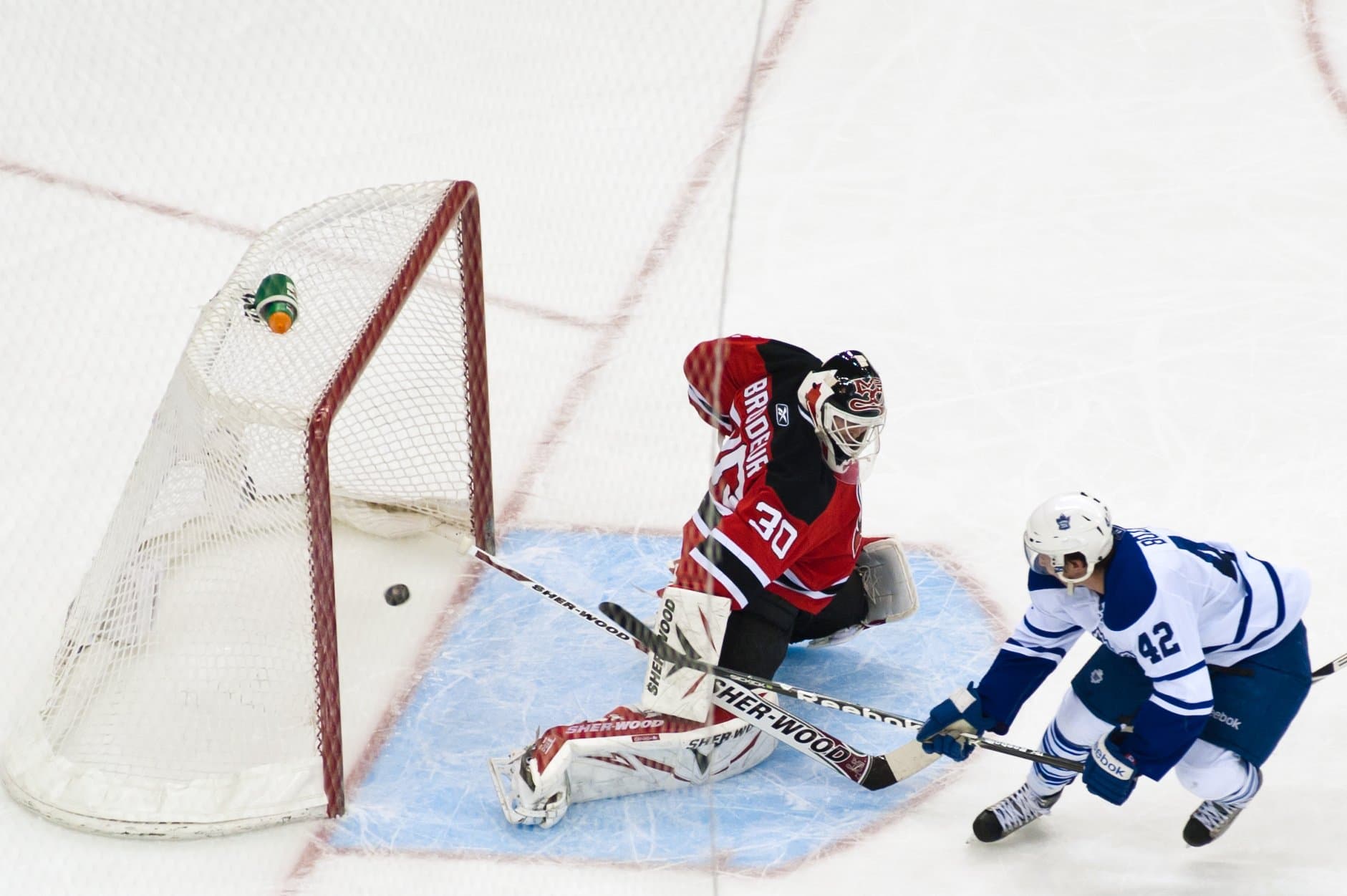
Photo: James DiBianco, Wikimedia Commons (BY-SA-2.0)
John Chayka Built the Maple Leafs Out of Other Teams' Winners. That Is the Whole Plan
Table of Contents
Read the transaction log as one sentence
Line up everything John Chayka has added since taking over the Maple Leafs in May and a pattern falls out immediately: almost every player came from an organization that has recently won something. That is the through-line of the Chayka Maple Leafs offseason, and it is a deliberate roster-construction philosophy rather than a coincidence of market timing.
Darren Raddysh and Nick Paul came out of Tampa Bay. Sergei Bobrovsky came out of Florida. Colton Sissons came out of Vegas. Jack Roslovic spent last season in Edmonton. Teddy Blueger and Brandon Duhaime were added on the same July 1 to fill out the bottom of the lineup. Toronto did not chase the best available point totals this summer. It chased players who have been in rooms that went deep.
Whether that works is a separate question, and a fair one. But it is worth being precise about what Chayka actually did, because the "the Leafs got worse on paper" take and the "the Leafs finally addressed their character problem" take are both being argued without much attention to the contracts themselves.
The Tampa pipeline
Two of the more consequential additions came from the same organization. Raddysh arrived in a sign-and-trade — eight years at an $8.5-million cap hit, with Tampa Bay receiving a 2026 fifth-round pick for facilitating it. That is an enormous bet on a right-shot defenceman whose offensive numbers were produced inside one of the league's best structures, and it is the single most criticized move of Chayka's summer.
Paul cost far less: Dennis Hildeby, a 2027 fourth-round pick and a 2028 third went to Tampa on July 1. Paul carries a $3.15-million cap hit with three years remaining and is coming off a modest 15 points in 51 games. He is also a 6-foot-4 Mississauga native who kills penalties, plays centre or wing, and has been through two long playoff runs. Toronto did not pay for the scoring. It paid for the rest.
The Vegas and Florida imports
Colton Sissons signed a two-year deal reported at roughly $4.25 million per season after one year in Vegas. His raw production was thin — 11 points in 66 regular season games — but he added eight points in 22 playoff games and logs heavy penalty-kill minutes. It is a large number for a fourth-line centre, and it is defensible only if you value what he does in April.
Bobrovsky's three-year, $21-million contract is the loudest version of the same logic. Toronto signed a goaltender in his late thirties, from the team that eliminated it repeatedly, on the theory that the biggest gap between the Leafs and the teams that beat them was not talent but the ability to steal a series. Pair him with Anthony Stolarz and Toronto's crease is now built entirely out of ex-Panthers.
What Chayka gave up to do it
The subtractions matter as much as the additions. Joseph Woll, Simon Benoit, Brandon Carlo, Nick Robertson and Hildeby were all moved. Matias Maccelli and Calle Jarnkrok were allowed to leave in free agency. Craig Berube was fired on May 13, and after a search that reportedly ran past 25 candidates, Jim Hiller was hired on June 17 as the 41st head coach in franchise history.
Read together, that is not a retool at the margins. It is a near-complete turnover of the supporting cast around Auston Matthews, William Nylander, Matthew Knies and Morgan Rielly in a single summer, executed by a general manager who had been on the job for about six weeks when free agency opened.
The Fletcher comparison is closer than it looks
The obvious historical rhyme is Cliff Fletcher, who arrived in Toronto in 1991 and rebuilt the Leafs largely by importing players and staff from the Calgary organization he had just won a Stanley Cup with. Fletcher's version worked because the players he brought in were genuinely good, not merely credentialed — the Doug Gilmour trade is remembered as a heist for a reason.
That is the fair test here too, and it cuts against Chayka in at least two spots. Sissons at $4.25 million and Raddysh at $8.5 million are prices set by pedigree rather than by production. If those two are what they were last season, Toronto has paid roughly $12.75 million for a fourth-line centre and a second-pair defenceman. Culture does not appear on the cap sheet, but the cap hits do.
The part of the theory that actually holds up
Here is the case for the defence. Toronto finished 32-36-14 for 78 points last season, eighth in the Atlantic, with a minus-46 goal differential and a league-leading 2,660 shots against. That is not a team that lost a couple of close games. That is a team that could not defend, could not kill penalties reliably, and could not get out of its own zone.
Every single forward Chayka signed — Sissons, Blueger, Duhaime, Paul, Roslovic — kills penalties or wins pucks below the goal line. That is not vibes. That is a targeted, if expensive, attempt to fix the specific thing that broke. Whether he overpaid is arguable. Whether he identified the right problem is not.
The cost of buying pedigree in a flat-ish cap
There is a structural reason this approach is riskier now than it was in Fletcher's era. Playoff pedigree is the most heavily taxed attribute in the summer market, because every contender is bidding on the same 40 players and the supply does not expand. Toronto was not the only team that wanted a fourth-line centre who had killed penalties in a conference final, and prices reflect that.
The offsetting risk is term. Blueger runs two years, Sissons two, Duhaime three, Roslovic two — those are all survivable mistakes. Raddysh at eight years is not, and Bobrovsky at three years in his late thirties is the kind of deal that looks fine in year one and becomes an anchor in year three. Chayka concentrated his exposure into two contracts and kept the rest short. That is a defensible way to take this particular gamble, even if you hate one of the two big bets.
The room, and the thing nobody can measure
The soft version of this plan has been visible in the way the veterans are being onboarded. Roslovic has spoken publicly about Matthews reaching out repeatedly to help him settle in Toronto, and Blueger cited the pull of an Original Six franchise and the chance to play with Dakota Joshua again as reasons he signed. Those are small things. They are also the sort of small things that were conspicuously absent from the reporting around last year's team.
We are sceptical of culture arguments in general, because they are unfalsifiable until the results arrive and then they explain everything retroactively. But there is a narrower and more testable claim buried in Chayka's summer: players who have recently played meaningful games in May know what that gear feels like, and a room with six or seven of them recovers from a bad October faster than a room with one. That is at least measurable in the standings.
What's next
The blueprint is not finished. Toronto sits roughly $2.75 million over the $104-million ceiling, with Max Domi's long-term injured reserve status the likeliest route to compliance, and there is still an unresolved top-four hole on the right side of the defence. The public projection models still have Toronto as a bubble team, which tells you the market does not yet believe pedigree is worth what Chayka paid for it.
Camp opens in September and the first honest evidence arrives in October. Track the cap sheet on the contracts page and the standings as they move on the standings page. The league's own transaction record is at NHL.com.
Frequently Asked Questions
Who did the Maple Leafs sign in 2026 free agency?
Toronto's July 1 class included Sergei Bobrovsky on a three-year, $21-million deal, Colton Sissons on a two-year contract reported around $4.25 million per season, Teddy Blueger at $2.5 million annually on a two-year deal, Brandon Duhaime on a three-year contract at a $2.6-million cap hit, and Jack Roslovic on a two-year, $8-million deal.
What did the Maple Leafs give up for Nick Paul?
Toronto acquired Paul from Tampa Bay on July 1, 2026 in exchange for goaltender Dennis Hildeby, a 2027 fourth-round pick and a 2028 third-round pick. Paul carries a $3.15-million cap hit with three years remaining.
How much is Darren Raddysh's contract with the Maple Leafs?
Raddysh signed an eight-year deal with an $8.5-million average annual value and was acquired from Tampa Bay in a sign-and-trade, with the Lightning receiving a 2026 fifth-round pick. It is the largest commitment of John Chayka's first offseason.
Who is the Maple Leafs' head coach for 2026-27?
Jim Hiller, hired June 17, 2026 as the 41st head coach in franchise history. He replaced Craig Berube, who was fired May 13 after two seasons. Hiller previously coached the Los Angeles Kings and was a Maple Leafs assistant from 2015 to 2019.
How bad were the Maple Leafs in 2025-26?
Toronto went 32-36-14 for 78 points and finished eighth in the Atlantic Division, missing the playoffs for the first time in nine years. The team posted a minus-46 goal differential and allowed a league-leading 2,660 shots against.
Are the Maple Leafs better or worse after the 2026 offseason?
On raw point totals the roster looks worse, since Toronto replaced scoring with defensive depth. The case for improvement rests on goaltending, penalty killing and shot suppression — the three areas that collapsed in 2025-26 — plus the arrival of first-overall pick Gavin McKenna.
Why did John Chayka target players from Tampa, Florida and Vegas?
All three organizations have won recently, and Chayka's additions skew heavily toward players with deep playoff experience and defensive roles. The stated logic is that Toronto needed players who have been through long postseason runs, not more offensive talent.


