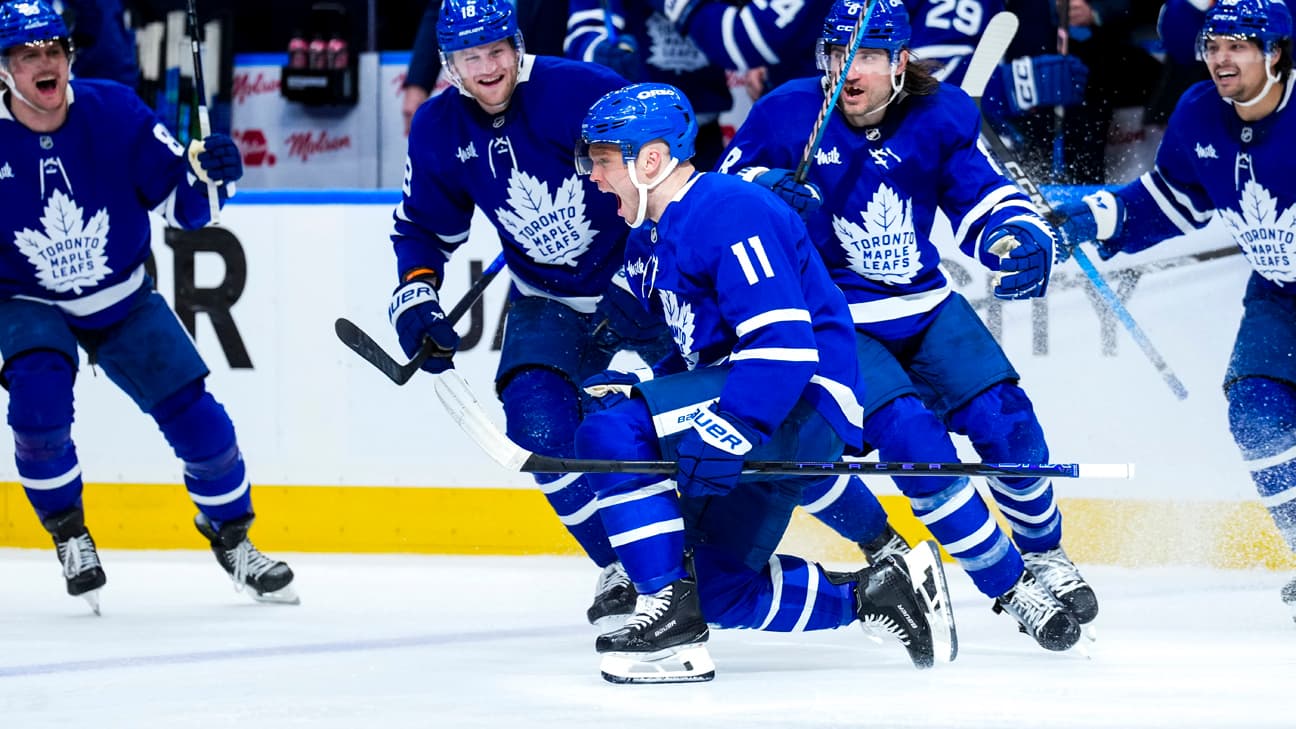
Photo: NHL.com
Should the Maple Leafs Trade for Mason McTavish? The Centre Math Says Maybe
Table of Contents
The Mason McTavish question lands at exactly the wrong time for Toronto's centre depth
A Mason McTavish trade is suddenly worth talking about in Toronto, and the timing is not a coincidence. The Anaheim Ducks are taking calls on their young centre, the Maple Leafs are among the teams that have checked in, and Toronto's depth down the middle just took a hit it did not budget for. Whether the Leafs should actually pay Anaheim's price is a harder question than the fit suggests — but the fit is real.
This is the kind of move new GM John Chayka was hired to weigh: a controllable, cost-certain centre who would slot cleanly into a top six that has a hole in it. The catch is the asking price, and a Toronto draft cupboard that is thinner than the team would like.
Why the Leafs need a centre right now
Start with the injury that reshaped the math. Max Domi underwent offseason surgery to address an issue he played through in 2025-26, and there were complications from the procedure. He is out indefinitely, with the next real update not expected until training camp — we laid out the fallout when the Domi surgery complications blew a hole in the Leafs' centre depth. Losing Domi for an unknown stretch turns a comfortable middle into a question mark.
Layer in the age and durability concerns above him. John Tavares is 35 and cannot be penciled in as a high-event second-line centre forever. Auston Matthews carries an injury history that the team manages season to season. Behind them, prospect Easton Cowan and the incoming first overall pick are part of the long-term plan, not a fix for opening night. That is the context in which adding a 23-year-old centre signed through the end of the decade starts to look less like a luxury and more like insulation.
What McTavish actually is
McTavish is a former third overall pick (2021) who has grown into a legitimate top-six centre in Anaheim. He plays a heavy, competitive game with real offensive upside — the profile of a No. 2 centre a contender builds around, not a depth piece you plug in and forget. He is exactly what Matthews and Nylander reportedly asked the front office to prioritize in spirit: more skill and more bite through the middle.
The contract is the part that makes him appealing rather than risky. McTavish is signed to a six-year, $42 million deal that carries a $7 million cap hit through 2030-31. That is a known, manageable number on a rising cap, and it is not an offer-sheet situation — he is under contract, so any acquisition is a straight trade. Insider Frank Seravalli has poured cold water on the offer-sheet chatter, which tracks: you cannot offer-sheet a signed player.
Crucially, his deal runs on the same clock as the rest of Toronto's core. A centre signed through 2030-31 is not a one-year rental that costs futures and then walks; he is a player you control through the heart of the window. For a team that has repeatedly mortgaged its future for short-term help, acquiring cost certainty rather than renting it would be a philosophical change worth making.
The cap fits — barely, and that helps
Toronto's cap picture is the friendliest it has been in years. The Leafs project to have roughly $22 million in space heading into the summer, and the NHL's upper limit jumps to $104 million for 2026-27 — an $8.5 million increase. A $7 million cap hit is digestible inside that room, and the climbing ceiling makes a long-term deal age better than it would have under a flat cap. We walked through how Chayka can deploy that space in our 2026 free agency breakdown, and a trade for a signed centre is one of the cleaner uses of it. You can cross-check the commitments on our contracts page.
The point is that the money is not the obstacle. Toronto can fit McTavish without contortions. The obstacle is what leaves the building to get him.
The price is the problem
Anaheim GM Pat Verbeek is not shopping McTavish — he is listening, with the Leafs, Blues and Jets reportedly among the interested teams. When a GM takes calls on a young, signed top-six centre, the bar is set high: expect Anaheim to ask for a first-round pick and an NHL-ready roster player who can step in immediately.
That is where Toronto runs into trouble. The Leafs spent heavily in recent seasons chasing the playoffs, and their pick capital is not deep. The one premium asset they hold — the 2026 first overall pick — is not going anywhere; this front office has effectively committed to it. So a McTavish package would have to be built from roster players and whatever mid-round and future capital Toronto can assemble, which may not match what a rebuilding Anaheim wants. The Ducks have no reason to take pennies for a centre on a team-friendly deal.
Toronto's history of overpaying is the cautionary tale
The Leafs already know what it feels like to pay top dollar at the deadline and come up empty. The pursuit of Calgary's Rasmus Andersson this past season ended with the Flames demanding a haul and Toronto walking away rather than gutting the system; Andersson was dealt elsewhere. That restraint, in hindsight, looks wise. The lesson applies here: a young, signed centre is more valuable than a rental defenceman, but the discipline that kept Cowan and Toronto's best futures off the table in the Andersson talks is the same discipline Chayka should bring to an Anaheim negotiation.
There is a version of this trade that is responsible and a version that repeats old mistakes. Paying with roster redundancy and secondary picks is responsible. Stripping the cupboard bare months after winning a lottery that finally restocked it is not.
The alternatives, and where McTavish ranks
McTavish is not the only centre on Toronto's radar. We made the case for a cheaper, more attainable option in the Vincent Trocheck pursuit, and the free-agent market offers stopgaps like Boone Jenner, a useful third-liner who can fill a second-line role in a pinch but is not a long-term answer. The trade route also runs through names like Elias Pettersson if Vancouver ever truly opens that door.
Ranked honestly, McTavish is the highest-upside target and the hardest to land. He is younger than Trocheck, signed longer than any free agent, and a better bet to grow into a true 1B centre. If Chayka believes the timeline lines up with Matthews' prime, McTavish is the swing worth exploring first — provided the price does not cost Toronto a piece of the rebuild it just started.
The verdict
Should the Leafs trade for Mason McTavish? If Anaheim's ask stays at a first-round pick the Leafs do not have to spare plus a quality roster player, the answer is a reluctant no — not because the fit is wrong, but because the cost would gut a rebuild that finally has direction. If the price softens to a package of roster players and secondary capital, it becomes one of the smartest moves Chayka could make, addressing a need that the Domi injury made urgent and the Tavares age curve made structural.
It connects to the broader project we have been tracking all spring: a roster being rebuilt for mobility and youth, the same theme running through the blueline rebuild. McTavish would be the centre-ice version of that bet. Worth the call. Maybe worth the trade. Not worth mortgaging the future the Leafs just won.
Frequently Asked Questions
Are the Maple Leafs interested in Mason McTavish?
Yes. The Anaheim Ducks are taking calls on McTavish, and the Maple Leafs are among the teams that have checked in, along with the St. Louis Blues and Winnipeg Jets. Anaheim is listening rather than actively shopping him.
What is Mason McTavish's contract?
McTavish is signed to a six-year, $42 million deal with a $7 million cap hit that runs through the 2030-31 season. Because he is under contract, any acquisition would be a trade, not an offer sheet.
What would the Maple Leafs have to give up for Mason McTavish?
Anaheim is expected to ask for a first-round pick plus an NHL-ready roster player who can step in immediately. Toronto's pick capital is thin and the team is keeping its 2026 first overall selection, which complicates any package.
Why do the Maple Leafs need a centre in 2026?
Max Domi is out indefinitely after offseason surgery with complications, John Tavares is 35, and Auston Matthews carries an injury history. That combination leaves Toronto's centre depth thin heading into the 2026-27 season.
How much cap space do the Maple Leafs have for 2026-27?
Toronto projects to have roughly $22 million in cap space, and the NHL salary cap rises to $104 million for 2026-27, an $8.5 million increase. A $7 million cap hit for McTavish fits comfortably inside that room.
Is Mason McTavish an offer-sheet candidate?
No. McTavish is already signed through 2030-31, so he cannot be offer-sheeted. Insider Frank Seravalli has dismissed offer-sheet speculation; any move for him would be a straight trade with Anaheim.


