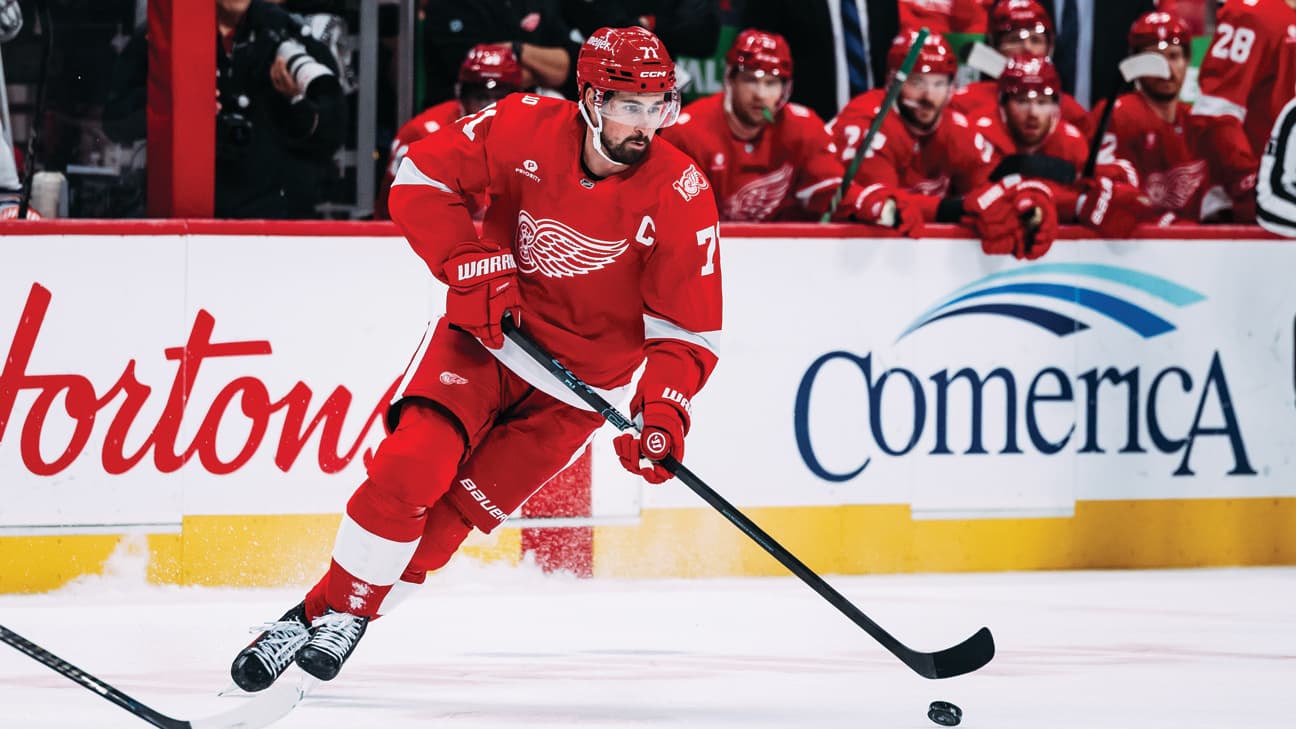
Photo: NHL.com
Dylan Larkin Trade Request Is Stuck, and Detroit's GM Vacancy Helps Toronto
Table of Contents
The Dylan Larkin trade saga has gone quiet, and that is the story
Seven weeks after Detroit's captain reportedly asked out, the Dylan Larkin trade request is exactly where it started: unresolved, unexpanded, and now sitting on the desk of a general manager the Red Wings have not yet hired. Larkin submitted a three-team list — Florida, Minnesota and Vegas — and per Daily Faceoff's reporting he has not widened it. None of those three has put forward an offer Detroit found compelling. And on July 15, the executive he was reportedly asking to trade him stepped aside.
For the Toronto Maple Leafs, who share a division with Detroit and are trying to climb back into a playoff race they fell out of last spring, this is not a neutral development. An Atlantic rival with an unhappy franchise centre and no permanent general manager is a team that is very unlikely to get better between now and October. That matters to Toronto's math.
What Larkin actually asked for
The request came in early June, reported around June 4, after Detroit missed the playoffs for a 10th consecutive season. The reasons that surfaced publicly were the losing and what multiple outlets described as a strained working relationship with then-general manager Steve Yzerman. Larkin's camp has said nothing since, and Larkin himself has not spoken publicly about it.
The contract is the constraint. Larkin has five seasons remaining at an $8.7-million average annual value on the eight-year, $69.6-million extension he signed in 2023, and it includes a full no-trade clause. That clause is why the list exists and why the list matters — Detroit cannot simply take the best offer. It can only take the best offer from Florida, Minnesota or Vegas.
Three bidders is not a market. It is a negotiation with three participants who all know the seller has nowhere else to go, which is precisely why nothing has happened. Yzerman said publicly in late June that he could make no guarantees about meeting the request, and reporting since has indicated Detroit wants roster players who can replace Larkin now, not futures.
The Yzerman exit changed the timeline
On July 15, the Red Wings announced Yzerman was stepping down as executive vice-president and general manager, moving to a senior adviser role with governor and CEO Chris Ilitch. "Clearly, we are not where we and our fans expect to be as an organization," Ilitch said in announcing the change.
Detroit is now running a search for a new head of hockey operations, with internal candidates reported to include Hall of Fame defenceman Nicklas Lidstrom, currently vice-president of hockey operations, assistant general manager Shawn Horcoff, and assistant GM and director of amateur scouting Kris Draper. Outside candidates are in the mix. Yzerman has stayed on to handle day-to-day operations during the transition.
Whatever else that does, it slows everything down. No incoming executive trades a franchise centre in his first month on a three-team list for a return the previous regime already rejected. The most likely outcome, and the one Chris Johnston has floated, is that Larkin reports to Detroit's training camp on Sept. 18 as the captain of the Red Wings.
Why Toronto is not in this
Let us dispense with the fantasy quickly. Toronto is not on Larkin's list, has never been reported to be on it, and could not fit an $8.7-million centre without gutting the roster around him. The Leafs project roughly $2.75 million over the $104-million ceiling before adding anything.
Nor is the fit as clean as it looks on a depth chart. Toronto's second-line centre question was answered internally this summer, with John Tavares sliding into the role at a $4.38-million cap hit — a piece of value we broke down in our look at Tavares as Toronto's second-line bargain. Chayka also explored the external market extensively before it thinned out, as we covered when the second-line centre market collapsed. Larkin was never part of either conversation, and the list is the reason.
What it does to the Atlantic
This is where it gets interesting for Leafs fans. The Atlantic Division reshaped itself aggressively this summer — Florida and Tampa both added, Ottawa moved toward a longer runway, and Toronto retooled around a new front office. We mapped the whole thing in our piece on the reloaded Atlantic.
Detroit was always the division's wild card, and the Larkin situation is why. There were two versions of the Red Wings' 2026-27: one where they trade the captain, bank real assets and begin a proper reset, and one where they keep him, sign veterans like Viktor Arvidsson around him and try to finally break the streak. The front-office vacancy has quietly produced a third version — neither reset nor push, just a holding pattern with an unhappy star.
That third version is the best one for Toronto. A Red Wings team that neither commits to winning nor cashes in its best player is a team unlikely to leap into the playoff picture. In a division where the Leafs are fighting for one of the final spots — you can follow the shape of it on our standings page — one fewer serious competitor is worth real points.
The scenario Toronto should worry about
There is a version of this that hurts. If a new Detroit general manager decides the relationship is unsalvageable and moves Larkin for immediate help, the Red Wings could come back better in the short term, and the teams on Larkin's list — Florida in particular — get stronger. Adding a two-way top-six centre to the Panthers would be a genuinely bad outcome for everyone in the Eastern Conference, Toronto included.
The other worry is more subtle. Larkin at $8.7 million over five more years is, by the standards of a $104-million cap climbing to $113.5 million in 2027-28, a bargain contract for a legitimate first-line centre. If Detroit gets full value in a trade, the Red Wings could accelerate rather than rebuild. Yzerman's stated preference for "value-now players" suggests that was always the plan.
How to read the signals from here
Two things are worth watching. The first is the hire: an internal promotion of Lidstrom, Horcoff or Draper suggests organizational continuity and a slower resolution, while an outside hire with a rebuilding background makes a Larkin trade more likely by December. The second is whether the list moves. A player who expands from three teams to eight has decided he genuinely wants out; a player who does not is leaving the door open to staying.
Right now the signals point toward staying. Larkin posted video of himself training in Red Wings gear roughly a week after Yzerman's departure, which is not a contract clause but is not nothing either. Detroit's camp opens Sept. 18. If nothing has happened by then, the question moves to the trade deadline, where the new playoff salary cap will make an $8.7-million addition harder to absorb than it used to be.
What's next
For Detroit, the sequence is hire a general manager, then decide on the captain. For Toronto, there is nothing to do but watch, because the Leafs are neither a suitor nor a factor. The Maple Leafs' own priorities this summer remain the blue line and the crease, not another centre — a case we laid out in where Toronto actually stands in the Atlantic.
Still, in a division likely to be decided by three or four points, the health of a rival's front office is a real variable. Detroit spent the summer stuck. Toronto spent it rebuilding a roster. That difference will not decide the season, but it will show up in the standings somewhere around March.
Frequently Asked Questions
Has Dylan Larkin been traded by the Red Wings?
No. As of July 26, 2026, Larkin remains a Detroit Red Wing. He reportedly requested a trade in early June after Detroit missed the playoffs for a 10th straight season, but no deal has been completed and reporting indicates none is close.
What teams are on Dylan Larkin's trade list?
Larkin submitted a three-team list of the Florida Panthers, Minnesota Wild and Vegas Golden Knights, reported in early June. Daily Faceoff has reported he has not expanded that list, though some outlets have suggested he might also consider Dallas.
What is Dylan Larkin's contract?
Larkin has five seasons remaining at an $8.7-million average annual value on the eight-year, $69.6-million extension he signed in 2023. The deal carries a full no-trade clause, which is why Detroit can only trade him to teams he approves.
Why did Steve Yzerman step down as Red Wings GM?
Detroit announced on July 15, 2026 that Yzerman was stepping down as executive vice-president and general manager and moving to a senior adviser role. Governor and CEO Chris Ilitch said the organization was not where it and its fans expected it to be after 10 straight seasons without a playoff berth.
Who will be the Red Wings' next general manager?
Detroit has not named a replacement. Reported internal candidates include vice-president of hockey operations Nicklas Lidstrom, assistant general manager Shawn Horcoff, and assistant GM and director of amateur scouting Kris Draper, with external candidates also under consideration.
Could the Maple Leafs trade for Dylan Larkin?
No. Toronto is not on Larkin's approved trade list and has never been reported as a suitor. The Leafs also project roughly $2.75 million over the $104-million salary cap before adding any salary, and filled their second-line centre role internally with John Tavares at $4.38 million.
When does Red Wings training camp start in 2026?
Detroit's training camp begins Sept. 18, 2026. Multiple insiders, including Chris Johnston, have suggested it would not be a surprise if Larkin reports to camp as the Red Wings' captain with the trade request still unresolved.


