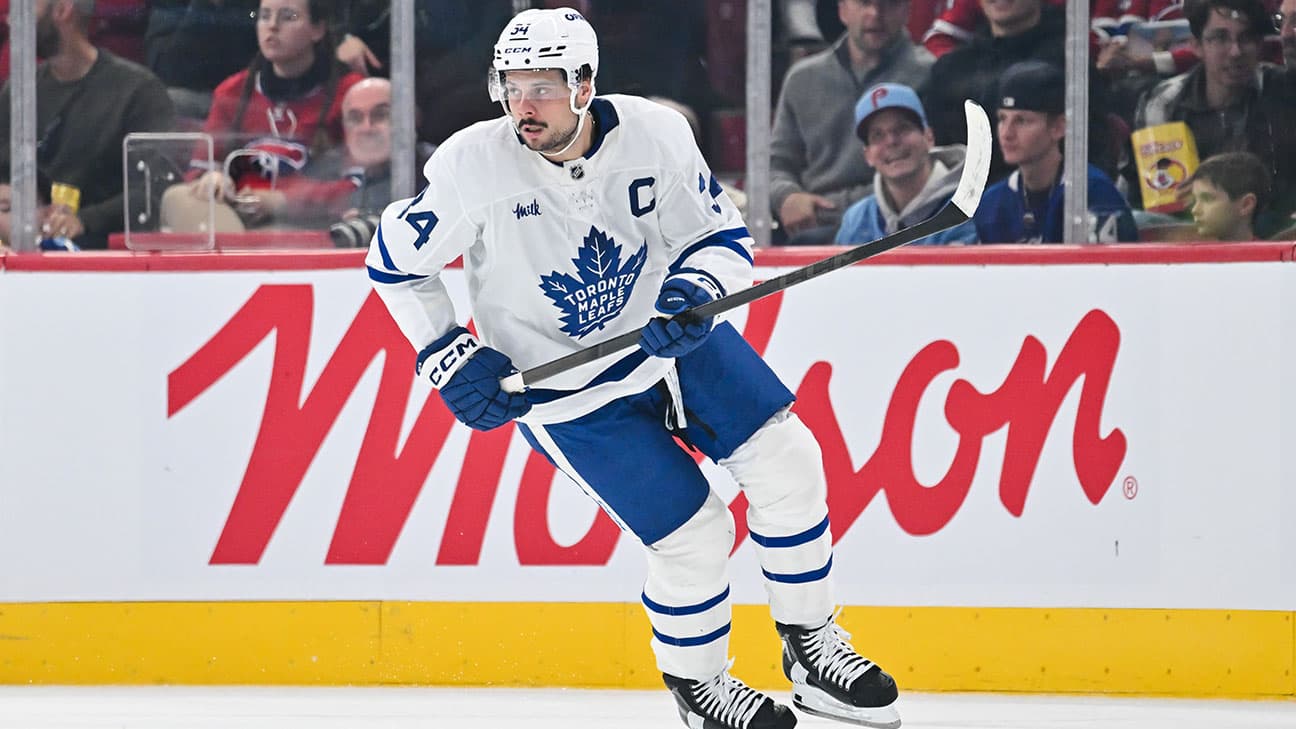
Photo: NHL.com
Matthew Knies 30 Goals: The Question the Maple Leafs Need Answered
Table of Contents
Matthew Knies has never scored 30 goals, and the Maple Leafs need him to start
The Matthew Knies 30 goals question is the quietest important storyline of Toronto's summer. He is 23, he is signed at $7.75 million through 2030-31, he has produced back-to-back seasons of real top-six value, and he has never crossed 30. In a lineup that just added the No. 1 overall pick and is banking on a captain returning from knee surgery, Knies is the one forward whose next step is both plausible and load-bearing.
This is not a knock. Knies has been better than his draft slot and better than his contract, which is why we have argued his deal is already the best asset on Toronto's books. But an $7.75-million winger on a team with a two-year competitive window is being paid to be a 30-goal player, and the gap between where he is and where that number sits is smaller than the discourse suggests.
What actually happened in 2025-26
The season looks odd until you break it apart. Knies finished with 23 goals and 66 points in 79 games — a career high in points, and a six-goal drop from the year before. In 2024-25 he had put up 29 goals and 58 points in 78 games. So he scored less and produced more, on a worse team, in a season that ended without a playoff game.
He also registered 152 hits and 16 power-play points, which is the shape of the player Toronto thought it was signing: a forward who scores on the interior, wins pucks on the wall, and contributes on the man advantage without being the unit's engine. That profile does not usually swing wildly year to year, and it did not.
What changed was the finishing. Twenty-nine goals to 23 in a nearly identical number of games, with assists climbing from 29 to 43, is the signature of a player whose role shifted toward playmaking and whose shooting luck cooled at the same time. Neither of those is a skill decline.
The Auston Matthews problem sitting underneath the numbers
Knies' scoring has always been partly a function of who is on his line. And in 2025-26, the centre he built his NHL career alongside was hurt.
Matthews suffered a Grade 3 MCL tear and a quadriceps contusion in his left leg on March 12 against Anaheim after a knee-on-knee collision with Radko Gudas, underwent surgery with a roughly 12-week recovery timeline, and missed the balance of the year. Toronto's season was already sliding by then, but the specific consequence for Knies was losing the highest-percentage shooting environment available to him at exactly the point in the schedule where goal totals get padded.
There is a second wrinkle. Reporting through the summer has suggested Matthews and Knies did not consistently find the chemistry they had earlier in their partnership, which is part of why several projections now break them up. Toronto's information on Matthews' readiness has been characteristically thin — the most specific update of the offseason came from his chiropractor rather than the team — and Knies' ceiling this season is partly hostage to that.
What Gavin McKenna changes
The arrival of Gavin McKenna is usually framed as a threat to Knies' role. It is closer to the opposite.
McKenna is a distributor. Knies is a finisher who works the interior. The most-discussed projection has McKenna and Knies flanking Matthews on an all-left-shot top line — an unusual configuration Jim Hiller will almost certainly test in camp, and one we have argued makes sense on day one. Handedness on a line matters less than most people insist; what matters is whether somebody is willing to carry the puck into the offensive zone and give it up.
If McKenna is even 80 per cent of the player his draft billing suggests, Knies gets more clean-entry possessions and more pucks arriving in the slot rather than behind him. That is the exact input that converts a 23-goal season into a 30-goal one.
The power play matters just as much. Toronto's man advantage is being rebuilt around Darren Raddysh's shot volume from the point, and a net-front forward who can tip, screen and clean up rebounds is the primary beneficiary of a defenceman who shoots first. Sixteen power-play points is a floor for a player in that role, not a ceiling.
Where the extra seven goals actually come from
Thirty is not a leap. It is seven goals across 84 games — one additional finish every 12 games. Three plausible sources:
- Two more power-play goals. A top-10 unit with a genuine point shooter should generate that from the net front alone.
- Three more five-on-five goals from better entries. If McKenna does what he is supposed to do, Knies spends more of his shift inside the dots.
- Two goals of normal shooting variance. A player who scored 29 and then 23 in consecutive full seasons is not a 23-goal talent.
Add the two extra games from the league's move to an 84-game schedule and the arithmetic gets easier still. The fantasy projections floating around this summer have him in the high-70s in points; 29 goals and 48 assists is one commonly cited line. That would be a career year, and it would not be a shock.
The honest counter-case
The bear argument is straightforward: Knies has now had two full seasons in a premium role and has topped out at 29 goals. Players who score on the interior take a physical toll — 152 hits is not a passive number — and power forwards who lean on net-front offence historically peak earlier and decline harder than perimeter shooters. He is also entering a season where his usage genuinely might drop if McKenna forces his way onto the top line and pushes Knies to the second unit with John Tavares.
There is a deployment risk too. Toronto's forward group is deeper than it has been in years after a summer that brought in Jack Roslovic, Nick Paul, Colton Sissons and others. Depth is good for the team and mildly bad for any individual's counting stats. If Hiller spreads scoring across three lines, nobody gets 22 minutes a night.
And Matthews is a real variable. If the captain is not himself in October, the whole top-six projection moves.
Why Matthew Knies 30 goals matters more than any other number on this roster
Toronto's 2026-27 season rests on a specific bet: that the core scores enough to cover a defence corps the front office has publicly acknowledged is unfinished, and that a rookie and a 37-year-old goaltender hold up. We have run the same exercise on Auston Matthews reaching 40 and William Nylander reaching 50. Both of those require the star to be the star.
Knies is different. His 30 does not require anyone to be exceptional. It requires the system to work as designed — clean entries, a functioning power play, a healthy centre — and it is therefore the single best proxy for whether Chayka's roster is actually built correctly. If Knies scores 30, the Maple Leafs are probably a playoff team. If he scores 20, something upstream broke.
What's next
Camp opens in September, and the first thing worth watching is line construction: whether Hiller starts Knies with Matthews and McKenna, or splits him off with Tavares to balance the top six. The second is power-play alignment — specifically whether Knies is the net-front option on PP1 ahead of Tavares.
Toronto opens at home against Montreal on September 29. Knies turns 24 in October. Twenty-three-year-old power forwards signed for six more years at a number the cap will outrun are supposed to take a step in exactly this window. Whether he does is the difference between a good contract and a great one, and between a bubble team and a real one. Track the standings as it unfolds on our standings page.
Frequently Asked Questions
How many goals did Matthew Knies score in 2025-26?
Knies scored 23 goals and added 43 assists for a career-high 66 points in 79 games. He also recorded 152 hits and 16 power-play points. The year before, in 2024-25, he had 29 goals and 29 assists for 58 points in 78 games.
What is Matthew Knies' contract with the Maple Leafs?
Knies signed a six-year extension worth $46.5 million in July 2025, carrying a $7.75 million average annual value through the 2030-31 season. As the salary cap rises, that percentage of the cap gets smaller every year, which is why the deal is widely viewed as team-friendly.
Will Matthew Knies play on Auston Matthews' line in 2026-27?
It is the most common projection, often with Gavin McKenna on the other wing in an all-left-shot configuration. Jim Hiller is expected to test it in camp, though reports through the summer suggested Matthews and Knies had not consistently found chemistry, which is why some projections move Knies to a line with John Tavares.
How old is Matthew Knies?
Knies is 23 and turns 24 in October 2026. He is entering his fourth full NHL season, which places him at the front end of the typical scoring peak for a power forward.
Can Matthew Knies score 30 goals?
The math is modest. Thirty goals is seven more than last season across 84 games, or one extra finish every 12 games. Two more power-play goals, three more at five-on-five from better zone entries and two goals of normal shooting variance would get him there.
How does Gavin McKenna affect Matthew Knies?
McKenna profiles as a distributor rather than a shooter, which complements Knies' interior finishing. If McKenna delivers cleaner zone entries and more slot passes, Knies is the most direct beneficiary. The competing risk is that McKenna pushes Knies off the top line and reduces his ice time.
Why did Matthew Knies' goal total drop in 2025-26?
His assists rose from 29 to 43 while his goals fell from 29 to 23, which points to a role shift toward playmaking plus cooler finishing. Auston Matthews also missed the end of the season after a Grade 3 MCL tear on March 12, removing Knies' most productive linemate down the stretch.


