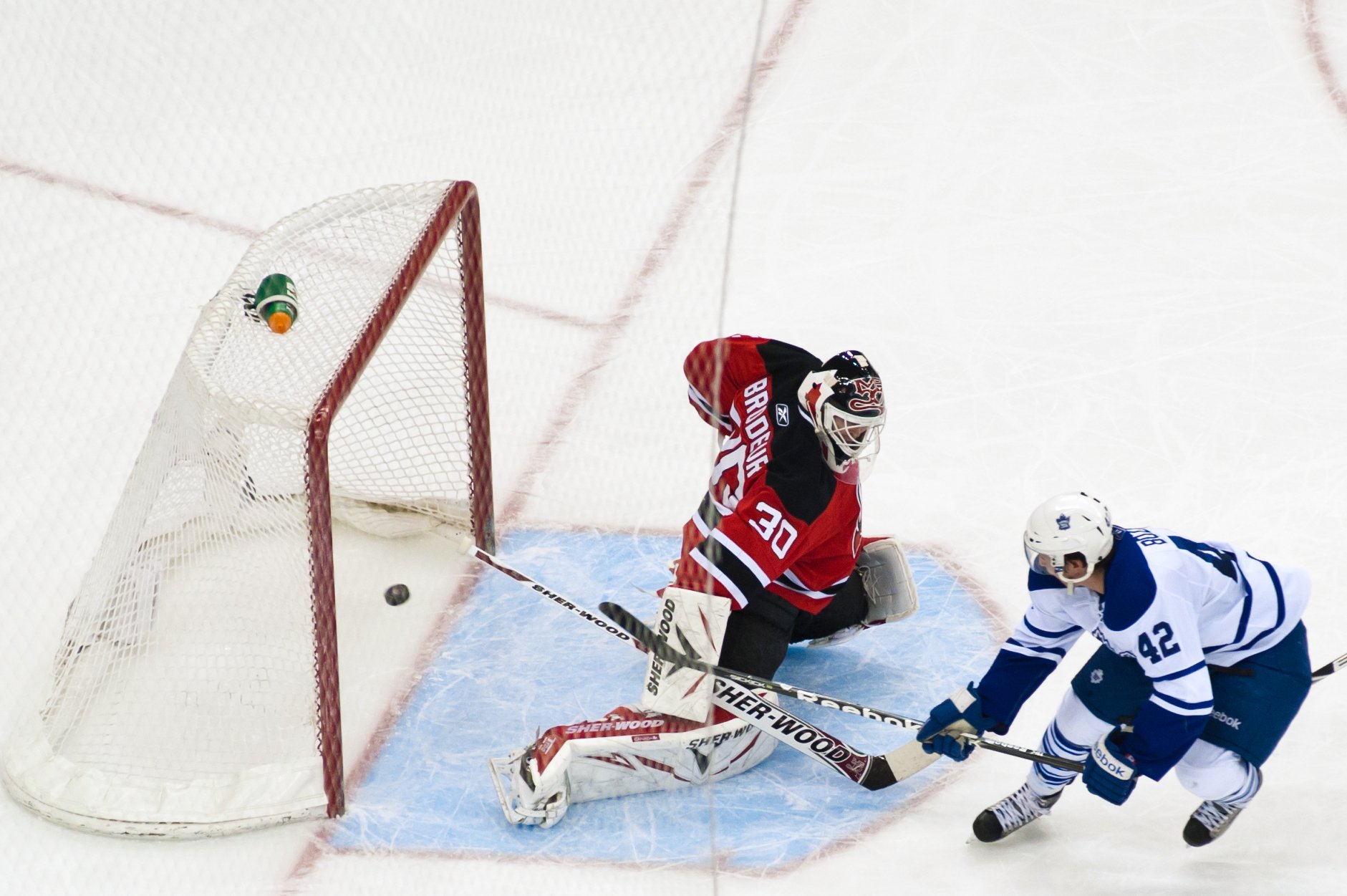
Photo: Toronto Public Library Special Collections, Flickr (BY-SA-2.0)
Easton Cowan Was Jim Hiller's Day One Standout. The Line Says More
Table of Contents
Hiller picked Easton Cowan out of a crowded first practice
Asked who stood out at his first practice as head coach of the Maple Leafs, Jim Hiller did not name the 18-year-old first overall pick who had just thrown a backhand saucer pass through traffic. He named Easton Cowan. "For me, it was Easton Cowan," Hiller told reporters, describing a player who was everywhere with the puck and adding that while Cowan has tremendous skill, where he helps the team most is as a puck hound who then uses that skill.
That is a specific compliment, and it is paired with a specific instruction. Hiller did not call Cowan the most skilled player on the ice. He said the skill is real and that the pursuit is what will get him minutes. Coaches do not phrase praise that carefully by accident.
Cowan skated on the third line with Nick Paul and Colton Sissons, which is the other half of the story and the more important half.
The Cowan-Paul-Sissons line is a job description
Hiller described the Cowan-Paul-Sissons trio as a line that should be able to play against other teams' best players while also pushing offensively. Read that twice. It is not a checking line and it is not a scoring line. It is a matchup line that is expected to produce, which in modern NHL usage is the hardest forward assignment on a roster that is not the first line.
Paul arrived from Tampa Bay in July — Toronto sent goaltender Dennis Hildeby, a 2027 fourth-round pick and a 2028 third-round pick, and absorbed the remaining three years of a contract carrying a $3.15 million cap hit. He is a 6-foot-3 centre who has spent his career doing exactly this job. Sissons signed this summer as a right-shot centre with a long track record in defensive assignments. Both are here to make that line function without needing a 21-year-old to carry it.
Which frees Cowan to do the thing Hiller just described. Hunt pucks, win them back, and then make the play. On a line with two veterans who will handle the structural responsibilities, the skill becomes the differentiator rather than the liability.
What Cowan actually did last season
Cowan's rookie year was neither a breakout nor a disappointment. He produced 29 points in 66 games, including 11 goals, in a season where almost nothing went right for the Maple Leafs as a group. Then he went to the Marlies and put up 18 points during a Calder Cup run, which is the sort of postseason performance that tells you more about a young player than a middling regular-season point total does.
We argued earlier this month that Cowan is the cheapest available fix for a real problem — a team that needs secondary scoring and has almost no cap room to buy it. Nothing about the first practice contradicts that. What the first practice adds is a clearer picture of where the club intends to extract that value from, and it is not the top six.
That is a slight cooling of the more optimistic projections. There was a version of this camp where Cowan opened on Auston Matthews' right wing. Jack Roslovic got that look instead. But third-line minutes on a line Hiller expects to matchup and score is not a demotion. In a lot of ways it is a more honest opportunity.
The contract context nobody is discussing yet
Cowan is heading toward a contract negotiation that Toronto would very much like to conduct from a position of strength. We have written about the comparables, and the range shifts meaningfully depending on whether he produces 30 points or 50 this season. Our contracts page tracks where every Toronto deal sits.
The Maple Leafs have very little cap flexibility. John Chayka spent the summer rebuilding the roster around a core that is already expensive, and the club is pressed against structural limits beyond just the cap. A Cowan breakout is good for the team on the ice and complicated for the team's balance sheet, which is the pleasant kind of problem but a problem nonetheless.
None of that should affect how he is deployed. It does mean this season has unusual stakes for a 21-year-old who has already proven he can play in the league.
The competition Cowan just beat, and the competition still ahead
Toronto brought 41 forwards to camp. Most of them are not competing for anything close to a third-line job, but several are, and the day one sheet quietly sorted them. Dakota Joshua skated as an extra while Steven Lorentz drew into the fourth line with Brandon Duhaime and Teddy Blueger. Nobody from the Marlies group forced his way onto a line with NHL veterans.
Cowan starting above all of them is not a surprise given his rookie season, but it does mean he opens camp with the thing young players most need and least often get: a defined role with defined linemates from the first whistle. He is not auditioning for a spot. He is auditioning for how many minutes that spot carries.
The threat to those minutes is not from below. It is from above. If Gavin McKenna struggles alongside Tavares and Nylander, or if Jack Roslovic does not click with Matthews, Hiller has options — and one of them is moving Cowan up and asking a fourth-liner or a Marlies call-up to fill in behind him. That is the good version of the risk. The bad version is a Cowan slump that lets Paul and Sissons keep the matchup assignment with someone else on the wing.
Why "puck hound" is the right coaching note
Cowan's junior reputation was built on relentlessness as much as skill. He was the player who would not stop coming, and that trait translated better to the NHL than his hands did in year one — which is a normal progression, not a warning sign. Young skill players almost always find their forechecking and retrieval game before they find their finishing touch at this level.
Hiller framing it this way tells Cowan exactly how to keep his minutes on nights when the puck does not go in. That is the difference between a young forward who survives a slump in the lineup and one who watches it from the press box. The 299 goals against Toronto surrendered last season is the context for every deployment decision Hiller makes this year, and a third line that hunts pucks is a direct response to it.
What to watch in preseason
Three things. Whether Hiller keeps Cowan on Paul's wing or rotates him up when the scoring lines need a jolt. Whether the Cowan-Paul-Sissons unit draws genuine matchup assignments in the preseason games or gets sheltered. And whether Cowan gets second power play unit time, which is where a third-line forward turns 30 points into 45.
The first live test comes Saturday against Montreal in split-squad action. With only four exhibition games under the new CBA, the sample will be tiny and the decisions will be made fast.
What's next
Easton Cowan enters the 2026-27 season with a clear role, a clear coaching instruction, and a contract year looming behind it. Toronto opens the regular season against Montreal on September 29 at Scotiabank Arena, the first night of an 84-game schedule. Watch the third line early — if Hiller's matchup plan works, it is the piece of this roster that changes Toronto's defensive profile most, and Cowan is the reason it might also score.
Frequently Asked Questions
What did Jim Hiller say about Easton Cowan?
After his first practice as Maple Leafs head coach on September 17, 2026, Hiller named Cowan the standout of the session. He said Cowan made plays with the puck and was everywhere, and that while Cowan has tremendous skill, he helps most as a puck hound who then uses that skill.
What line is Easton Cowan on for the Maple Leafs?
Cowan opened 2026 training camp on the third line with Nick Paul and Colton Sissons. Hiller described the trio as a line that should be able to play against other teams' best players while also pushing offensively.
How many points did Easton Cowan score as a rookie?
Cowan produced 29 points in 66 games as an NHL rookie in 2025-26, including 11 goals. He then added 18 points for the Toronto Marlies during their Calder Cup run.
How did the Maple Leafs acquire Nick Paul?
Toronto acquired Paul from the Tampa Bay Lightning in July 2026 in exchange for goaltender Dennis Hildeby, a 2027 fourth-round pick and a 2028 third-round pick. Paul has three years left on his contract at a $3.15 million cap hit, running through 2029.
Is Easton Cowan going to play in the Maple Leafs top six?
Not to open camp. Jack Roslovic drew the assignment on Auston Matthews' right wing and Gavin McKenna opened with John Tavares and William Nylander, leaving Cowan on the third line. That could change during the four-game preseason.
When does Easton Cowan's contract expire?
Cowan is on his entry-level deal and heads toward a new contract negotiation with restricted free agent status ahead. His 2026-27 production will largely set the range, and Toronto has very little cap flexibility to work with.
Who is the Maple Leafs head coach in 2026-27?
Jim Hiller, hired on June 17, 2026 as the 41st head coach in franchise history. He replaced Craig Berube, who was fired in May 2026, and previously coached the Los Angeles Kings to a 93-58-24 record over parts of three seasons.