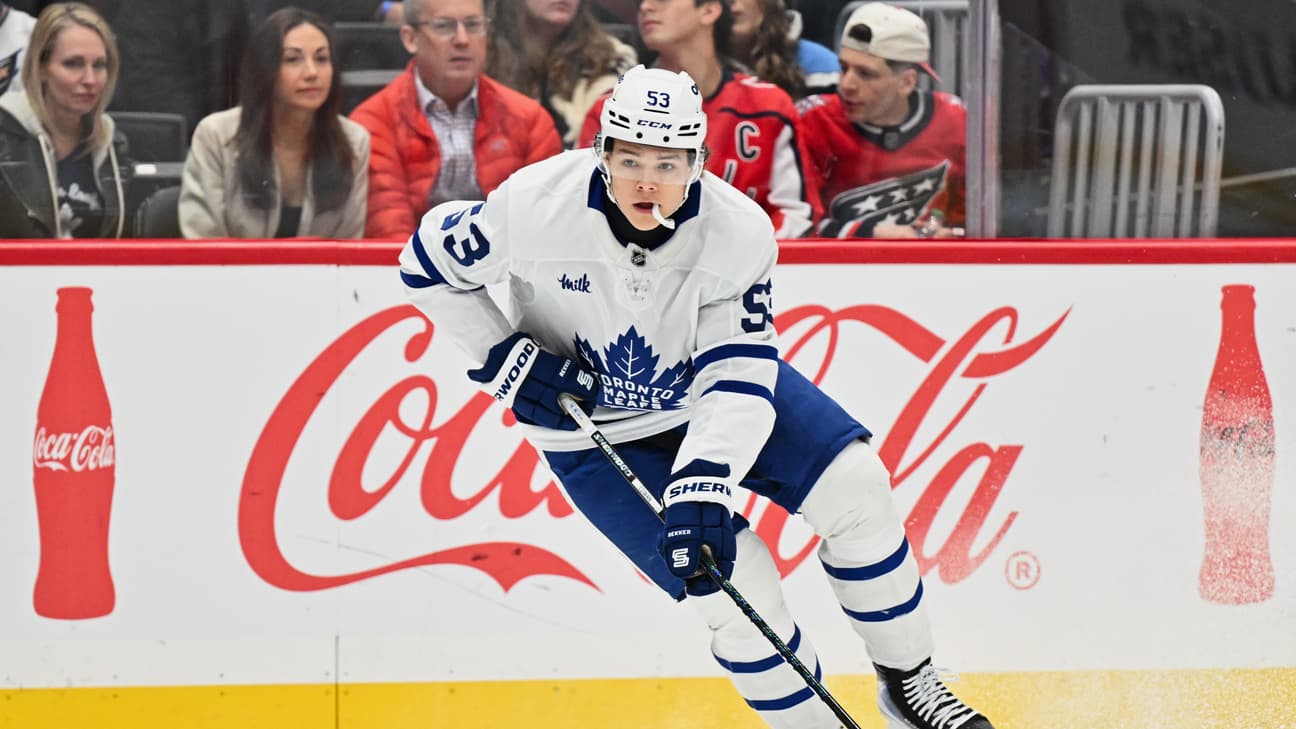
Photo: NHL.com
Easton Cowan's Next Contract Just Got a Much Scarier Comparable
Table of Contents
The Easton Cowan next contract problem starts with a number Toronto did not choose
The Easton Cowan next contract conversation was supposed to be a 2028 problem. Boston moved it up. When the Bruins signed Fraser Minten to a seven-year, $50.4-million extension on Sept. 8 — a $7.2-million cap hit for a 21-year-old coming off a 35-point rookie year — they created the exact comparable that every agent representing a young Maple Leafs forward will now put on the table. Cowan's camp will not have to argue for it. It is already on the board, signed, filed and public.
Toronto should not pay Minten money for Cowan. It also should stop pretending the ceiling on this negotiation is where it was two weeks ago.
Where Cowan actually stands
Cowan is on a three-year entry-level deal at an $891,167 cap hit that runs through 2027-28. He becomes a restricted free agent after that, which means the real negotiation happens in the summer of 2028 — unless Toronto decides to move early, and there are now reasons it might.
His rookie season was solid rather than spectacular. He played 66 games, scored 11 goals and added 18 assists for 29 points, averaging roughly 14 minutes a night. He was not force-fed power-play time. He was not sheltered into an inflated point total. He was a 20-year-old winger holding his own in a bottom-six role on a team that fell apart around him, and then he went to the Marlies and helped them win a Calder Cup.
Minten, for comparison, played all 82 games and put up 17 goals and 35 points. That is six more points across 16 more games. Per game, the two rookie seasons are closer than the contract gap suggests — and Cowan did his in a worse situation, one year younger.
The part that should worry Toronto
Minten plays centre. Cowan plays wing. That single positional distinction is worth real money in every RFA negotiation in the league, and it is the strongest argument Toronto will have for paying less.
It is not a strong enough argument on its own. If Cowan takes the step that his second NHL season is set up to produce — top-six minutes, power-play work, a run alongside Auston Matthews or Gavin McKenna — he will finish 2026-27 with a case that a bridge deal insults. Fifty points on a winger's usage at 21 is a $6-million conversation, and Toronto knows it.
Why the Sept. 16 CBA change makes this harder, not easier
The new collective bargaining agreement takes effect on Sept. 16, and three provisions land directly on this negotiation.
- Maximum term with a player's own club drops from eight years to seven. With another club, it drops from seven to six.
- The difference between adjacent years in a contract is capped at 20 per cent of the first year's value.
- The lowest year in a deal cannot fall below 71 per cent of the highest year.
The term reduction is the one that costs Toronto. Buying eight years of a young player has always been the mechanism for getting a discount on the unrestricted years — more term, lower average. Seven years buys less, so the annual number goes up, not down. The structure rules close the other escape hatch: front-loading a deal into signing bonuses and letting the cap hit sit below the real cost is now much harder to engineer. We covered the mechanics in detail when the new contract-structure rules were confirmed.
Minten's deal beat that deadline by eight days. Cowan's will not.
The cap picture Cowan is walking into
Toronto is not signing anyone this week. The Maple Leafs open camp above the $104-million upper limit and expect to reach compliance through long-term injured reserve. The relevant year is 2028-29, and by then the club's obligations get genuinely uncomfortable.
Matthews is signed at $13.25 million through 2027-28 and becomes eligible for an extension on July 1, 2027, at a moment when the top of the market has been reset above $20 million. Nylander, Rielly, Knies, Raddysh and Bobrovsky are all on long-term money. The rising cap helps — the upper limit is projected at $113.5 million for 2027-28 — but it does not help enough to absorb a franchise-centre extension and a $6-million-plus raise for a winger in consecutive summers.
That is the actual squeeze. Not whether Cowan is worth the money. Whether Toronto can pay him the money it will owe him at the same time it pays Matthews what the market says he is worth. Our contracts tracker lays out how little room the roster leaves.
What LeafsLurker would do
Do not sign Easton Cowan to an extension before he plays a game this season. That is the discipline test.
The temptation after a deal like Minten's is to move early and lock in a price before it climbs. That works when you are certain. Toronto is not certain — one 29-point season in a bottom-six role does not establish what a player becomes, and Cowan has never played a full year of NHL top-six minutes. Buying now means buying the ceiling on faith.
Instead, judge the season honestly and split the outcomes.
If Cowan is a 45-to-55-point winger who drives play in a real role, pay him long. Seven years at somewhere between $6 million and $7 million is a defensible price for a 22-year-old who has already shown he can produce, and it is the last version of that contract Toronto will be able to write before the cap catches up to the rest of the roster.
If he is a 30-to-38-point complementary piece, take the bridge. Two or three years at $3 million to $4 million keeps the option open, keeps the cap sheet clean into the Matthews negotiation, and puts the burden of proof back on the player. Bridges are unfashionable. They are also how teams avoid paying $7 million for a season that never arrives.
What Toronto cannot do is what it did with the Carlo trade — decide the price in advance based on what a rival paid for someone else. Boston valued Minten and paid for Minten. That is Boston's read on a centre it developed. It is information, not an invoice.
What Cowan has to show to earn the long deal
Three things, and none of them is a point total on its own.
Five-on-five production without a passenger seat. Cowan posted 1.54 points per 60 minutes at five-on-five as a rookie, seventh among Toronto forwards who played regularly. That is a respectable number for a 20-year-old in limited minutes, and it is the number that has to climb rather than the raw total. Points that arrive because a player is stapled to Matthews prove nothing about what he is worth. Points that arrive on a line that outshoots the opposition do.
Volume. He averaged 6.37 shots per 60 at five-on-five, fourth among Leafs forwards. Shot generation at that rate from a player in a bottom-six role suggests the finishing will follow with better linemates and more power-play exposure. If the volume holds while the ice time doubles, the goals come.
Availability. Cowan played 66 NHL games and then a full Calder Cup run. The 84-game schedule is new this season, and the players who handle the added workload at 21 are the ones clubs feel comfortable signing to seven years. This sounds like a soft factor. It is not — durability is priced into every long-term contract in the league.
The comparables that should actually matter
Minten is the loud comparable. He should not be the operative one, because Toronto is not negotiating with Boston.
The useful reference points are wingers who signed their second contracts coming off partial breakouts at 21 or 22, in a rising cap environment, with fewer than 150 NHL games played. That group signs bridges more often than it signs eight-year deals, and the teams that jumped early on the long term have a mixed record. For every club that locked in a bargain, there is one carrying a $6-million cap hit on a 40-point winger it cannot move.
Toronto has lived the second version. The Maple Leafs have spent the past three seasons trying to unwind commitments made on projection rather than production, which is a large part of why they entered this summer with no flexibility and no first-round picks. That institutional memory should count for something.
What's next
Camp opens Sept. 17 and Jim Hiller has 13 days and four exhibition games to sort a top six that includes McKenna, Matthews, Nylander, Tavares, Knies and Cowan. Where Cowan lines up on opening night against Montreal on Sept. 29 will tell you more about his next contract than any comparable will.
Watch the deployment, not the points. If Hiller puts him on a scoring line and the power play in October and leaves him there, Toronto is going to be writing a large cheque. If he opens on the third line, the bridge stays live. Track how it shakes out on our players page as the season goes.
Frequently Asked Questions
When can Easton Cowan sign a contract extension with the Maple Leafs?
Cowan is on a three-year entry-level contract at an $891,167 cap hit that runs through the 2027-28 season. He becomes a restricted free agent after it expires, making the summer of 2028 the natural negotiating window.
How much will Easton Cowan's next contract cost?
It depends entirely on his 2026-27 season. A 45-to-55-point year in top-six minutes puts him in the $6-million to $7-million range on long term. A 30-to-38-point complementary season points to a bridge deal closer to $3 million to $4 million.
What did Easton Cowan do in his rookie NHL season?
Cowan played 66 games in 2025-26 and recorded 11 goals and 18 assists for 29 points, averaging roughly 14 minutes of ice time a night. He then joined the Toronto Marlies for their Calder Cup championship run.
How does Fraser Minten's contract affect Easton Cowan?
Minten signed for seven years and $50.4 million at age 21 after a 35-point rookie season. That establishes a public comparable for young forwards coming off entry-level deals, which raises the floor in any Cowan negotiation even though Minten plays centre and Cowan plays wing.
How does the new NHL CBA change contract extensions?
From Sept. 16, 2026, the maximum term with a player's current club drops from eight years to seven, and from seven to six with another club. Year-over-year salary variance is capped at 20 per cent of the first year, and no year can fall below 71 per cent of the highest year.
Can the Maple Leafs afford to extend both Auston Matthews and Easton Cowan?
It will be tight. Matthews is signed at $13.25 million through 2027-28 and becomes extension-eligible on July 1, 2027, with the top of the market now above $20 million. The projected $113.5-million upper limit for 2027-28 helps, but Toronto's long-term commitments leave limited room for both raises.
Should the Maple Leafs give Easton Cowan a bridge deal or a long-term contract?
The case for waiting is strong. One 29-point season in a bottom-six role does not establish a player's ceiling, and signing long term before he plays a full season in a scoring role means paying for projection rather than production.


