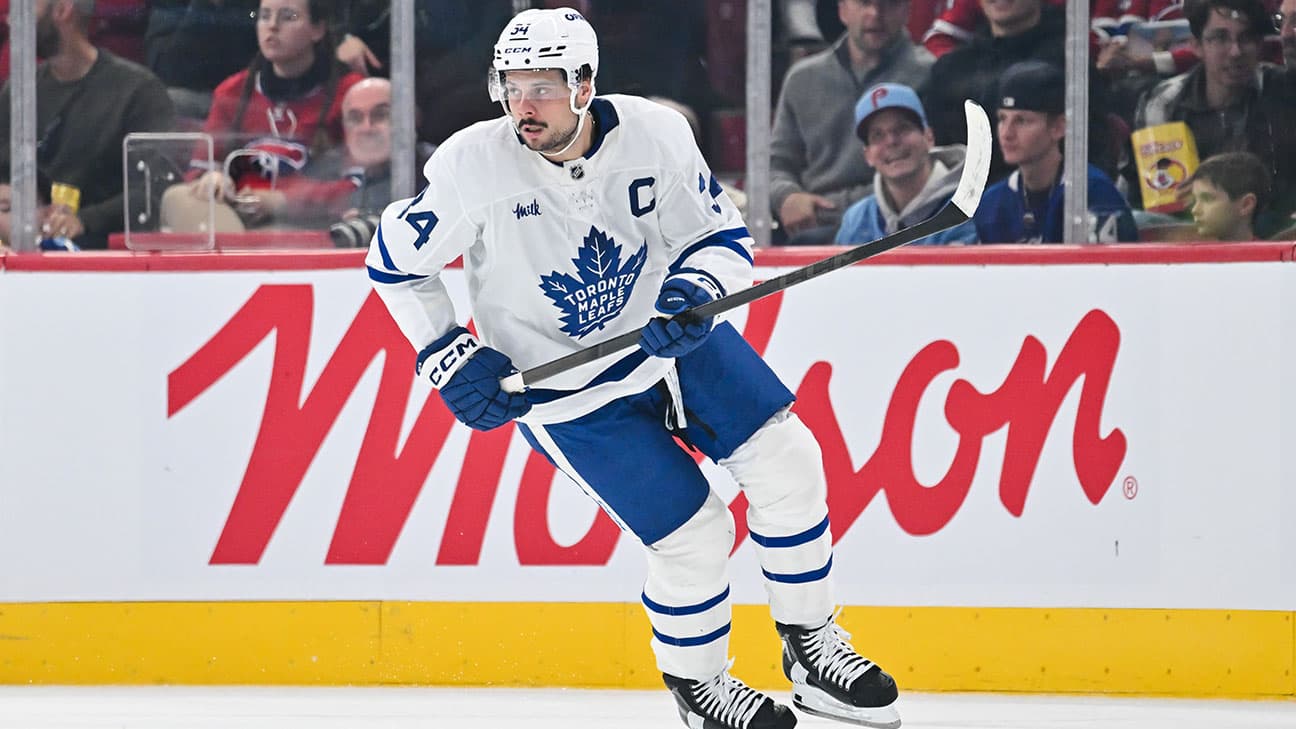
Photo: NHL.com
Auston Matthews Penalty Kill Minutes Should Go to Zero in 2026-27
Table of Contents
The Auston Matthews penalty kill experiment has run its course
The Auston Matthews penalty kill assignment was one of the defining tactical choices of the last two Toronto coaching staffs, and it should not survive Jim Hiller's first training camp. Matthews logged 70 minutes and seven seconds of shorthanded ice time across 60 games in 2025-26, an average of 1:10 a night, sixth among Maple Leafs forwards. That is not a lot of hockey. It is also, at this point, entirely unnecessary hockey — and the case for cutting it to zero has never been cleaner than it is right now.
Hiller has already hinted at where he is going. Toronto's new head coach has said he wants Matthews in more offensive situations to get his scoring back. John Chayka then spent July 1 buying the exact personnel that makes it possible. This is not a hot take that requires the coach to be talked into anything. It is a hot take about finishing a job the organization has already started.
Here is the argument in one line: the Maple Leafs are paying a premium for the most valuable even-strength offensive centre of his generation, they are asking him to do it across an 84-game season at 29 years old coming off a 60-game year, and they now have four cheaper forwards who kill penalties for a living. Take him off it. Completely.
What Matthews actually played on the penalty kill
Start with the honest version of the numbers, because the pro-PK crowd and the anti-PK crowd both tend to overstate them.
In 2025-26 Matthews was not Toronto's primary penalty killer. He was sixth among forwards in total shorthanded ice time at 70:07, roughly 1:10 per game across the 60 games he played. That is a second-unit workload — a first-change-after-an-offensive-zone-penalty workload — not a Selke campaign. Over a full 84-game season at the same rate, you are talking about something in the neighbourhood of 98 minutes of shorthanded hockey.
Which cuts both ways. The volume is small enough that removing it will not transform Matthews' season on its own. Anyone promising you ten extra goals from this is selling something. But the volume is also small enough that replacing it is trivially easy, and that is the actual point. When the cost of a policy is low and the benefit of the policy is also low, you look at the tail risk. And the tail risk of a 220-pound centre blocking a Zdeno-Chara-descendant one-timer in November is the entire season.
Hiller has said the quiet part out loud
Hiller inherited a specific problem: Matthews played 60 games last season and Toronto's offence disintegrated without him, finishing with 253 goals. The coach's public framing this summer has been about getting Matthews into more offensive situations and rebuilding his scoring environment, which is coach-speak with a very short decoding key.
You cannot simultaneously maximise a player's offensive-zone starts and keep sending him over the boards down a man. Shorthanded shifts are defensive-zone shifts by definition. They are also, in the modern NHL, the shifts most likely to end with a forward on his knees in a shot lane. Every minute Matthews spends there is a minute of usage pulling directly against the coach's stated plan.
Hiller's history supports the read. His Los Angeles teams were built on defensive structure and role clarity — he went 93-58-24 there before being fired in March 2026 — and structure coaches generally prefer dedicated penalty-kill units to star cameos. We broke down what Hiller's system actually asks of a roster when he was hired, and specialised deployment is central to it.
Chayka built the exit ramp in July
The reason this is now easy rather than merely desirable is that Toronto's general manager spent his July 1 depth budget on penalty killers, deliberately and almost exclusively.
Colton Sissons, two years at a $4.25-million cap hit, is the headliner. He led Vegas forwards in average shorthanded ice time last season at 1:28 per game and was third on the team in total penalty-kill minutes at 96:19 across 66 games. Over his decade in Nashville he was the Predators' most-used penalty-killing forward by an enormous margin. This is not a guy who kills penalties. This is a guy whose career is killing penalties.
Teddy Blueger, two years at $2.5 million, averaged 1:52 shorthanded per game in his 35 games with Vancouver, tied for second on that team. Brandon Duhaime, three years at $2.6 million, arrived from Washington with the same job description. Nick Paul was acquired specifically to solve the third-line centre hole and has killed penalties his entire career. Add holdovers Steven Lorentz and Dakota Joshua and Toronto has, conservatively, six forwards who can take those 98 minutes without anyone noticing.
We wrote in July that Chayka's bottom-six rebuild was built to unleash the core. This is the specific mechanism by which that happens. If the fourth line exists to take hard minutes so the stars can chase offence, and the stars are still taking the hard minutes anyway, you have bought a tool and left it in the box.
The counter-argument, and why it is weaker than it looks
There are three defences of Matthews on the PK. Take them in order.
"He's actually good at it." True, and irrelevant. Matthews reads plays well, his stick is excellent, and he is a genuine shorthanded scoring threat because a puck he wins at his own blue line becomes a breakaway. But "good at it" is not the test. The test is whether he is enough better than Sissons to justify the cost, and he is not. Sissons is a career specialist. The marginal difference across 98 minutes is a fraction of a goal.
"It sets a tone. Captains kill penalties." This one gets said in Toronto more than anywhere else, and it is the least serious argument in hockey. Leadership is not measured in shorthanded time on ice. Nobody questioned Steven Stamkos' captaincy over penalty-kill usage. If the room needs Matthews on the PK to believe he cares, the problem is the room.
"You need him there in big moments." Fine — keep the emergency exception. A 6-on-5 defensive-zone faceoff in the final minute of a one-goal playoff game is not a penalty-kill deployment policy. Nobody is arguing Hiller should be forbidden from using his best centre in a crisis. The argument is about the other 81 games.
The health math on an 84-game season
This is where the case stops being about goals and starts being about availability, which is the only Matthews statistic that matters now.
He played 60 games last season. The season ahead is 84 games, up from 82 for the first time since 1993-94, with a preseason cut to four games and a schedule that opens September 29 and is designed to award the Cup by mid-June. That is more hockey in a comparable window. Toronto's response to their 32-36-14 collapse was to add depth, hire a new vice-president of sport performance, and — as of this week — reshape the medical department. Every one of those moves is an availability move.
Removing 98 minutes of shorthanded hockey from a 29-year-old centre with a recent injury history is the cheapest availability move on the list. It costs nothing. It does not require a trade, cap space or a player's consent. It requires a coach to write a different name on a whiteboard.
We have argued before that everything about Toronto's season runs through Matthews' health. If you believe that, you cannot also be relaxed about him standing in shot lanes in a scoreless second period in Buffalo in February.
What zero actually looks like
Practically, Hiller would run something like Sissons-Blueger as the first unit and Duhaime-Paul as the second, with Lorentz or Joshua as the swing option depending on who wins the fourth-line competition. John Tavares can take defensive-zone draws down a man without logging full shifts. On the back end the pairs sort themselves — the full projected deployment is in our 2026-27 lineup breakdown.
The payoff is not just fewer risky shifts. It is rest. Matthews comes off the ice after an offensive-zone shift, sits through a full kill, and comes back with fresh legs for a 5-on-5 shift against a tired defence pair, instead of arriving at that shift 40 seconds into a bag skate. Across 84 games that compounds in ways no single stat captures well.
And there is a roster-construction argument too. If Sissons at $4.25 million and Blueger at $2.5 million are not the primary penalty killers, what exactly did Toronto buy? Chayka's summer only makes sense if the specialists specialise.
What's next
Watch the first special-teams installation day of camp. Hiller's staff will run penalty-kill units in practice well before the September 19 preseason opener, and the units on the ice that day will tell you more than any press conference. If Matthews is standing on the boards watching Sissons and Blueger work, the decision is made. If he is out there taking reps, Toronto is running last year's policy with a new coach's name on it.
Then watch the first road game against a top power play. That is where coaches revert. It takes real discipline to keep your best player off the ice when the game is on the line and the other bench has just sent out its top unit.
Toronto has spent the summer buying certainty in every area it could. This is one of the few remaining places where certainty is free. Take the best centre in franchise history off the penalty kill, put the men you paid for out there instead, and find out what 84 games of a healthy Auston Matthews looks like. Check the roster page and it is hard to argue the personnel is not already in the building.
Frequently Asked Questions
How much does Auston Matthews play on the penalty kill?
In 2025-26 Matthews logged 70 minutes and seven seconds of shorthanded ice time across 60 games, an average of 1:10 per game. That ranked sixth among Maple Leafs forwards, making him a second-unit penalty killer rather than a primary one.
Will Auston Matthews kill penalties under Jim Hiller?
Hiller has publicly said he wants Matthews in more offensive situations to restore his scoring, which points toward reduced shorthanded usage. Nothing has been formally announced, and the first real evidence will come from special-teams work at training camp in September.
Which Maple Leafs forwards will kill penalties in 2026-27?
Colton Sissons and Teddy Blueger project as the primary unit, with Brandon Duhaime and Nick Paul behind them and Steven Lorentz and Dakota Joshua available. Sissons led Vegas forwards at 1:28 of shorthanded ice time per game last season; Blueger averaged 1:52 in 35 games with Vancouver.
How much did the Maple Leafs pay their new penalty killers?
Colton Sissons signed for two years at a $4.25-million cap hit, Teddy Blueger for two years at $2.5 million, and Brandon Duhaime for three years at $2.6 million. All three signed in the opening days of free agency on July 1, 2026.
How many games did Auston Matthews play in 2025-26?
Matthews played 60 of Toronto's 82 games. The Maple Leafs finished 32-36-14 with 253 goals for and 299 against, last in the Atlantic Division, and missed the playoffs for the first time in his career.
Does the 84-game NHL season change how stars are used?
It should. The 2026-27 season expands to 84 games, the first increase since 1993-94, with each team playing 42 home and 42 road games and a preseason capped at four games. More regular-season hockey in a similar window raises the value of load management for older, injury-prone cores.
Is Auston Matthews good at killing penalties?
Yes — he reads plays well, has an active stick and is a legitimate shorthanded scoring threat off turnovers. The argument against using him is not ability, it is opportunity cost and injury risk when the roster now carries multiple career penalty-kill specialists.


