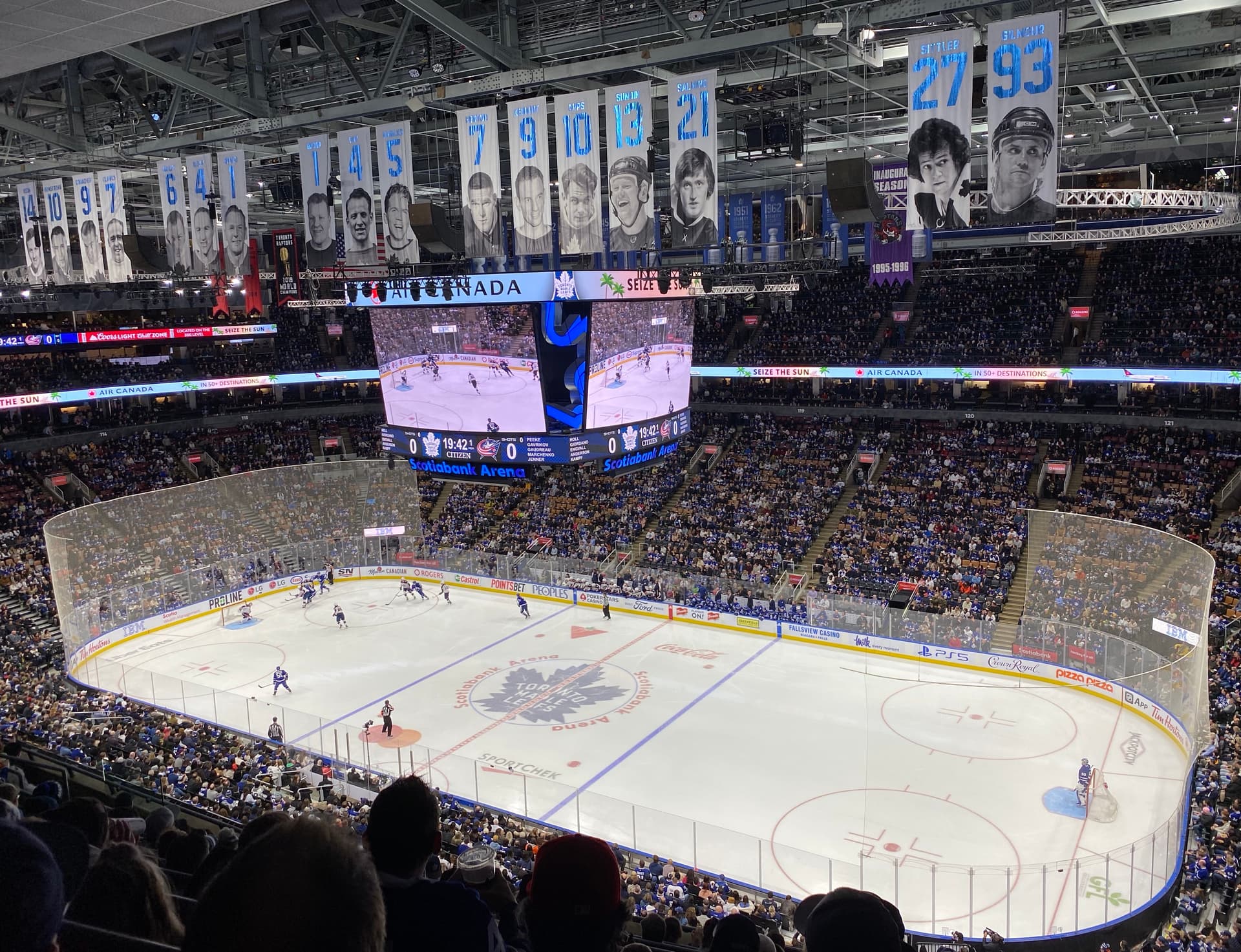
Photo: Adam Bishop, Wikimedia Commons (BY-SA-4.0)
Auston Matthews' Next Contract Just Got Harder: Celebrini's $18.8M Record Resets the Pay Scale
Table of Contents
Auston Matthews' next contract is still eleven months from being legal, and it already looks more complicated than it did a week ago. On July 29, the San Jose Sharks signed Macklin Celebrini to a five-year extension worth $94 million — an $18.8 million average annual value that makes him the highest-paid player in NHL history by cap hit. The deal does not begin until 2027-28. That is the same summer John Chayka can finally put pen to paper with the Toronto Maple Leafs captain.
Nobody in Toronto needs to panic about a Sharks contract. But the Celebrini number is the fourth major domino to fall in eight months, and together they have moved the ceiling on what a franchise centre costs by an amount that should change how the Leafs plan the back half of this decade.
What Celebrini actually signed
The terms, per the Sharks' announcement and multiple national reports: five years, $94 million, $18.8 million against the cap, covering 2027-28 through 2031-32. Celebrini turns 21 in June 2027, which means San Jose has bought the seasons that ought to be his statistical peak and has done it before he ever reached unrestricted free agency.
The performance case is not thin. Celebrini played all 82 games in 2025-26 and finished with 45 goals and 70 assists for 115 points, breaking the Sharks' single-season franchise record that Joe Thornton set in 2006-07. He was not a Hart Trophy finalist — the league named Connor McDavid, Nikita Kucherov and Nathan MacKinnon — but he was involved in a larger share of his team's offence than all but one player in the NHL.
That is the profile that now costs $18.8 million: a first-overall centre who becomes a 115-point player before his 21st birthday and carries a bad team most of the way to a playoff spot.
The ladder moved four times in eight months
Celebrini did not jump the queue alone. Anaheim's Leo Carlsson is reported at $18 million and Minnesota's Kirill Kaprizov at $17 million, both of which put them ahead of everyone in the league for 2026-27. On July 18, a day after his 21st birthday, Chicago signed Connor Bedard to a five-year, $75 million extension at a $15 million cap hit that begins this coming season and runs through 2030-31. We wrote about that one at the time in our look at what Bedard's $15 million says about the Leafs' own contracts.
Ten days later, Celebrini cleared Bedard by $3.8 million.
The pattern is not random. Every one of these deals is a young, drafted-and-developed centre or winger being paid at the top of the market by a club that cannot afford to let him get to July 1 as a free agent. The elite-young-forward tier is repricing all at once, and it is repricing upward faster than the cap.
Where Auston Matthews' next contract stands right now
Matthews is in the third year of the four-year, $53 million extension he signed in 2023. He carries a $13.25 million cap hit through 2027-28 and a no-move clause. He becomes eligible to sign an extension on July 1, 2027 — not a day earlier, no matter how many conversations happen before then.
Chayka has already had several of those conversations. The GM has described his early interactions with Matthews as positive, and Matthews reportedly had a Zoom meeting with Chayka and senior executive adviser Mats Sundin not long after the new front office took over. Our piece on Matthews' commitment to Toronto covered the state of that relationship earlier this month. Nothing about the Celebrini deal changes the relationship. It changes the number at the end of it.
The percentage-of-cap math that actually matters
Raw dollars are the wrong unit here, because the cap is climbing hard. The NHL and NHLPA have set the upper limit at $104 million for 2026-27 and $113.5 million for 2027-28 — increases of $8.5 million and then $9.5 million. The maximum individual salary in 2026-27 clears $20 million for the first time.
Run the percentages and the picture sharpens:
- Matthews at $13.25 million is 12.7 per cent of the 2026-27 cap.
- Bedard at $15 million is 14.4 per cent of the same cap.
- Celebrini at $18.8 million is 16.6 per cent of the 2027-28 cap.
Matthews' current deal, signed when the cap was $83.5 million, was a genuine outlier at the time — it was roughly 15.9 per cent of the cap in its first year. Cap inflation has quietly turned it into a bargain. It will keep doing that through 2027-28.
The problem is what happens on the other side. If Matthews' camp asks for the same share of the cap he commanded in 2024-25, that is a cap hit in the $18 million range on a $113.5 million ceiling — right at Celebrini's number, on a player who will be 30 when the new deal starts rather than 21. Toronto's counter-argument is age. Matthews' counter-argument is that he has been the best goal-scorer of his generation and that the market just moved.
The seven-year problem nobody is talking about
Term is the other variable, and it cuts against Toronto. Under the new CBA, a club can re-sign its own player for a maximum of seven years, down from eight — the wrinkle we broke down in our look at the seven-year term limit and what it means for a Matthews extension.
Shorter maximum term means less runway to average down a big AAV. Under the old rules, a club could stretch a huge total across eight years and shave the cap hit. Seven years does less of that work. It also means that a seven-year deal signed for 2028-29 carries Matthews through his age-37 season, which is exactly the kind of tail that has buried teams before.
Celebrini's camp took five years, which is short by superstar standards, and got the highest AAV in league history in exchange. That trade — maximum dollars for limited term — is the template a 30-year-old Matthews might not be able to use, because a five-year deal starting in 2028 takes him only to 35 and San Jose was buying prime years while Toronto would be buying decline years.
What Chayka can actually control
Not much of this. The GM cannot negotiate an extension until July 2027, cannot stop other clubs from setting the market, and cannot make the cap grow faster than it is already growing.
What he can control is whether Toronto is a place Matthews wants to sign that deal. That is the real project of this season. The Leafs missed the playoffs in 2025-26, finished 32-36-14, and got outshot more than any team in the league. Chayka has since rebuilt the depth, changed the goaltending and turned over the coaching staff. He has not yet added the top-four defenceman the roster still needs — the gap we laid out in our piece on the unfinished blue line.
Matthews has said, in effect, that he wants to see the roster get better before he talks about the long term. He is holding the strongest hand in the building: a no-move clause, an expiring deal in an inflating market, and a league full of teams that would clear $18 million for him without blinking.
What's next
Nothing formal until July 1, 2027. Informally, the conversation starts the moment this season does. If Toronto is a playoff team by Christmas with Gavin McKenna producing on an entry-level deal, Chayka negotiates from strength and Matthews signs something in the $16 million to $17 million range without much drama. If the Leafs are 12th in the East in February, the number goes up and the term gets shorter, or the conversation stops being about an extension at all.
Celebrini's $18.8 million did not create that fork in the road. It just put a very large, very public number on the end of it. Keep an eye on our contracts page as the rest of the elite-forward tier reprices between now and next summer — the ceiling Matthews eventually signs under is being built right now, one extension at a time.
Frequently Asked Questions
When can Auston Matthews sign a contract extension with the Maple Leafs?
July 1, 2027. Matthews is in the third year of the four-year, $53 million extension he signed in 2023, which carries a $13.25 million cap hit through 2027-28. Under NHL rules he cannot sign an extension until one year remains on the deal. Talks can happen informally before that, but no contract can be filed until that date.
How much is Macklin Celebrini's contract worth?
Five years and $94 million, an $18.8 million average annual value. It was announced on July 29, 2026 and begins with the 2027-28 season, running through 2031-32. It is the highest cap hit in NHL history.
What is Auston Matthews' current salary cap hit?
$13.25 million per season through 2027-28, from the four-year, $53 million extension he signed in 2023. That is 12.7 per cent of the $104 million cap for 2026-27. He also holds a no-move clause for the length of the deal.
What is the NHL salary cap for 2026-27 and 2027-28?
The upper limit is $104 million for 2026-27 and $113.5 million for 2027-28, per the payroll ranges announced by the NHL and NHLPA. Those are increases of $8.5 million and $9.5 million respectively. The maximum individual salary in 2026-27 clears $20 million for the first time.
Is Connor Bedard or Macklin Celebrini the highest-paid player in the NHL?
Celebrini, once his extension begins. Bedard signed a five-year, $75 million extension on July 18, 2026 at a $15 million cap hit starting in 2026-27. Celebrini's $18.8 million starts a year later and is $3.8 million higher. For 2026-27 itself, Anaheim's Leo Carlsson is reported highest at $18 million.
How long can the Maple Leafs sign Auston Matthews for?
A maximum of seven years. The new CBA reduced the maximum term for a club re-signing its own player from eight years to seven. That matters because shorter maximum term gives teams less room to average down a large total, and a seven-year deal beginning in 2028-29 would run through Matthews' age-37 season.
What did Macklin Celebrini do in the 2025-26 season?
He played all 82 games and put up 45 goals and 70 assists for 115 points, breaking San Jose's single-season franchise record previously held by Joe Thornton from 2006-07. He was not named a Hart Trophy finalist; the league selected Connor McDavid, Nikita Kucherov and Nathan MacKinnon.