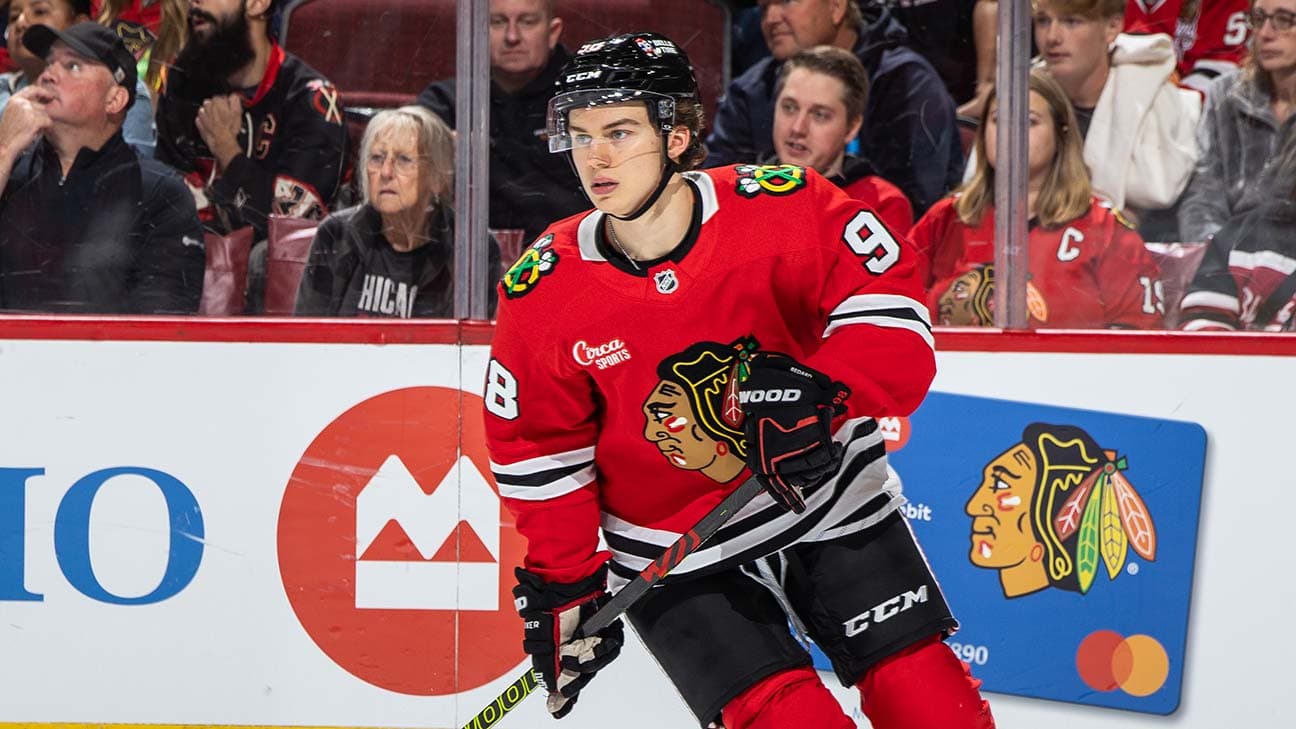
Photo: NHL.com
Bedard's $15M and the NHL's New Pay Scale Just Made the Maple Leafs' Core Look Like a Bargain
Table of Contents
Connor Bedard's new contract did more than reset the Chicago Blackhawks' books — it quietly reframed the Maple Leafs salary cap picture. Bedard signed a five-year, $75 million extension at a $15 million average annual value, slotting in as the NHL's third-highest cap hit behind Leo Carlsson at $18 million and Kirill Kaprizov at $17 million. Against that new ceiling, Auston Matthews at $13.25 million and William Nylander at $11.5 million suddenly look less like albatrosses and more like value.
How Bedard's deal moves the Maple Leafs salary cap conversation
For three years, the loudest criticism of the Leafs' team-building was that they had too much money tied up in too few forwards. Matthews and Nylander alone account for nearly $25 million against a $104 million cap. That math has not changed. What has changed is the context around it.
When a 20-year-old centre with 203 points in 219 games commands $15 million, and Carlsson's offer-sheet-driven number sits at $18 million, the price of elite offence has moved decisively upward. Matthews, a three-time Rocket Richard winner, is signed at $13.25 million. In the market that existed when he signed, that looked steep. In the market that exists now, it looks like a discount on one of the five best goal-scorers alive.
The salary cap is a relative game. A contract is only expensive compared to what the same production would cost today. By that measure, Toronto's two biggest deals aged well the moment the summer's mega-extensions started landing.
The new top of the pay scale
Consider the order of operations at the top of the league's cap sheet. Carlsson at $18 million, Kaprizov at $17 million, Bedard at $15 million. These are the new anchors of the NHL's pay structure, and they were all signed or reset inside the last year as the cap began its steep climb.
The through-line is simple: as the ceiling rises from the flat-cap era into a $104 million world and beyond, the players signed during the flat years become bargains, and the players signing now set new highs. Toronto's core was locked in during the transition. Matthews' four-year term, in particular, means his $13.25 million looks better every season the cap climbs.
We broke down the mechanics of the rising ceiling in our piece on what the $104 million cap and $20.8 million individual max mean for the Leafs. The short version: the room to pay stars is expanding faster than most rosters can fill it, and teams with cost-controlled elite talent are the ones best positioned to exploit it.
Nylander's deal is the one that really ages well
If Matthews looks like value, Nylander looks like a steal. His eight-year, $92 million extension carries an $11.5 million cap hit and runs through 2031-32 — deep into an era when the cap could push toward $115 million or higher. A point-per-game winger locked in below $12 million for the better part of a decade is the kind of contract that wins arguments in five years.
That is why the trade chatter around Nylander always felt misplaced. We argued in our look at his clean slate under the new regime that Toronto's best move was to let him cook, not shop him. The pay-scale reset only sharpens that logic. Term at a fixed number is an asset when every comparable player is signing for more.
The counterpoint is production, not price. Nylander has to play like a genuine first-line winger for the value to be real. But that was always the bet. The contract itself is no longer the problem — if it ever was.
Where the flexibility actually goes
None of this means the Leafs are swimming in space. As we have covered repeatedly this month, Toronto is essentially bumping against the ceiling right now, roughly $127,000 over on a 21-player roster before making a move. Cost-controlled stars do not automatically produce cap room; they just make the room you do have more efficient.
The real benefit shows up over the horizon. With Matthews and Nylander fixed while the cap rises, Chayka has more relative room every year to address the roster's actual holes — chiefly the top-four defence. The bargain core is what makes an expensive blue-line addition affordable down the line, provided he can clear the money currently clogging the back end.
That is the strategic read. The stars are not the constraint. The constraint is the mid-tier money — the Rielly limbo, the depth deals — that eats the space the cheap-by-comparison core creates.
The Matthews question that still hangs over it
There is one asterisk, and it is a big one. Matthews' deal is only four years, which means it expires sooner than Nylander's — and when it does, he will be negotiating in exactly the inflated market that makes his current deal look cheap. The bargain is real, but it is temporary. The next Matthews contract will be written at the top of a pay scale that Bedard just pushed higher.
That is the tension baked into Toronto's whole situation, the one the local media keeps circling back to. The core is a bargain today and a looming bill tomorrow. Chayka's job is to win with the discount before it comes due — and to keep an eye on the contract structure that will define the next negotiation.
The cautionary side of the comparison
It is worth being honest about the limits of the bargain framing. A cheap contract is only a bargain if the player produces, and both Matthews and Nylander carry real questions into 2026-27. Matthews is coming off a season disrupted by injury, and his value to the Leafs has always been tied to his availability as much as his rate. A $13.25 million cap hit is a discount on a healthy, dominant Matthews. It is a market-rate deal on one who plays 65 games.
Nylander, for his part, has to shoulder more of the offensive load in a reshaped forward group that shed scoring depth over the summer. The contract is team-friendly relative to the market, but relative value does not put pucks in the net. If the production dips, the discount stops mattering. The pay-scale reset makes the deals look good on paper; the players still have to make them look good on the ice.
That is the fair rebuttal to the bargain narrative, and it is the same tension that runs through the entire Leafs project: the structure is sound, the numbers are defensible, and none of it means anything without the results. Cheap stars are an advantage only for a team that wins with them.
What it means for 2026-27
Practically, the pay-scale shift does not add a defenceman or fix the crease this season. What it does is change the framing of every future Leafs cap debate. Matthews and Nylander are no longer the problem contracts on the sheet. In a $104 million league climbing higher, they are the cost-controlled foundation that gives Toronto a chance to build around them efficiently.
The Blackhawks paid Bedard $15 million because that is what a franchise centre costs now. Toronto has two of the game's best offensive players signed for less, one of them for years. In a league where the money only goes up, that is the kind of edge that quietly matters — even in an offseason where the headlines have all been about the holes.
Frequently Asked Questions
How much is Connor Bedard's new contract?
Bedard signed a five-year, $75 million extension with the Chicago Blackhawks at a $15 million average annual value. That makes him the NHL's third-highest cap hit, behind Leo Carlsson ($18 million) and Kirill Kaprizov ($17 million).
What is Auston Matthews' cap hit?
Matthews carries a $13.25 million cap hit on a four-year, $53 million deal that runs through 2027-28. In 2026-27 his salary is structured as a $900,000 base plus a $10.18 million signing bonus.
What is William Nylander's contract with the Maple Leafs?
Nylander signed an eight-year, $92 million extension with a $11.5 million average annual value, running through the 2031-32 season. It is increasingly seen as a value deal as the salary cap rises.
What is the NHL salary cap for 2026-27?
The salary cap for 2026-27 is $104 million, up sharply from the flat-cap era. It is projected to keep climbing in subsequent seasons, which makes contracts signed during the flat years look cheaper over time.
Are Matthews and Nylander overpaid?
By the current market, no. When a 20-year-old like Bedard commands $15 million and Carlsson sits at $18 million, Matthews at $13.25 million and Nylander at $11.5 million look like below-market value for their production.
Does having a cheap core give the Maple Leafs cap space?
Not directly. Toronto is essentially at the ceiling right now, roughly $127,000 over on a 21-player roster. Cost-controlled stars make the space more efficient over time, but the mid-tier contracts still have to be managed to create real room.


