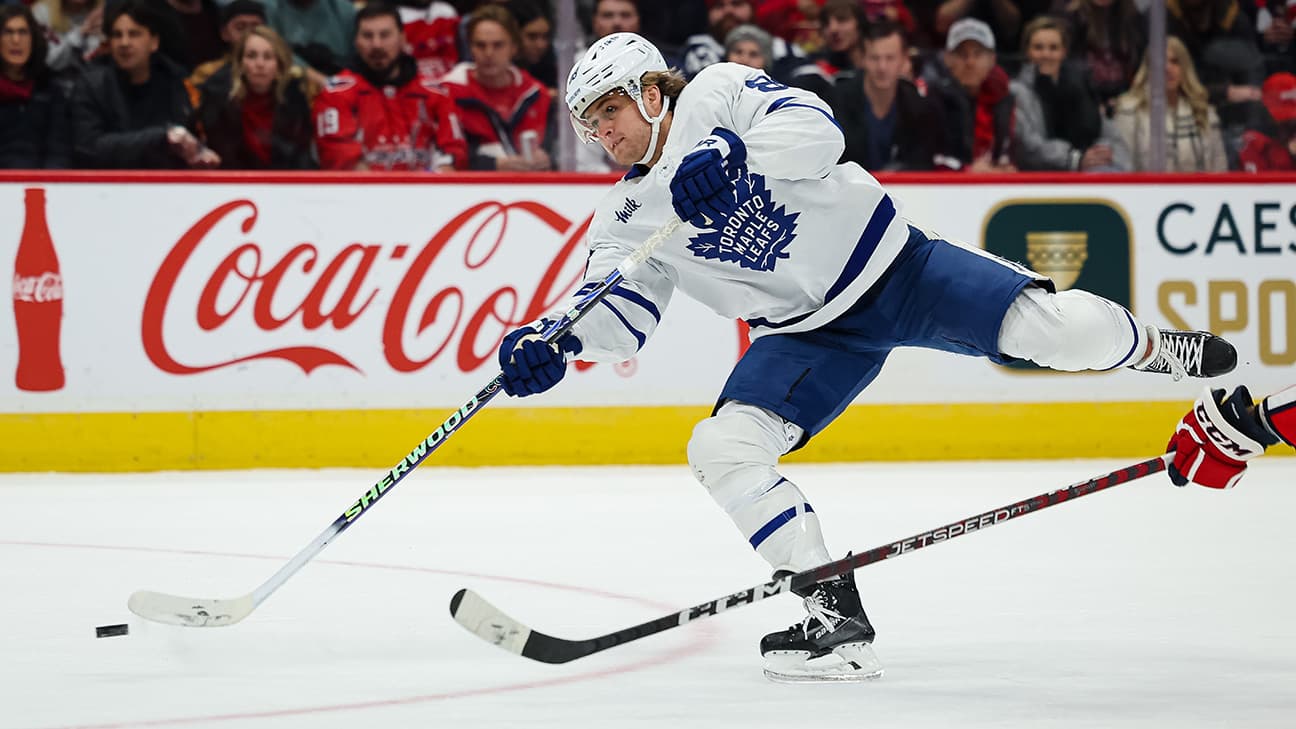
Photo: NHL.com
William Nylander Trade Talk Is Back. His No-Move Clause Isn't Moving
Table of Contents
William Nylander Trade Talk Has Reappeared — and It Still Runs Into One Clause
William Nylander trade speculation has crept back into the Toronto conversation for the first time in a while, driven less by a specific report than by a shift in tone from the front office. John Chayka has signalled that this administration is willing to listen on players the previous one would not have entertained, and rival executives have taken that at face value. The problem with every version of the scenario is the same, and it is not negotiable: Nylander holds a full no-movement clause, and it does not expire until his contract does.
He is signed through the 2031-32 season at an $11.5 million cap hit — eight years, $92 million, with movement protection attached for the full term. Nothing happens without his signature. Not a trade, not a waiver claim, not a reassignment. Chayka can take calls, run scenarios and get as far as an agreed framework with another general manager, and Nylander can end it with a sentence.
That is the entire story, and it is worth saying plainly before anyone builds a mock trade around it.
What Actually Changed
The shift is real even if the outcome probably is not. Under the previous regime, Toronto's core four were effectively untouchable in public and largely untouchable in practice. Chayka has spent his first offseason demonstrating that he does not operate that way.
Since taking over in May he has moved Joseph Woll, Simon Benoit, Brandon Carlo, Nick Robertson and Dennis Hildeby, and brought in Sergei Bobrovsky, Nick Paul, Darren Raddysh, Colton Sissons, Emil Andrae, Jack Roslovic and Brandon Duhaime. He fired Craig Berube and hired Jim Hiller. He rebuilt the scouting department around people he trusts. The pattern is a general manager who treats no name as sacred.
Reporting this summer has been careful to distinguish between the two ends of the roster's top tier. Auston Matthews is the one player Toronto has consistently signalled it will not discuss. Nylander and Matthew Knies have come up more often, though both for different reasons — Knies because his contract is an asset other teams covet, Nylander because his cap hit is the largest movable number on the books.
Movable, in this case, is doing an enormous amount of work.
The No-Movement Clause Is Not a Formality
Full no-movement protection is the strongest instrument a player can hold. It covers trades, waivers and minor-league assignment, and Nylander's runs the length of an eight-year term signed in January 2024. There is no partial window, no submitted list, no modified structure that kicks in later. It is total, and it is his.
Players do waive. It happens most often when a team is losing, a player is aging, or a preferred destination emerges. Nylander fits none of those. He is 30, coming off a 79-point season, playing in a market where he has publicly been comfortable, on a contract that pays him at the top of the winger scale through his mid-thirties. There is no version of this where waiving improves his situation, and no leverage Toronto can apply to change that.
If you want the template for what this looks like in practice, it is playing out ten feet away. Morgan Rielly's trade situation has been stalled all summer for precisely this reason, with Chris Johnston reporting that Rielly has neither waived his clause nor approved a move. That is a player on a declining contract with an obvious market. Nylander is a substantially more attached player with substantially less reason to leave.
Would Trading Him Even Help?
Set the clause aside for a moment and ask the hockey question, because it deserves an answer independent of the legal one.
Toronto is roughly $2.75 million over the upper limit heading into camp, with Max Domi's $3.75 million likely headed to long-term injured reserve to solve it. That is a compliance problem, not a structural one. It does not require moving $11.5 million.
The roster problem is different. Chayka has spent the summer building depth — Paul, Sissons, Blueger, Duhaime, Roslovic, Lorentz, Joshua — and thinning the top end. Removing Nylander from a group that already lost Mitch Marner and is waiting on Matthews' health would leave Toronto with an enormous amount of competent middle-six hockey and very little that scares anyone. Gavin McKenna is 18 and about to play his first professional season. Knies is a very good complementary scorer, not a first option.
You do not fix a top-end problem by subtracting from the top end. The return would have to be a comparable scorer on a better contract, which is a trade nobody makes, or a package of futures, which is a rebuild — and Chayka has spent all summer signalling the opposite. Our read on the two-year window this front office is operating inside has not changed.
The Case for Listening Anyway
Here is where we will give the other side its due. There is a coherent argument for Chayka taking every call on Nylander, and it has nothing to do with expecting a deal.
Information is cheap and useful. Knowing what a rival would surrender for an $11.5 million winger tells you what the market values, which informs what you might get for smaller pieces. It also establishes with the rest of the league that Toronto is genuinely open for business, which matters when you are trying to solve a defence corps and a cap sheet simultaneously.
And there is a long-horizon version. Nylander's contract runs to 2031-32, by which point he will be 36. If Toronto's competitive window closes and a retool begins, the conversation about moving him becomes real — and a player's willingness to waive tends to shift when the team around him stops winning. That is a 2028 or 2029 discussion, not an August 2026 one.
What the Numbers Say About His Value
Nylander's 79 points last season came on a team that missed the playoffs and lost its franchise centre to knee surgery down the stretch. He has been the most durable and most consistent of Toronto's high-priced forwards for several seasons running, and his cap percentage — roughly 11 per cent of the $104 million ceiling, dropping toward 10 per cent when the limit hits $113.5 million in 2027-28 — is defensible for a genuine first-line scorer.
It is not a bargain the way Knies' $7.75 million deal is. It is not a problem either. It is a market-rate contract for a player producing at market rate, which in a hard-cap league is the definition of neutral. Neutral contracts are not the ones you trade to fix a roster.
What's Next
Expect the speculation to persist through camp, because it always does, and expect nothing to come of it. The realistic Toronto trade market between now and Sept. 29 involves Rielly, the bottom of the forward group, and whatever small move is needed to get the cap sheet legal on opening night.
The Nylander question gets genuinely interesting only if two things happen at once: Toronto struggles early, and Matthews' contract situation resolves in a direction that forces a broader reset. Neither is close. Matthews has this season and next remaining, and what his next deal costs is the question that will actually shape this roster.
Until then, the answer to every Nylander trade proposal is the same three words. He decides, not Chayka. You can track every contract and clause on the contracts page as camp approaches.
Frequently Asked Questions
Can the Maple Leafs trade William Nylander?
Not without his permission. Nylander holds a full no-movement clause for the entire length of his eight-year contract, which runs through 2031-32. It covers trades, waivers and minor-league assignment, so no deal can be completed unless he agrees to waive it.
What is William Nylander's contract and cap hit?
Nylander signed an eight-year, $92 million extension in January 2024 carrying an $11.5 million average annual value. The deal expires after the 2031-32 season, at which point he becomes an unrestricted free agent.
Has John Chayka said he would trade William Nylander?
Chayka has not said that. He has indicated this front office is willing to listen on players the previous administration would not have discussed, which is a general posture rather than a Nylander-specific statement. Auston Matthews is the one name Toronto has consistently signalled is off the table.
How many points did William Nylander score last season?
Nylander finished with 79 points for a Toronto team that missed the playoffs and lost Auston Matthews to knee surgery down the stretch. He has been the most durable of the club's high-priced forwards over the past several seasons.
Does Auston Matthews have a no-movement clause too?
Yes. Both Matthews and Nylander carry full no-movement protection, meaning neither contract can be traded without the player personally signing off. Matthews has this season and next remaining on his current deal.
Why are the Maple Leafs listening on more players under Chayka?
Since taking over in May, Chayka has traded Joseph Woll, Simon Benoit, Brandon Carlo, Nick Robertson and Dennis Hildeby while adding Sergei Bobrovsky, Nick Paul, Darren Raddysh, Colton Sissons, Emil Andrae, Jack Roslovic and Brandon Duhaime. The pattern reflects a general manager who treats no name as untouchable except Matthews.
Do the Maple Leafs need to trade Nylander to get cap compliant?
No. Toronto is roughly $2.75 million over the upper limit, a gap that closes by placing Max Domi and his $3.75 million cap hit on long-term injured reserve. Moving an $11.5 million contract is not required to solve a compliance issue of that size.
Which Maple Leafs are most likely to be traded before the season?
Morgan Rielly has been the most persistent name all summer, though his own no-movement clause has left the situation stalled. Beyond that, the realistic market involves bottom-of-the-roster forwards and whatever small move is needed to make the cap sheet legal for the Sept. 29 opener.


