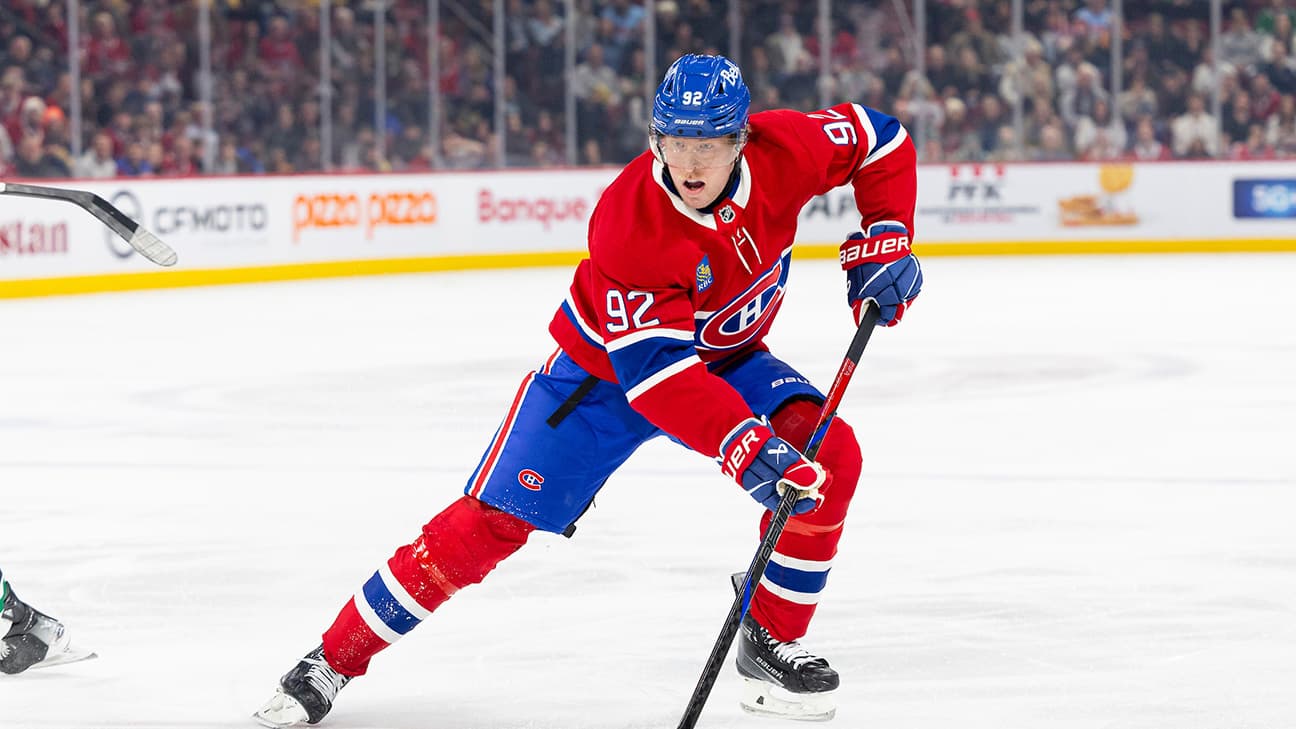
Photo: NHL.com
The Patrik Laine Maple Leafs Case Just Got Cheaper — He's Down to PTO Offers
Table of Contents
The Patrik Laine Maple Leafs case just got a lot cheaper
Patrik Laine is still unsigned on July 26, nearly four weeks into free agency, and the reporting around him has gone from thin to grim. The New York Islanders held conversations with his camp when the market opened and, per reports published this week, were unwilling to offer anything beyond a professional tryout. Analysts now peg his likely landing spot as a one-year contract somewhere between $1 million and $2.5 million — a fall of roughly 75 to 90 per cent from the $8.7-million cap hit he carried on his last deal. That is the number that should make this a live Patrik Laine Maple Leafs conversation again.
It was worth having on July 1. It is more worth having now, because the price has dropped into the range where the downside effectively disappears. We argued in late June that Laine was the swing Toronto should take. That was an opinion about a $4-million player. This is an opinion about a $1.5-million player, and the two are not remotely the same argument.
This is editorial. It is a bet on upside, and reasonable people can hate it. But John Chayka has spent the summer telling anyone who asks that he is still hunting for difference-makers, and difference-makers do not usually show up in the last week of July at league-minimum-adjacent money.
What Toronto would actually be buying
Laine turned 28 in April. He was the second overall pick in 2016 and scored 44 goals for Winnipeg in 2017-18, a number only a handful of active players have ever matched. He is, on the balance of a decade, one of the purest shooters of his generation — a right-shot winger with a one-timer that changes how penalty kills set up.
He is also, plainly, a flawed hockey player. His last season in Montreal was interrupted by injury and never found any rhythm; he spent time on injured reserve and finished nowhere near the production the Canadiens paid for. His defensive game has never been an asset. He has struggled with consistency and availability for years, and his time in Columbus included a personal leave he has spoken about publicly. Any team signing him is signing volatility.
The question is not whether Laine is a good bet at $8.7 million. He obviously is not — the market has rendered that verdict unanimously. The question is whether a player who has scored 30-plus goals in an NHL season is worth $1.5 million and a roster spot. Framed that way, it stops being close.
The specific hole he fills
Toronto's forward group after Chayka's reshaping is deeper and harder to play against than last year's, but it is short on one particular commodity: a right-shot shooter who can occupy the off-side flank on the top power-play unit. William Nylander is the only established one, and Nylander's value is highest when he is creating from the half-wall rather than parked as a trigger man. We went through the shape of this problem in our look at Toronto's right-shot winger shortage.
A healthy Laine is the platonic solution to that specific problem. He does not need to skate well or forecheck to be useful there. He needs to get to a spot and shoot, which is the one thing he has always been able to do. With Daniel Alfredsson now on Jim Hiller's staff and the power play under new direction, a low-cost specialist is an obvious experiment.
The 5-on-5 minutes are where it gets harder. Laine on a checking line is a mismatch of player and job. But that is a coaching problem to be solved in October, not a reason to pass on the asset in July.
Can the Leafs even fit him?
Barely, and only with help. PuckPedia has projected Toronto roughly $2.75 million over the $104-million upper limit, which is normal for late July — clubs may exceed the ceiling by 10 per cent in the offseason — but it means the Leafs cannot simply add salary without subtracting some first.
Two levers exist. The first is Max Domi's long-term injured reserve situation: Domi had back surgery in late May and is out indefinitely pending a training-camp re-evaluation, and his $3.75-million cap hit is the largest single piece of relief Toronto has available. We walked through that arithmetic in how the Leafs get cap-compliant with Domi's LTIR. The second is a straightforward depth subtraction — Marlies assignments and the sort of cap-clearing trade Toronto has been circling all month, which we covered in our piece on the Leafs waiting to clear room for a forward.
Neither is exotic. A $1.5-million forward is the exact size of addition that fits inside the normal churn of a September roster. You can see the full commitment picture on our contracts page.
The PTO option is the real answer
Here is the version of this that requires almost no cap gymnastics at all: sign Laine to a professional tryout and let training camp decide.
The Islanders reportedly would not go past a PTO. If that is the market, Toronto should be at the front of the queue offering the same thing, because a PTO carries zero cap consequence until a contract is signed, and it gives Hiller three weeks of live evaluation before anyone commits a dollar. The new CBA shortens the preseason — a maximum of four exhibition games, with veterans of 100-plus NHL games limited to two — so the runway is tighter than it used to be, which cuts both ways. Less time to prove it, but also less time for a team to talk itself out of a good idea.
If Laine looks like a shooter who can still shoot, you sign him for a million and change and you have improved the power play for free. If he looks finished, you shake hands and he walks. That is not a gamble. That is a free option, and free options are the whole point of late July.
The argument against, taken seriously
The strongest case for passing has nothing to do with Laine's talent. It is that Toronto's dressing room spent last season being described, fairly, as soft in the wrong moments, and that a player with Laine's availability record and defensive indifference is the opposite of the identity Chayka and Hiller have spent the summer trying to install. Colton Sissons, Teddy Blueger and the rest of the new bottom six were signed to make Toronto annoying. Laine is not annoying to play against. He is dangerous, which is a different thing.
There is also a roster-spot argument. Toronto has young forwards who need NHL games — Easton Cowan chief among them, with Gavin McKenna arriving on an entry-level deal. Handing a lineup slot to a 28-year-old reclamation project is a real cost when the alternative is development.
Both objections are legitimate. Neither survives a $1.5-million price tag, because at that number the player is disposable. You are not blocking Cowan for a season; you are blocking him until Laine stops scoring, at which point Laine is a healthy scratch you can bury or waive.
Where he probably ends up
Reported interest has been scattered rather than intense. The Los Angeles Kings and Tampa Bay Lightning have both been linked by insiders, the Minnesota Wild have surfaced as a possibility, and there has been unsourced chatter about Washington. None of it has produced a contract, which is itself the story: a former 40-goal scorer has been available for four weeks and nobody has bid.
That silence is a market signal, and it deserves respect. Thirty-one other front offices with full analytics departments have looked at the same medicals and passed. It is entirely possible they are right and this piece is wrong.
What's next
Laine's decision point is training camp. Once clubs open camp in mid-September, a PTO becomes the only realistic route, and the number of teams with an obvious opening shrinks. Toronto's own timeline runs through Domi's September re-evaluation and the preseason schedule, which opens Sept. 19 with split-squad games against Montreal — a detail we covered in our preseason schedule breakdown.
Chayka has said he expects more liquidity in the market through July and August. This is what liquidity looks like: a legitimately talented player, no leverage, and a price that has fallen below the point where being wrong costs anything. Make the call.
Frequently Asked Questions
Is Patrik Laine still a free agent?
Yes. As of July 26, 2026, Laine remains an unsigned unrestricted free agent nearly four weeks into the signing period. His previous contract, a four-year deal worth $34.8 million with an $8.7-million cap hit, expired after the 2025-26 season.
How much would Patrik Laine cost on his next contract?
Analysts project a one-year deal in the $1 million to $2.5 million range, a dramatic drop from his $8.7-million cap hit. Reports this week indicated the New York Islanders were only willing to offer a professional tryout rather than a guaranteed contract.
Which teams are interested in Patrik Laine?
Insiders have linked the Los Angeles Kings and Tampa Bay Lightning to Laine, with the Minnesota Wild also mentioned as a possible fit. The New York Islanders spoke with his camp when free agency opened but reportedly would not go beyond a tryout offer.
Do the Maple Leafs have cap space to sign Patrik Laine?
Not without clearing money first. PuckPedia has projected Toronto roughly $2.75 million over the $104-million upper limit, though teams may exceed the cap by 10 per cent during the offseason. Max Domi's expected long-term injured reserve placement and routine Marlies assignments would create enough room for a contract in the $1-2 million range.
What is a PTO in the NHL?
A professional tryout is a non-guaranteed agreement that lets a player attend an NHL training camp without signing a contract. It carries no salary cap charge, and the team can either sign the player to a contract before the season or release him with no obligation.
How many goals has Patrik Laine scored in his NHL career?
Laine, the second overall pick in the 2016 draft, hit a career high of 44 goals with the Winnipeg Jets in 2017-18 and has posted multiple 30-goal seasons since. His recent seasons have been shortened by injuries and a personal leave he took while with Columbus.
Would Patrik Laine help the Maple Leafs power play?
That is the clearest argument for signing him. Toronto lacks a right-shot one-timer threat behind William Nylander, and Laine's shot from the off-side flank is his most transferable skill. With Daniel Alfredsson now on the coaching staff, a low-cost specialist is a low-risk experiment.


