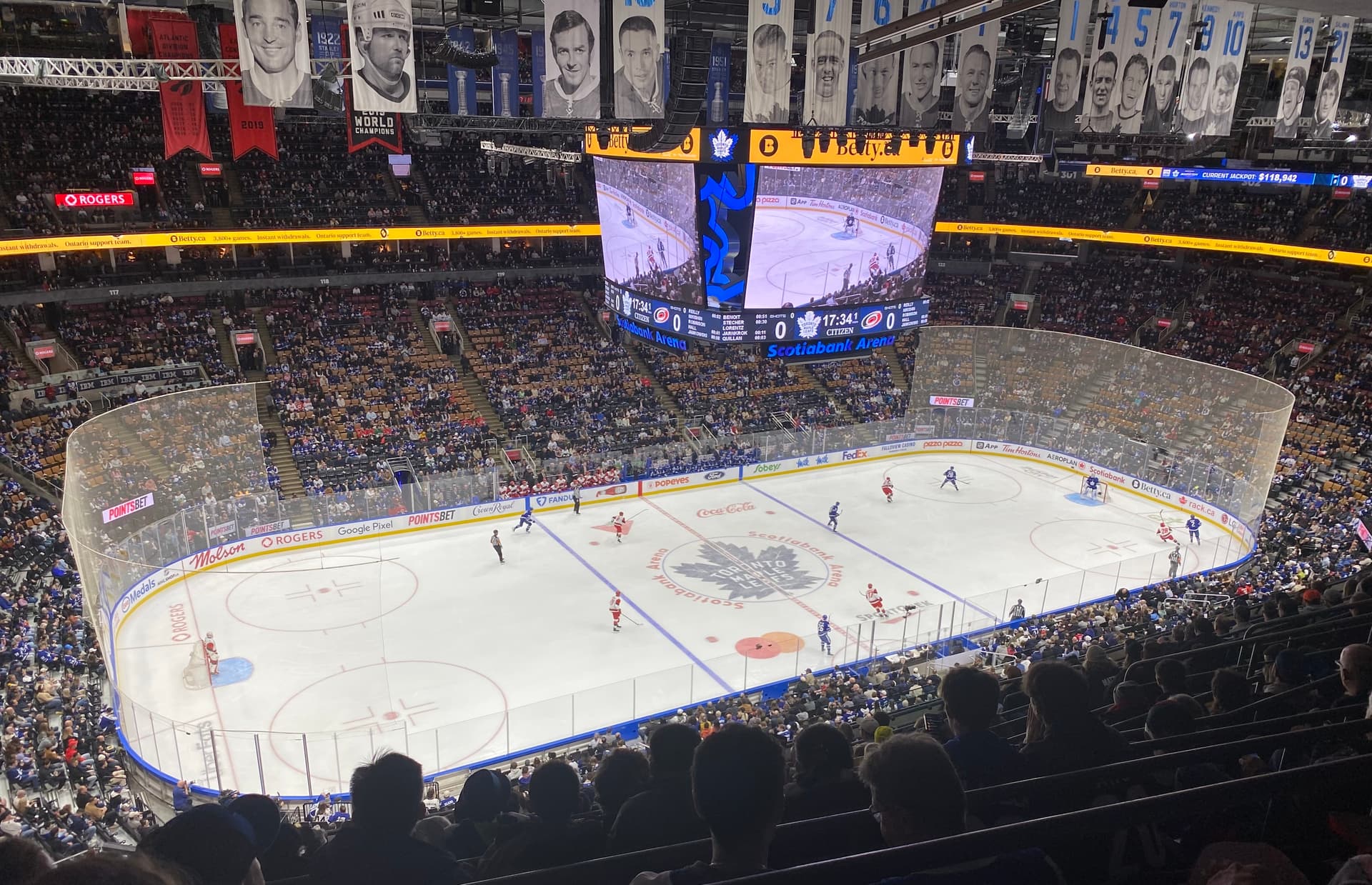
Photo: Adam Bishop, Wikimedia Commons (BY-SA-4.0)
Morgan Rielly Trade Never Had a Serious Offer, John Chayka Says
Table of Contents
The Morgan Rielly trade that consumed most of the Maple Leafs' summer never actually existed. John Chayka said so himself this week, telling reporters at his pre-camp availability that "at no point" did Toronto have what he would characterize as a serious trade opportunity involving its longest-tenured player. Rielly reports to training camp Thursday as a Maple Leaf, with four seasons left on his contract and a full no-move clause he was never asked to waive.
That is a flat answer to a question that had been asked in a dozen different ways since June. It is also, in its own way, an admission. A general manager who spent four months rebuilding the roster around the edges could not find a market for a $7.5 million defenceman in his thirties, and now has to coach him, play him and get value out of him anyway.
What John Chayka actually said about the Morgan Rielly trade
Chayka's phrasing was careful. He did not say Toronto never discussed Rielly. He said no discussion reached the level he would call serious — no package that made the Leafs better, no offer worth taking to Rielly and asking him to tear up his life in Toronto for.
He paired that with a personal note, describing Rielly as an incredible person who has played an important role for this organization and is expected to keep playing one. Standard general-manager language, but it lands differently here. Rielly is the last man standing from the 2012 draft class that was supposed to change everything, the only player in the room who was there for the Kessel years, the Babcock years, the Keefe years, the Berube months and now the first day of the Jim Hiller era.
The reported mechanics support Chayka's version. Rielly's agent, J.P. Barry, was reported in June to have submitted a list of four Western-based teams his client would consider — the standard first step when a player with a full no-move clause wants to know what is out there without demanding an exit. A list is not a trade request. Rielly never publicly asked out, and nothing in the reporting since suggests he privately did either.
The contract that made a Rielly trade almost impossible
Here is the part nobody wanted to say out loud in July. Rielly signed an eight-year, $60 million extension that carries a $7.5 million cap hit through the 2029-30 season, and it came with full no-move protection. When it was signed, it was a reasonable price for a top-pairing puck-mover in his prime. It is now the contract of a 32-year-old defenceman coming off the quietest offensive year of his prime.
Rielly put up 11 goals and 36 points in 78 games in 2025-26. The goal total was the second-highest of his career. The points total dropped him under 40 for the first time in five seasons, on a team that scored plenty and gave up more. He is still the player Toronto sends over the boards to get the puck out of its own end with possession, and he is still miscast anywhere near a matchup role.
Add a $7.5 million cap hit with three more seasons after this one, a full no-move clause, and a league where the Cale Makar extension reset what elite defencemen cost, and the market thins out fast. Teams with cap space want term on younger players. Teams that want Rielly's skill set do not want the money. That is not a failure of imagination on Chayka's part. It is arithmetic.
Why the speculation got so loud in the first place
Because everything else moved. Chayka traded Joseph Woll and Simon Benoit to Philadelphia, moved Brandon Carlo, signed Sergei Bobrovsky for three years and $21 million, brought in Nick Paul as a third-line centre, added Darren Raddysh on a sign-and-trade, and stocked the bottom six with Colton Sissons, Teddy Blueger and Jack Roslovic. When a first-year general manager touches that much of a roster, the players he does not touch become the story.
Rielly was the obvious candidate. He is the highest-paid holdover who is not part of the forward core, he plays a position where Toronto suddenly has bodies, and his cap hit is roughly the amount of room the Leafs have been short all summer. The trade talk carried real weight heading into camp precisely because it solved two problems at once, at least on paper.
On paper is where it stayed. Toronto enters camp roughly $2.75 million over the $104 million ceiling, expecting Max Domi's long-term injured reserve placement to sort the compliance question rather than a trade. That is a meaningfully different plan than the one a Rielly deal would have enabled, and it leaves less flexibility in-season.
Where Rielly fits on Hiller's blue line
Toronto's defence corps is crowded in a way it has not been in years. Raddysh arrives as the power-play quarterback Chayka paid for. Jake McCabe is the most reliable defensive presence on the roster. Chris Tanev, cleared for camp after an offseason scare, remains the shutdown right side. Oliver Ekman-Larsson is still here. Emil Andrae came back in the Woll trade. Nick Blankenburg is in on a professional tryout, which only matters if somebody gets subtracted from the 50-contract list.
That means Rielly does not have to carry a pairing the way he did under Sheldon Keefe. The most sensible pairing structure puts Rielly with a partner who defends, gives him offensive-zone starts, and stops asking him to be a No. 1 in any meaningful sense. Hiller's Los Angeles teams ran a structured, low-event defensive system that asked defencemen to be positionally disciplined above all else. That is not naturally Rielly's game, and it is the single most interesting thing to watch over the next 13 days.
The real question this answers about Chayka
Chayka took the job in May with a reputation as an analytics-first executive who moves quickly and is not sentimental. The Woll trade and the Bobrovsky signing fit that profile. Keeping Rielly does not, until you read the quote properly.
What Chayka said was that the price was never right. Not that Rielly is untouchable, not that he is central to the plan, not that the no-move clause is an unbreakable wall. He said no serious opportunity arose. That is the language of a general manager who will revisit this at the trade deadline, in the summer, or whenever a contender loses a defenceman in November and suddenly needs a left-shot puck-mover more than it needs cap discipline.
It is also, bluntly, the honest answer. Chayka's overhaul gets its first real test this week, and it is a better sign that he refused to make a bad trade for the sake of movement than it would have been if he had dumped Rielly for a third-rounder to clear room. The Leafs have spent a decade making moves to look like they are making moves.
What's next for Rielly and the Leafs
Rielly skates Thursday. He plays at most two of Toronto's four preseason games, because the new collective bargaining agreement limits anyone with 100-plus NHL games to that many exhibitions. He opens the season September 29 against Montreal at Scotiabank Arena, and he does it while closing in on 1,000 career games, all of them in one uniform.
The trade conversation does not end here — it just pauses. If Toronto is out of the playoff picture by February, Rielly's name comes back immediately, and the no-move clause becomes the story again rather than the market. If the Leafs are in it, Chayka gets to say the thing every general manager wants to say about a decision he did not make: it worked out.
For now, a summer of speculation ends with a one-sentence answer and a defenceman on the ice. You can check the full picture on our Maple Leafs contracts page and follow the roster as camp cuts begin on the players page.
Frequently Asked Questions
Was Morgan Rielly traded by the Maple Leafs?
No. Rielly remains with Toronto and reported to training camp in September 2026. General manager John Chayka said publicly that at no point did the Maple Leafs have what he would characterize as a serious trade opportunity involving Rielly.
What is Morgan Rielly's contract and cap hit?
Rielly signed an eight-year, $60 million extension that carries a $7.5 million annual cap hit. It runs through the 2029-30 season and includes a full no-move clause, meaning Rielly must approve any trade or waiver placement.
Did Morgan Rielly request a trade from Toronto?
There is no indication he did. His agent, J.P. Barry, was reported in June 2026 to have provided a list of four Western-based teams Rielly would consider, which is a common step for a player with no-move protection. Rielly never publicly asked to be moved.
How many points did Morgan Rielly score in 2025-26?
Rielly recorded 11 goals and 36 points in 78 games during the 2025-26 season. The 11 goals were the second-highest total of his career, but it was the first time in five seasons he finished under 40 points.
Why couldn't the Maple Leafs trade Morgan Rielly?
Three factors: a $7.5 million cap hit with three seasons remaining beyond 2026-27, a full no-move clause that gives Rielly veto power over any destination, and a defence market reset by Cale Makar's extension that pushed teams toward younger, cheaper options.
Who will Morgan Rielly play with on the Maple Leafs defence in 2026-27?
Toronto's blue line includes Jake McCabe, Chris Tanev, Darren Raddysh, Oliver Ekman-Larsson and Emil Andrae, with Nick Blankenburg in camp on a professional tryout. Rielly is expected to play a sheltered offensive role rather than carry a shutdown pairing under new coach Jim Hiller.
Could the Maple Leafs still trade Morgan Rielly this season?
Yes. Chayka's comment addressed the offseason market, not Rielly's long-term status. A trade would still require Rielly to waive his full no-move clause, and the most likely window would be the NHL trade deadline if Toronto falls out of the playoff race.


