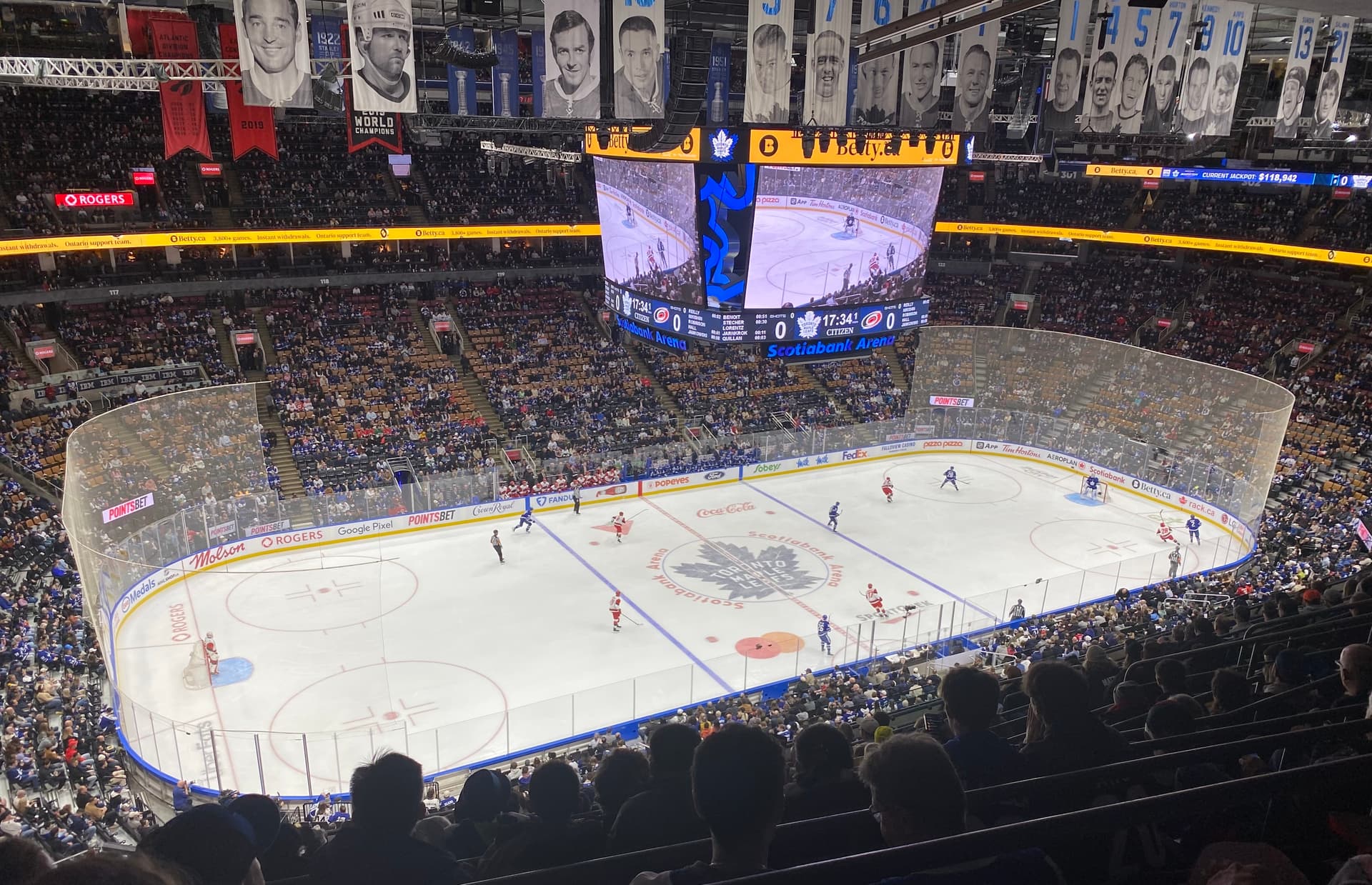
Photo: Adam Bishop, Wikimedia Commons (BY-SA-4.0)
Matthew Knies Contract Is Toronto's Best Asset After Deadline Day
Table of Contents
The Matthew Knies contract was signed in June 2025 and nobody has thought hard about it since. Six years, $46.5 million, a $7.75 million cap hit running through 2030-31. At the time it read as a fair price for a young power forward coming off a 29-goal, 58-point season. After what happened to the winger market on September 15, it reads as the single most valuable piece of paper John Chayka owns.
On the last day eight-year contracts were legal, Ottawa gave Drake Batherson $10.75 million a season and Washington gave Ryan Leonard $10.5 million. Leonard is 21 and has played one full NHL season. Toronto has a bigger, more physical winger, signed for three million dollars a year less, with five seasons of term still on it.
What the Matthew Knies contract actually costs Toronto
Knies carries a $7.75 million cap hit against a $104 million ceiling. That is 7.5 per cent of the cap for a top-six left winger who plays on Auston Matthews' line, kills nothing, and does the physical work Toronto's forward group has historically refused to do.
The deal has no no-trade protection, which is the detail that turns a good contract into an asset. Chayka can move Knies anywhere, to anyone, at any time, without a conversation about lists. That is rare for a player of this quality and it is the reason his name surfaced in trade speculation all summer despite Toronto having no intention of moving him.
The term is the other half. Five more seasons after this one takes Knies through the years where wingers are typically most productive, at a number the market has already blown past. Every year the cap rises, the contract gets better. Chayka did not negotiate it — Brad Treliving did — and it may end up being the most useful thing the previous regime left behind.
What deadline day did to the winger market
September 15 was not a normal Tuesday. It was the last day a club could register an eight-year contract before the new collective bargaining agreement capped re-signings at seven years and free-agent signings at six. Teams that wanted maximum term had one window and they used it.
Batherson's eight-year, $86 million extension made him the highest-paid player in Senators history at $10.75 million per season. Leonard's eight-year, $84 million deal in Washington carries a $10.5 million AAV, kicks in for 2027-28 and runs through 2034-35, and ties him with Alex Tuch for the highest cap hit on the Capitals. Leonard scored 20 goals and 45 points in 75 games as a rookie last season. That is the number a team is now willing to pay for one season of evidence and a high draft pedigree.
Add Adrian Kempe and Tuch crossing $10 million earlier this offseason and the picture is unambiguous: the second tier of NHL wingers now costs eight figures. Knies is, on any reasonable evaluation, in that tier or above it.
Why this makes Knies untouchable — and valuable
Those two words normally contradict each other. Here they do not.
The reason Knies is valuable in trade is exactly the reason Toronto should not trade him. A 23-year-old power forward at $7.75 million with five years of term and no trade protection is the kind of contract a contending team will overpay for, because nothing like it is available in free agency any more — the new CBA's six-year maximum for players changing teams makes it structurally impossible to acquire that much cost-controlled term on the open market.
Chayka said in July that a Knies trade was not probable, and the market has spent the two months since proving him right. The return required to justify moving him has gone up, not down. Any team calling now is asking Toronto to sell the one contract on its books that beats the market by three million dollars a year.
There is a version of this where a Knies trade makes sense — a genuine first-line centre coming back, or a legitimate No. 1 defenceman on comparable term. Dylan Larkin does not qualify, and neither does anything Detroit could package around him. Short of that, moving Knies is the kind of move that looks defensible in a press conference and indefensible in three years.
The cap math that makes it matter now
Toronto enters camp roughly $2.75 million over the ceiling, expecting Max Domi's long-term injured reserve placement to sort compliance. The club sits at the 50-contract limit. There is no room to add, and the flexibility that does exist arrives later, in 2028, when the current commitments start rolling off.
That is precisely why bargain contracts matter more to this roster than to most. Matthews at $13.25 million is market rate. Sergei Bobrovsky at $7 million for three years is a bet. Morgan Rielly at $7.5 million is an overpay Toronto could not move. Knies is the one place where the Leafs are getting more than they pay for, and it is carrying real weight on a cap sheet with very little slack in it.
The next one has to come from inside. Easton Cowan's second contract is the obvious candidate, and Gavin McKenna's entry-level deal is a three-year cap weapon whether or not he scores 30. Chayka's cap plan does not work without young players outperforming their contracts, which is another way of saying it does not work without keeping them.
How it compares to the rest of Toronto's core
Run the roster and the pattern is clear. Matthews at $13.25 million through 2027-28 is what a franchise centre costs — no discount, no overpay. William Nylander is signed long-term at a number that looked large when he got it and looks ordinary now. Bobrovsky at $7 million is a three-year bet on a goaltender in his late thirties. Rielly at $7.5 million is money Toronto tried and failed to move.
Knies is the only one of the group where the gap between production and price is trending in the club's favour and will keep trending that way as the ceiling rises. If the cap reaches the levels the league has projected by 2029, a $7.75 million power forward on a first line becomes something close to free.
That is how teams build depth without cap space, and it is the only mechanism available to a club sitting at the 50-contract limit with no room to sign anyone. Toronto does not need to find money. It needs its existing contracts to outperform, and this is the one already doing it.
The counterargument, honestly stated
A contract is only a bargain if the player holds his level. Knies plays a physical style that historically ages faster than a skill game, and he has done his best work beside Matthews — a linemate effect that is real and difficult to separate from individual value. If Jim Hiller's structure moves him down the lineup, or if Matthews misses time again after last season's surgery, the production case gets shakier fast.
It is also fair to note that $7.75 million is not free. It is one of the largest cap hits on the roster. If Knies plays like a good second-line winger rather than a first-line one, Toronto is paying market rate for a good player, not stealing anything. The bargain exists in comparison to Batherson and Leonard, not in isolation.
What's next
Knies plays at most two of Toronto's four preseason games under the new CBA's veteran limit, which means very few live looks before the season opens September 29 against Montreal. The real evaluation starts then: whether he holds the left side beside Matthews, whether Hiller's system asks him to do different things, and whether the 84-game schedule wears down a player who hits as often as he does.
For now, Toronto has the best value contract in the Atlantic Division and a general manager who has said he intends to keep it. Given how September 15 went across the rest of the league, that is the correct answer. You can see the full cap picture on our contracts page and follow the camp battles on the players page.
Frequently Asked Questions
What is Matthew Knies' contract with the Maple Leafs?
Knies signed a six-year, $46.5 million extension in June 2025. It carries a $7.75 million average annual value and runs through the end of the 2030-31 season, after which he would become an unrestricted free agent.
Does Matthew Knies have a no-trade clause?
No. The contract includes no trade protection, which means John Chayka can move Knies to any team without his approval. That lack of protection is part of why his name appeared so often in 2026 offseason trade speculation.
Why is Matthew Knies' contract considered a bargain?
The winger market moved past him. On September 15, 2026, Drake Batherson signed for $10.75 million per season and Ryan Leonard for $10.5 million, while Adrian Kempe and Alex Tuch had already crossed $10 million earlier in the offseason. Knies is signed at $7.75 million with five seasons of term remaining.
Will the Maple Leafs trade Matthew Knies?
John Chayka said in July 2026 that a Knies trade was not probable, and nothing since has changed that. Toronto would need a first-line centre or a genuine top-pairing defenceman on comparable term coming back to justify moving the best value contract on its cap sheet.
How much cap space do the Maple Leafs have in 2026-27?
None. Toronto entered training camp roughly $2.75 million over the $104 million ceiling and at the 50-contract limit, with Max Domi's expected long-term injured reserve placement the most likely route to compliance rather than a trade.
How does the new CBA affect trading for young wingers?
It makes cost-controlled term harder to acquire. Under the agreement that took effect September 16, 2026, a player signing with a new team can receive a maximum of six years, so long-term value contracts like Knies' can only be created by the team that already holds a player's rights.
What did Matthew Knies score before signing his extension?
Knies recorded 29 goals and 58 points in 78 games, setting career highs in goals, assists and points, and averaged 18:31 of ice time per game. He added seven points in 13 playoff games before signing the six-year extension in June 2025.