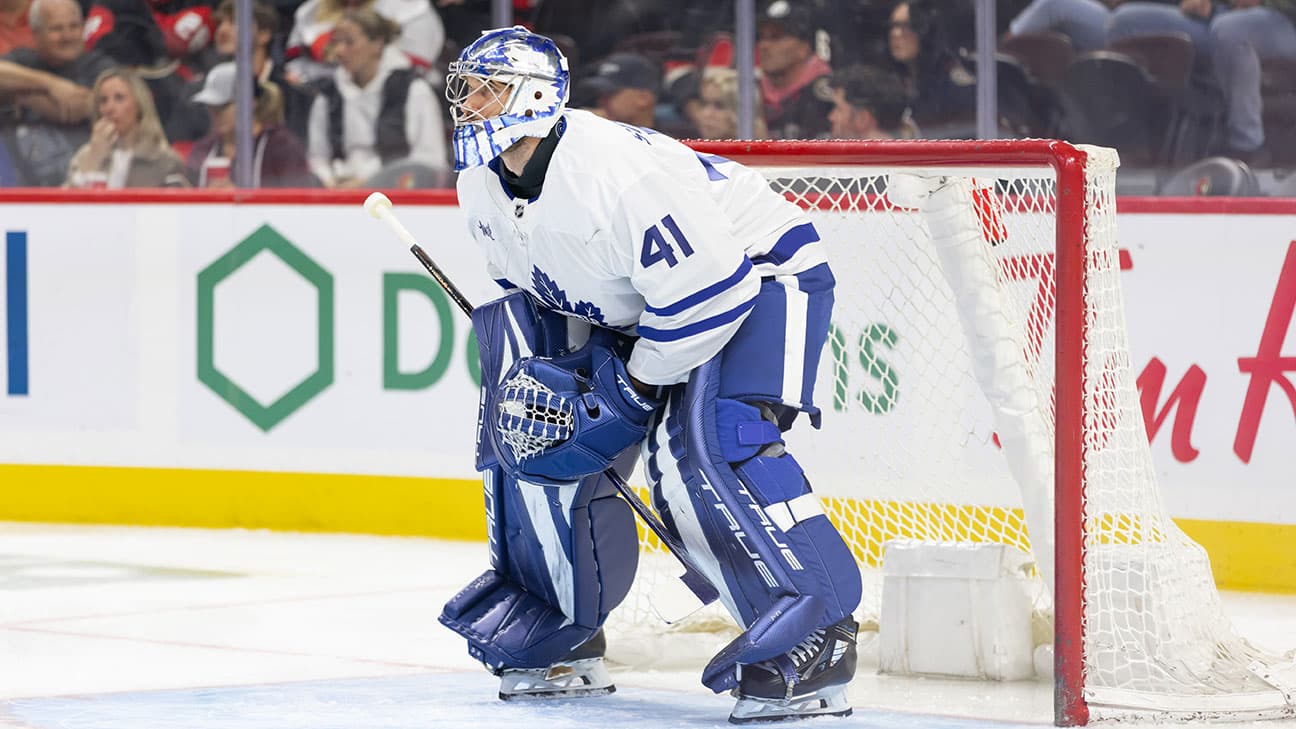
Photo: NHL.com
Jack Campbell Retires — What His Maple Leafs Run Really Meant
Table of Contents
Jack Campbell retires after eight NHL seasons
Jack Campbell retires from professional hockey at 34, closing a career that ran from the 11th pick of the 2010 draft to an All-Star appearance in a Toronto Maple Leafs sweater to a buyout in Edmonton and a quiet finish in the American Hockey League. The announcement, which surfaced in the back half of July, was not a surprise — Campbell had not played an NHL game since the 2023-24 season — but it still landed with weight in Toronto, where he remains one of the more genuinely beloved athletes of the last decade.
He is not going into coaching in the conventional sense. Campbell said he is beginning a second act as an identity and performance coach, working with people rather than goaltenders. Per his retirement statement, as reported by TSN and NHL.com:
The work that brought me the most fulfillment wasn't stopping pucks, it was helping people become who they're capable of becoming.
That is a very Campbell way to leave. It is also a reasonable moment to be honest about what he was, what he wasn't, and why the franchise he left behind has spent the four years since trying to solve the exact problem his departure created.
What Jack Campbell actually did in Toronto
The numbers are better than the memory. In a Maple Leafs uniform Campbell went 51-14-9 with a 2.50 goals-against average and a .916 save percentage. That is not a fluke sample or a hot month — that is a starter's body of work over parts of three seasons, and it is comfortably the best stretch of his career.
He arrived from Los Angeles in February 2020 as a depth acquisition and a personality hire as much as anything, and then immediately outplayed the assumption. In 2020-21 he set a Maple Leafs franchise record for consecutive wins by a goaltender, a run that carried Toronto through a stretch where Frederik Andersen's body had stopped cooperating. In 2021-22 he was named to the All-Star Game and finished the year with 31 wins and a 2.64 goals-against average.
Across his full NHL career — Dallas, Los Angeles, Toronto and Edmonton — Campbell went 93-52-18 with a 2.76 goals-against average, a .909 save percentage and 10 shutouts in 176 regular-season games. Roughly half of those wins came in Toronto. He never won a Stanley Cup.
The 2021-22 season, and the seven-game series that defined it
Campbell's peak and his unravelling happened inside the same calendar year. He was arguably the best goaltender in the league through the first two months of 2021-22 and was a legitimate early Vezina talking point. By February the save percentage had slid, the workload had caught up, and Toronto was managing his starts rather than riding him.
Then came the first round against a Tampa Bay Lightning team that had won the previous two Stanley Cups. The Maple Leafs led that series 3-2 and led Game 6 by a goal after two periods. They lost in seven. It was the sixth straight first-round exit of the Matthews era, and it was the last hockey Campbell played in Toronto.
The fair reading is that Campbell was neither the reason Toronto had a chance in that series nor the sole reason it ended. He was a good goaltender having an ordinary series against a great team. But in this market, a goaltender who is merely fine in a Game 7 becomes the story, and that framing followed him out the door.
The Edmonton contract that ended the career
Campbell signed a five-year, $25 million contract with the Edmonton Oilers on July 13, 2022. It did not work. He went 1-4-0 with a 4.50 goals-against average and an .873 save percentage in five appearances in 2023-24 before being placed on waivers in November 2024, and the final three seasons of the deal were bought out.
He signed a one-year contract with the Detroit Red Wings on July 1, 2024, and never appeared in an NHL game for them, playing 14 games for Grand Rapids in the AHL instead. That was effectively the end.
The Campbell contract is now a standard reference point in cap-management arguments across the league, and for good reason: a mid-tier goaltender coming off one strong season, paid $5 million a year for five years by a contender with no room for error, is a specific and repeatable way to lose a window. It is worth reading alongside our breakdown of the eight-year bet Toronto just made on Darren Raddysh, because the underlying question — how much term do you give a player coming off a career year — is identical.
The lesson Toronto appears to have finally learned
Since Campbell left, the Maple Leafs crease has been a rotating problem. Ilya Samsonov, Joseph Woll, Anthony Stolarz, Dennis Hildeby, Martin Jones — Toronto has cycled through more goaltending configurations than any other position group, and the common thread has been an unwillingness to commit real money to the position.
John Chayka broke that pattern this summer, but on his own terms. Rather than paying a 28-year-old for five or six years on the strength of one season, he signed 37-year-old Sergei Bobrovsky to a shorter, front-loaded commitment and reunited him with Stolarz, his Stanley Cup partner in Florida. It is a bet on the next two or three years rather than the next six. Our full look at the Bobrovsky-Stolarz tandem lays out how the starts are likely to split, and the signing itself is where the term-versus-risk logic gets argued out.
Behind them sits Artur Akhtyamov, a Calder Cup champion who profiles as the organization's goaltender of the near future and who, for now, gives Toronto an internal answer it did not have in 2022. Our piece on Akhtyamov's path behind Bobrovsky covers what a realistic timeline looks like.
Why Campbell mattered more than his save percentage
There is a version of this piece that treats Campbell as a cautionary tale and stops there. That version is incomplete. He was, by every available account, the most popular teammate in that room during a period when the room badly needed one, and he was the rare Toronto athlete who seemed to actively enjoy playing in Toronto rather than endure it.
That is not a statistic and it does not win playoff series. But the Maple Leafs teams of 2020 through 2022 were a fragile group carrying an enormous amount of external pressure, and Campbell's willingness to absorb some of it — to answer for bad nights, publicly and without deflection — was a real contribution. Goaltenders who do that are not common.
His post-playing plan reads as an extension of the same instinct. Identity and performance coaching is a soft-sounding job title that describes something the sport has quietly needed for a long time, and Campbell spent his career living the problem: a first-round goaltending pick who spent most of his twenties in the minors, then got very good very late, then lost it again. There are worse qualifications.
What's next
Campbell will not be back at Scotiabank Arena in a hockey capacity any time soon, and there is no jersey retirement coming — 51 wins and one All-Star nod does not get you to the rafters in a franchise with this much history. What he gets instead is a specific and durable place in Leafs memory: the goalie from the good-but-not-good-enough era who was easy to root for and hard to blame.
For the current team, the timing is almost too neat. Toronto opens 2026-27 with the most experienced goaltending duo it has had in years, a first overall pick in the fold, and a first-time head coach in Jim Hiller trying to reset a defensive structure that ranked among the league's leakiest last season. If you want the wider picture of what the roster looks like heading into camp, start with our projected 2026-27 lineup and the current contract and cap page.
Campbell's career is the reminder underneath all of it. Goaltending is the position where a franchise's plan gets tested first, and Toronto spent four years learning that the hard way after letting a good one walk.
Frequently Asked Questions
Why did Jack Campbell retire from the NHL?
Campbell had not played an NHL game since 2023-24 and spent 2024-25 in the AHL with Grand Rapids after signing a one-year deal with Detroit that never produced an NHL appearance. He announced his retirement in late July 2026 at age 34 and said he is moving into work as an identity and performance coach.
What were Jack Campbell's stats with the Maple Leafs?
Campbell went 51-14-9 with a 2.50 goals-against average and a .916 save percentage for Toronto. His best season was 2021-22, when he recorded 31 wins with a 2.64 GAA and was named to the NHL All-Star Game.
Did Jack Campbell ever win a Stanley Cup?
No. Campbell played 18 career NHL playoff games, going 7-8 with a 2.28 goals-against average, and never reached a Stanley Cup Final. His deepest run ended in a seven-game first-round loss to the two-time defending champion Tampa Bay Lightning in 2022.
What was Jack Campbell's contract with the Edmonton Oilers?
Campbell signed a five-year, $25 million contract with Edmonton on July 13, 2022, carrying a $5 million cap hit. He was placed on waivers in November 2024 and the final three years of the deal were bought out.
What are Jack Campbell's career NHL numbers?
Across 176 regular-season games with Dallas, Los Angeles, Toronto and Edmonton, Campbell went 93-52-18 with a 2.76 goals-against average, a .909 save percentage and 10 shutouts. He was originally drafted 11th overall by Dallas in 2010.
Who are the Maple Leafs' goalies for the 2026-27 season?
Toronto signed Sergei Bobrovsky in free agency and pairs him with Anthony Stolarz, reuniting the tandem that won a Stanley Cup together in Florida. Artur Akhtyamov, a Calder Cup winner with the Marlies, is the organization's third goaltender and is expected to start the season in the AHL.
When did Jack Campbell join the Maple Leafs?
Toronto acquired Campbell from the Los Angeles Kings in February 2020. He served as the primary starter for parts of the following two seasons before leaving as a free agent for Edmonton in July 2022.


