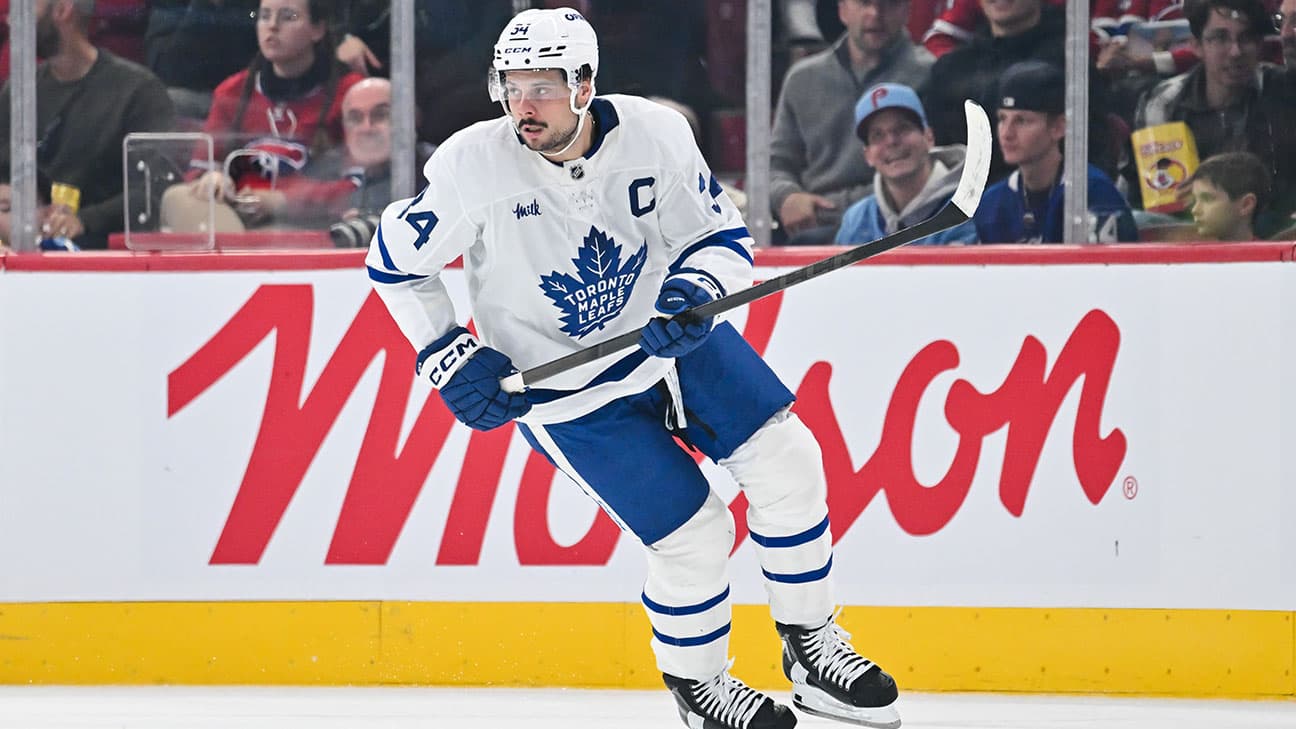
Photo: NHL.com
Gavin McKenna's Linemates Are the Real Question of Leafs Camp
Table of Contents
Gavin McKenna's linemates, not his roster spot, are the actual decision facing Jim Hiller when training camp opens. The first overall pick is playing in the NHL this season — that argument ended in July. What has replaced it is a harder question with no obviously correct answer: does Toronto put its 18-year-old on Auston Matthews' wing on opening night, or does it build him a softer landing with John Tavares and let him grow into the top line by December?
Why the Gavin McKenna linemates question is genuinely hard
Start with what McKenna actually is. He put up 15 goals and 36 assists for 51 points in 35 games at Penn State, setting the program's freshman records for assists and points and winning Big Ten Freshman of the Year. After returning from the World Juniors he scored 32 points in his next 18 games — the stretch that ended most of the debate about whether he was the right No. 1 pick. He signed his entry-level contract in early July and has been in Toronto since.
He is a playmaker first. That is the whole scouting profile: vision, deception, the ability to hold the puck an extra beat and make a defender commit. It is also the profile most sensitive to the quality of the players around him, which is why this is not a trivial lineup exercise. A playmaker with finishers scores 60 points. A playmaker without them scores 40 and looks like he's forcing plays.
The obvious answer, then, is Matthews — put the best passer on the roster next to the best shooter on the roster and let the arithmetic do the work. Most public projections have landed there. The line that keeps showing up is McKenna–Matthews–William Nylander, with Easton Cowan–Tavares–Matthew Knies behind it. On paper it is the most talent Toronto has assembled on one line in years.
The case against putting McKenna with Matthews on day one
Here is our position, and it is the less popular one: start McKenna with Tavares.
The reasoning has nothing to do with doubting the kid. It has to do with what Toronto cannot afford to get wrong. Matthews' bounce-back is the single load-bearing element of this season. He scored 27 goals and 53 points in 60 games last year, a rate of 0.45 goals per game — the lowest of his career — across a season shaped by the knee injury that ended it in March. Everything Chayka built this summer assumes Matthews returns to something close to himself. Tying that recovery to an 18-year-old's adjustment curve puts two variables on the same line.
There is also a tactical wrinkle that analysts keep circling. Matthews has historically been at his most dangerous with a right-shot setup man feeding him on his forehand — the Mitch Marner effect, and to a lesser extent Nylander. That is why Jack Roslovic's name keeps appearing in projected top-six combinations that otherwise make little sense. Roslovic is a right shot who can carry a puck and has scored 20-plus goals in three of the past five seasons, including each of the last two. He is a worse player than McKenna. He may still be a better fit on that specific wing in October.
Meanwhile the second line is where a rookie playmaker gets to be a rookie playmaker. Tavares remains an elite net-front and bumper option who reads give-and-go hockey as well as anyone on the roster, and Knies is a genuine finisher who scored 23 goals with a career-high 43 assists for 66 points in 79 games last season. Softer matchups, more offensive-zone starts, two linemates who will get to loose pucks McKenna creates. That is the environment you build for a first overall pick, not a trial by Aleksander Barkov.
The power play is where the argument resolves itself
None of this is an argument for sheltering McKenna. It is an argument about which minutes he gets, and the power play is where the two positions collapse into agreement.
Toronto's power play converted at 16.8 per cent last season, 25th in the NHL, down from 24.8 per cent the year before. Daniel Alfredsson arrives as associate coach after running an Ottawa unit that finished around 24 per cent and eighth overall. Darren Raddysh, signed to eight years, led the league in shot attempts of 90 miles per hour or faster. Put McKenna on that first unit from day one — half-wall, puck on his stick, Matthews at the top of the circle and Knies at the net — and he gets three to four minutes a night of exactly the hockey he is best at, without needing to survive a shutdown pair at five-on-five to earn it.
We made the case for McKenna on PP1 from the first game earlier this summer and nothing since has changed it. If anything, the coaching change strengthens it. Alfredsson's units in Ottawa were built around a playmaking distributor on the wall rather than a static overload, which is close to the ideal structure for what McKenna does.
What Hiller has actually said, and what he hasn't
Hiller has been careful, which is sensible for a coach who has not run a practice yet in this job. The public framing from the organization has been about giving McKenna a real opportunity while managing a developmental balance — the standard language, and probably the honest one. Chayka and Mats Sundin have spent the summer talking about rebuilding around Matthews rather than around the rookie, which is a meaningful tell about internal priorities.
What nobody in the building has said is that McKenna is guaranteed anything. His participation in the NHL Prospect Challenge on Sept. 12-13 has been described as up in the air as he manages the transition from Penn State to full-time professional life, which he has acknowledged has been harder than he expected. That is a normal thing for an 18-year-old to say and an abnormal thing to say publicly, and it is worth taking at face value rather than reading disaster into it.
Camp itself is short. Four preseason games under the new collective bargaining agreement is not much runway to test three different line configurations, which argues for Hiller picking a plan early and committing. Our read: he opens with McKenna in the top six somewhere, PP1 regardless, and treats the specific centre as a variable he can change in week three without anyone calling it a demotion.
The nine-game decision looming behind all of this
There is a structural deadline underneath the lineup debate. A player on an entry-level contract who appears in fewer than 10 NHL games has his contract slide, pushing the deal's start back a year. Once McKenna plays his 10th game, the clock starts and Toronto's control window is set.
Nobody seriously expects Toronto to send McKenna back after nine games. But the deadline does shape the first month: whatever role he is given, the organization wants a clear answer by mid-October rather than a muddy one in December. That argues against parking him on the fourth line to "learn the league," and in favour of the Tavares line — enough minutes and enough puck touches to actually evaluate, without the exposure of the toughest matchup every night. We broke down the nine-game slide math separately; the short version is that it is a real decision point and not a formality.
Where the rest of the top six shakes out
The knock-on effects matter. If McKenna slots with Tavares, Cowan is the one squeezed — and Cowan, a Calder Cup champion with the Marlies coming off a strong first professional season, has his own case for top-nine minutes. If McKenna goes with Matthews instead, Nylander and Roslovic both have claims to the right side and one of them ends up on the third line, which is either excellent depth or a misallocation depending on your mood.
Toronto also still has the bottom-six logjam it created on July 1 — Sissons, Blueger, Roslovic, Duhaime, Lorentz, Joshua and Zack MacEwen competing for a shrinking number of jobs. That crunch is the reason the top-six decision cannot be made in isolation. Every shift McKenna takes on the second line is a shift somebody else does not take. We mapped the full picture in our look at which roster spots are genuinely open.
What's next
The first real signal comes at camp, and it comes fast. Watch the opening practice line rushes, then watch who is on the ice for the first power-play unit — that is the tell that actually matters. If McKenna is on the half-wall with Matthews and Raddysh on the first unit, the organization has answered the important question regardless of who takes his five-on-five draws.
Our prediction: McKenna opens the season on Tavares' line, plays roughly 15 minutes a night at five-on-five, gets PP1 minutes from game one, and is on Matthews' wing by American Thanksgiving. That is not caution. It is the version of the plan where both players get what they need in October, which is the only month Toronto can afford to be patient in.
Frequently Asked Questions
Who will Gavin McKenna play with on the Maple Leafs?
Most public projections have McKenna on the top line with Auston Matthews and William Nylander, with Easton Cowan, John Tavares and Matthew Knies on the second unit. Jim Hiller has not committed publicly, and a second-line role alongside Tavares and Knies remains a realistic opening-night alternative.
Will Gavin McKenna play on the Maple Leafs power play?
He is the strongest candidate for the first unit. Toronto's power play ranked 25th in the NHL last season at 16.8 per cent, down from 24.8 per cent the year before, and new associate coach Daniel Alfredsson arrives from an Ottawa unit that ran around 24 per cent. McKenna's playmaking is the clearest available fix.
What were Gavin McKenna's stats at Penn State?
McKenna posted 15 goals and 36 assists for 51 points in 35 games as a freshman at Penn State, setting program freshman records for assists and points and earning Big Ten Freshman of the Year. He scored 32 points in 18 games after returning from the World Juniors.
Can the Maple Leafs send Gavin McKenna back to junior?
In practice, no. Toronto is not expected to return its first overall pick. The relevant mechanic is the entry-level slide: a player who appears in fewer than 10 NHL games has his contract start pushed back a year, which makes the first nine games a soft decision point rather than a genuine plan.
Is Gavin McKenna playing in the NHL Prospect Challenge?
His participation in the Sept. 12-13 tournament in Gatineau has been described as up in the air. McKenna has said the transition from Penn State to full-time pro life has been harder than he anticipated, and Toronto may hold him out in favour of a full main training camp.
Why would the Maple Leafs not play McKenna with Auston Matthews?
Two reasons. Matthews' return to form after knee surgery is the season's most important variable and tying it to a rookie's adjustment adds risk, and Matthews has historically produced most with a right-shot setup man on his flank. A second-line role with Tavares offers softer matchups without costing McKenna power-play time.
How many preseason games will Gavin McKenna get to prove himself?
Very few. The new collective bargaining agreement caps the preseason at four games per team, and Toronto plays two against Montreal and two against Ottawa between Sept. 19 and the end of the month. That compressed runway is a reason Hiller is likely to commit to a plan early rather than experiment.


