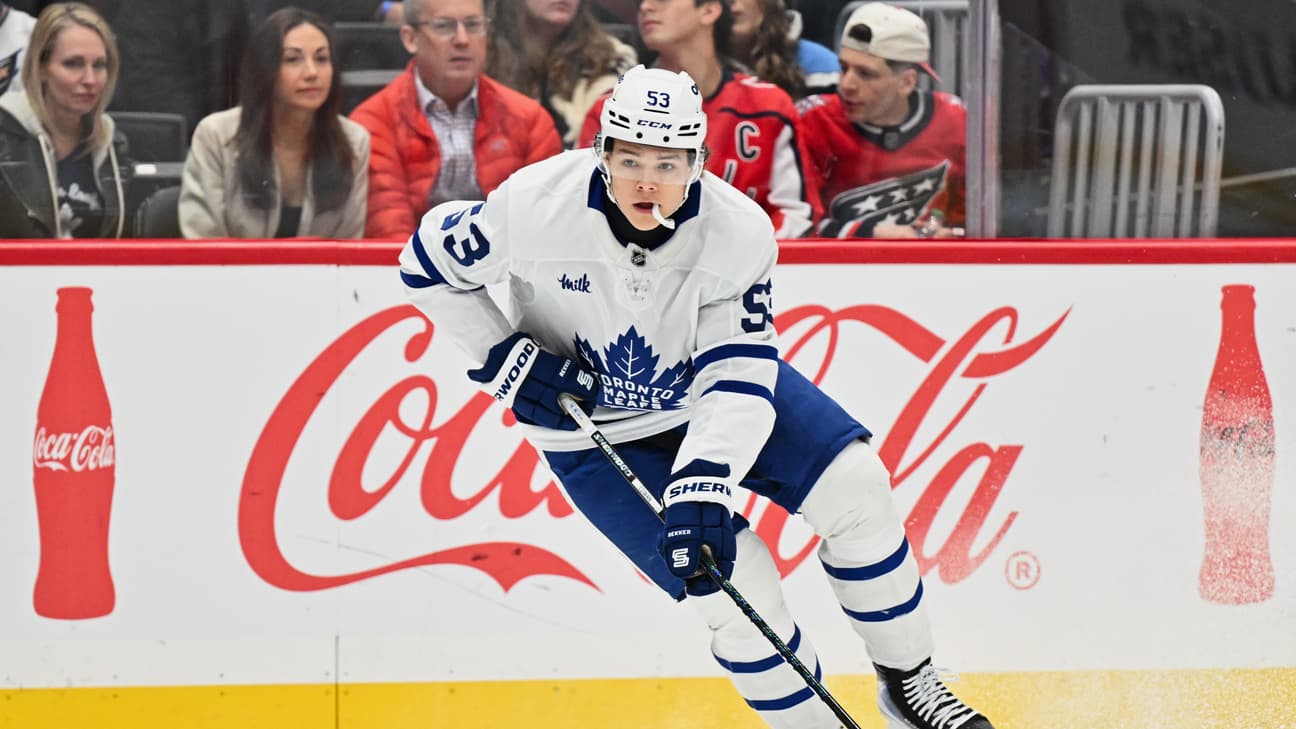
Photo: NHL.com
Maple Leafs Training Camp 2026: Which Roster Spots Are Actually Open
Table of Contents
The Maple Leafs training camp roster spots that are genuinely up for grabs
Training camps open across the NHL on Sept. 16, which gives Jim Hiller thirteen days to sort a lineup before Toronto hosts Montreal on Sept. 29. The honest read on Maple Leafs training camp roster spots is that most of this team is already decided — John Chayka spent July making sure of that — and the real competition is concentrated in about four jobs up front.
That is a very different camp than the last several. Toronto usually arrives in September with a settled top six and a scrum of AHL forwards fighting for the fourth line. This year the fourth line is essentially bought and paid for, and the open questions are higher in the lineup than they have been in years.
Here is what is actually decided, what is not, and what the compressed calendar does to all of it.
The locks
Auston Matthews, William Nylander, Matthew Knies and John Tavares are in the top six. That is not a competition, it is a fact of the cap sheet. Nick Paul, Colton Sissons, Teddy Blueger and Brandon Duhaime were all acquired this summer to play specific roles and will play them.
On the blue line, Morgan Rielly, Jake McCabe, Chris Tanev and Darren Raddysh are the top four. Sergei Bobrovsky and Anthony Stolarz are the goaltenders. None of that is in doubt.
Add it up and roughly 16 or 17 of the 20 roster spots that matter are spoken for before a single skate hits the ice. Which is the point of the summer Chayka just had — and also why the remaining jobs carry so much weight.
The two top-six wing spots
This is the marquee competition, and it is a three-into-two problem: Gavin McKenna, Easton Cowan and Jack Roslovic for two spots alongside the established four.
McKenna is the first overall pick and the reason Leafs fans have been counting days since May. He is 18, he signed his three-year entry-level deal in July, and the organization has been careful not to promise him anything. Morgan Rielly said this month he expects McKenna to be flying around at camp, which is what teammates say about first overall picks, and also what teammates say when they have watched a player in summer skates and come away impressed.
The complication is structural, not about talent. Toronto has a decision to make about McKenna's entry-level contract before his tenth NHL game — we broke down the nine-game slide rule and what it costs — and that decision is easier to make from a position of not having promised him a top-six job in September.
Cowan is the counterweight. He turned 21 this year, spent last season going from an opening-night healthy scratch to a player regularly logging over 20 minutes by April, and has spent the summer working on speed and strength. He is the one Leafs prospect who has already proven he can handle NHL minutes on a bad team, which is a genuinely difficult thing to do. We argued in August that Chayka should not trade him, and the reasoning holds: Cowan is cheap, improving, and the exact profile a cap-constrained team needs.
Roslovic is the veteran variable. He signed a two-year, $8 million deal on July 1 after scoring 21 goals in 69 games with Edmonton, and he has a well-documented relationship with Matthews. A coach who wants a safe answer at 1RW has one.
My guess: Cowan and Roslovic open in the top six, McKenna starts on the third line with a heavy power-play assignment, and the depth chart is completely different by American Thanksgiving.
The third-line centre job
Nick Paul is the favourite and probably the answer. Acquired from Tampa Bay this summer, he brings faceoff ability, a heavy forechecking game and the defensive detail that Toronto's third line has lacked for most of the Matthews era. We wrote about what the Paul acquisition actually solves when it happened.
The interesting wrinkle is what happens if Hiller decides he would rather have Paul on the wing next to Tavares, which would open the 3C job to Blueger or Sissons and shift the whole bottom six. Both are capable of centring a fourth line; neither is a natural third-line option on a team with playoff ambitions.
Watch the faceoff deployment in preseason. It will tell you what Hiller has decided before he says it.
The 12th and 13th forward spots, and the cap
This is where the roster gets decided by accountants rather than coaches. Toronto is projected roughly $2.75 million over the $104 million ceiling and has to be compliant by Sept. 28. The likeliest path runs through Max Domi's LTIR status, which will not be known until camp opens.
If Domi can be placed on LTIR, Toronto carries something close to a full roster. If he cannot, the club has to shed salary, and the mechanisms are ugly: Zack MacEwen and his $875,000 to the Marlies, then Troy Stecher and his $1.35 million after that, then a bare-minimum roster with no injury cushion.
Which means the 13th forward job may not exist at all. That is a meaningful thing for a fringe player to walk into camp knowing, and it is why the compliance question in our opening-night cap breakdown is really a roster question in disguise.
The third pair on defence
Behind the top four, Toronto has Emil Andrae, Troy Stecher and a handful of Marlies. Andrae came over in the Joseph Woll trade in June and is the most interesting name — a mobile, undersized left-shot defenceman who has never been given a clean runway in the NHL. We flagged him as a sleeper fit on Toronto's blue line when the deal happened.
The question is whether Hiller trusts a 24-year-old with 5-foot-9 listed size on the third pair in a division that plays as heavy as the Atlantic. The alternative is Stecher, who is exactly what he is, and whose $1.35 million is also the second lever in the cap-compliance chain. Those two facts are related in a way that will not be discussed publicly.
Why the compressed calendar changes everything
Camp opens Sept. 16. The league-wide preseason runs Sept. 19 to 26 — an eight-day, 65-game window, the shortest exhibition schedule in modern NHL history, and a direct consequence of the new CBA expanding the regular season to 84 games. Toronto's first preseason game is Sept. 21.
That leaves a handful of exhibition games for Hiller to install a system, evaluate a first overall pick, sort three players into two top-six jobs and figure out whether his third pair is functional. We covered the evaluation crunch this creates earlier in August, and the effect is straightforward: incumbency wins ties.
A short camp favours the veteran. Roslovic gets the benefit of the doubt over McKenna not because he is better but because there is no time to be wrong. Rielly put it plainly this month — camp has to be good and hard and fast, because it is quick this year.
What's next
The Maple Leafs will announce their camp roster in the days before Sept. 16, and the number to watch is how many players are invited. A large group signals Chayka wants competition and Marlies depth on display. A tight group signals the roster is already written.
Given the summer — six new forwards, a new goaltender, a new coach installing a new structure, and a first overall pick who has never played an NHL game — my expectation is a tight group and a camp built around cohesion rather than tryouts. Hiller's job is not to find players. It is to make the ones already here play the same way by Sept. 29.
The one genuine unknown is Domi's medical, and it lands the same day camp opens. Everything downstream of it — the 13th forward, whether Stecher stays, how much rope Andrae gets — waits on that. Track the depth chart as it firms up on our players page, and check the contracts page for the cap picture as transactions come in.
Frequently Asked Questions
When does Maple Leafs training camp start in 2026?
NHL training camps open league-wide on Sept. 16, 2026. Toronto's first preseason game is scheduled for Sept. 21, and the regular season begins Sept. 29 at home against Montreal.
How long is the 2026 NHL preseason?
Eight days. The preseason runs Sept. 19 to Sept. 26, 2026, with 65 games across 36 venues. It is the shortest exhibition schedule in modern NHL history, shortened to make room for the new 84-game regular season.
Will Gavin McKenna make the Maple Leafs out of training camp?
He is expected to be on the roster, but the top-six job is not guaranteed. Toronto also has an entry-level contract decision to make before his tenth NHL game, which gives the club a reason to be deliberate about how quickly it commits.
Who is the Maple Leafs' third-line centre in 2026-27?
Nick Paul is the favourite. Acquired from Tampa Bay this summer, he brings faceoff ability, forechecking and defensive detail. If Hiller moves Paul to the wing, Teddy Blueger or Colton Sissons would compete for the job.
How many forwards will the Maple Leafs carry?
Roughly 13, and possibly fewer. Toronto is projected about $2.75 million over the $104 million cap and must be compliant by Sept. 28, so the 13th forward spot depends on whether Max Domi can be placed on long-term injured reserve.
Who are the Maple Leafs' top four defencemen?
Morgan Rielly, Jake McCabe, Chris Tanev and Darren Raddysh, who was acquired this summer. The third pair is open, with Emil Andrae — acquired in the Joseph Woll trade in June — and Troy Stecher the primary candidates.
Who did the Maple Leafs add in free agency in 2026?
Toronto signed forwards Colton Sissons, Brandon Duhaime, Teddy Blueger, Jack Roslovic and Zack MacEwen, plus goaltender Sergei Bobrovsky. Nick Paul was acquired by trade from Tampa Bay and Darren Raddysh was also added via trade.


