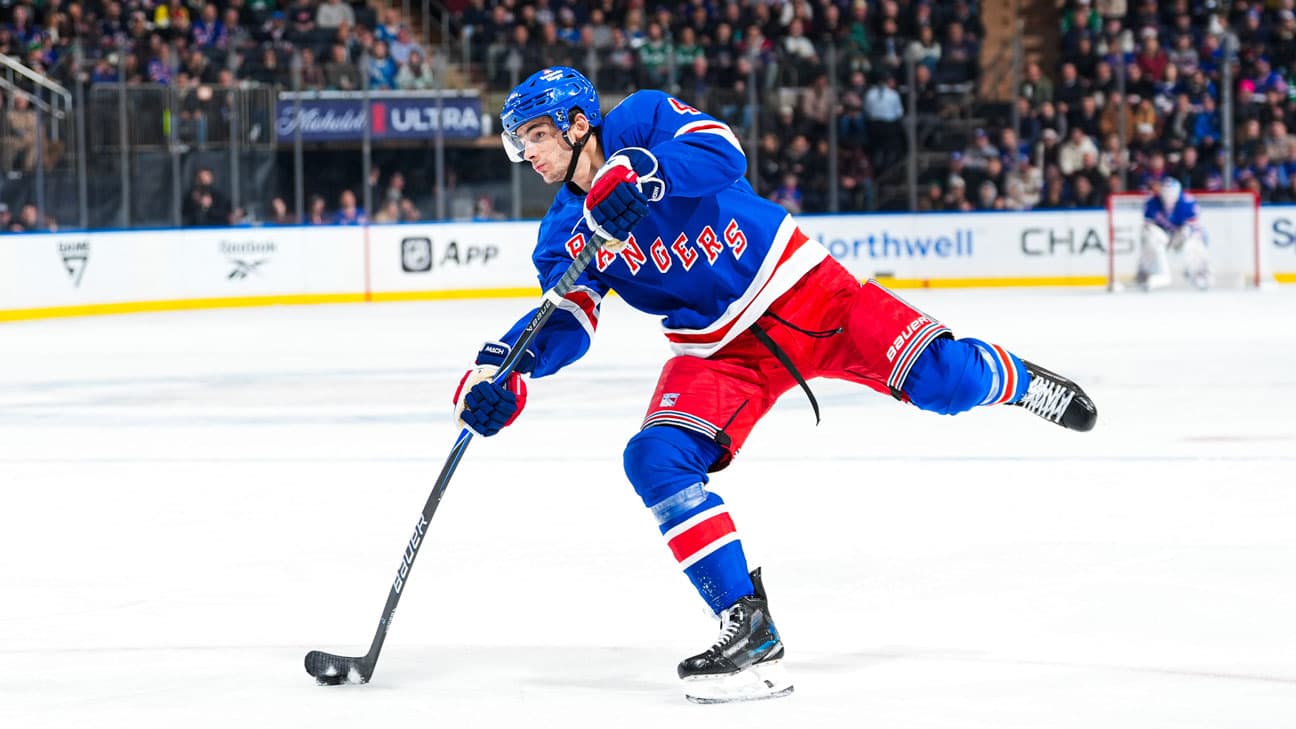
Photo: NHL.com
Braden Schneider Trade Rumours: Why the Maple Leafs Should Pass
Table of Contents
Braden Schneider is available, and Toronto keeps getting attached to him
The Braden Schneider trade rumours have circled back to Toronto, and the surface logic is easy to follow. The New York Rangers are willing to listen on their 24-year-old right-shot defenceman. The Maple Leafs have spent two summers hunting for right-side help. Schneider is exactly the kind of hard-edged, shot-blocking blueliner Toronto has historically overpaid to acquire in March. The fit writes itself.
It also does not survive contact with the Maple Leafs' actual depth chart or their actual cap sheet. This is a rumour built on a version of Toronto's blue line that stopped existing on July 1.
Schneider signed a one-year, $5.5 million contract with the Rangers in July after filing for salary arbitration on July 5. The two sides settled directly rather than walking into a hearing, and general manager Chris Drury never took his homegrown defenceman in front of an arbitrator. The structure of that deal — one year, a raise to a real number, no term — is the detail that matters most, and we will come back to it.
What a Braden Schneider trade would actually get Toronto
Start with the player, because he is genuinely good and the criticism here is not about his ability.
Schneider played all 82 games in 2025-26 and averaged 20:27 of ice time a night. He finished with two goals and 16 assists for 18 points. He led the Rangers in blocked shots with 140 and ranked third on the team in hits with 163. He is durable, physical, trusted with meaningful minutes against real competition, and he is 24 — young enough that the offensive side of his game could still tick up.
That is a legitimate second-pairing NHL defenceman. In a vacuum, most teams would take him.
The Maple Leafs are not a team operating in a vacuum. They are a team with eight defencemen who have a claim to a roster spot, a right side that is already the strength of the group, and no cap room to add a $5.5 million contract without subtracting one first.
Toronto's right side is already full, and already expensive
John Chayka's first offseason as general manager reshaped this blue line more aggressively than most fans have fully processed. The centrepiece was Darren Raddysh, acquired from Tampa Bay and signed to an eight-year extension at $8.5 million annually. Raddysh is coming off a 70-point season — 22 goals and 48 assists — that ranked sixth among all NHL defencemen in scoring. Whatever you think of the term, that is a top-pairing right shot with a signature skill, and he is locked in.
Behind him: Chris Tanev, healthy again after core muscle surgery ended his 2025-26 season in March, and expected back in a significant top-four role. Troy Stecher, re-signed on a two-year deal, is a right shot. The left side runs through Jake McCabe, Morgan Rielly, Oliver Ekman-Larsson and newly acquired Emil Andrae, who is already fighting a lineup logjam.
Count it out. That is seven or eight defencemen under contract for a six-man lineup, with the right side being the half that is already sorted. Adding Schneider does not fix a hole. It creates a scratch — an expensive one.
The cap math kills this before the hockey argument starts
Toronto is not close to cap compliant. Against the $104 million upper limit for 2026-27, the Maple Leafs are projected to be roughly $2.75 million over, a position that currently depends on Max Domi's injury and long-term injured reserve to resolve. Domi is out indefinitely after complications from offseason back surgery, and Chayka has said the club will have a clearer timeline at camp.
That is not a club with room to absorb $5.5 million. It is a club that has to send money out before it can take money in, and the only contracts big enough to make a Schneider trade balance are the ones Toronto would be least happy to move for a second-pairing defenceman.
This is the part the rumour never accounts for. A trade is not a wish. It is an equation, and the Maple Leafs' side of it has no slack in it right now.
The only version of this trade that makes any sense
There is one scenario where Schneider to Toronto becomes coherent: Morgan Rielly is traded first.
Rielly's situation has been the summer's longest-running stalemate. He carries a full no-movement clause for the next two seasons, which means he decides where he goes and whether he goes at all, and no deal has materialized because the price of moving his contract without a sweetener has not been acceptable to anyone. If that changes before camp, Toronto's blue line suddenly has a hole on the left, real money freed up, and a reason to shop.
Even then, Schneider is a right shot. He does not replace Rielly's role. He would be a second move, not the first one, and the first one has been stuck since June.
What New York is actually doing here
Read the contract. A one-year deal at $5.5 million for a 24-year-old restricted free agent is not how a team pays a player it plans to keep long term, and it is not how a team pays a player it has given up on either. It is a bridge that buys both sides a season of information.
It also had a procedural effect worth understanding: by filing for arbitration, Schneider made himself ineligible to receive an offer sheet this summer. Whatever leverage another club might have tried to apply, that door closed on July 5.
Reporting out of New York has been consistently skeptical that Drury actually moves him. The Rangers are looking for scoring, and Schneider is one of the few movable pieces who returns real value — but a team that just committed $5.5 million to a defenceman is not a team desperate to be rid of him. Treat "open to listening" as what it is. Every general manager is open to listening in August.
The independent take: Toronto should pass
LeafsLurker's position is that this is a bad use of the Maple Leafs' remaining flexibility, and it would be a bad use even if the cap situation were clean.
Toronto's roster problems in 2026-27 are not on the right side of the defence. They are goaltending variance, the top-six left wing question that Gavin McKenna and Easton Cowan are being asked to answer, and whether a group that missed the playoffs last spring has enough five-on-five offence to climb back into the Atlantic. Spending $5.5 million and an asset to add a seventh defenceman addresses none of that.
There is also an internal cost. Andrae was acquired to play. Ben Danford is pushing from the right side of the prospect pipeline. Chayka has spent the summer talking about role clarity and organizational structure, and blocking your own young defencemen with a one-year rental is the opposite of that.
If the price ever collapses — if New York eats salary, if the return is a mid-round pick, if Rielly moves first — revisit it. At the current price, on the current roster, it is a pass.
What's next
NHL training camps open in mid-September, and Toronto's regular season begins September 29 at home against Montreal. That gives Chayka roughly six weeks to become cap compliant, which is a real deadline with real consequences, and it is the constraint that will govern every move Toronto makes between now and opening night.
Expect the Schneider talk to keep resurfacing until the Rangers either trade him or the season starts. Expect Toronto's name to keep getting attached, because it always does. And expect the actual business, when it happens, to be about subtraction before addition. You can follow the running math on our Maple Leafs contracts page and track the roster on the players page as camp approaches.
Frequently Asked Questions
Are the Maple Leafs trading for Braden Schneider?
There is no reported trade in place. Schneider has been linked to Toronto in speculation because the Rangers are willing to listen and the Maple Leafs have historically wanted right-shot defence. Toronto is projected roughly $2.75 million over the $104 million cap for 2026-27, so any deal would require sending salary out first.
What is Braden Schneider's contract?
Schneider signed a one-year, $5.5 million contract with the New York Rangers in July 2026. He had filed for salary arbitration on July 5 before the two sides settled directly, which also made him ineligible to receive an offer sheet this summer.
How did Braden Schneider play in 2025-26?
He appeared in all 82 games and averaged 20:27 of ice time. He recorded two goals and 16 assists for 18 points, led the Rangers with 140 blocked shots and ranked third on the team with 163 hits.
Do the Maple Leafs need a right-shot defenceman?
Not urgently. Darren Raddysh signed an eight-year extension at $8.5 million annually after a 70-point season in Tampa Bay, Chris Tanev is healthy after core muscle surgery, and Troy Stecher is signed through 2027-28. The right side is the settled half of Toronto's blue line.
How much cap space do the Maple Leafs have for 2026-27?
None. Toronto is projected to be about $2.75 million over the $104 million upper limit, with compliance currently dependent on Max Domi's long-term injured reserve status. Domi is out indefinitely following complications from offseason back surgery.
Would a Morgan Rielly trade change the Schneider math?
It is the one scenario that would. Rielly holds a full no-movement clause for the next two seasons and has not been moved because the price without a sweetener has not worked for anyone. If he goes, Toronto frees money and opens a lineup spot — though on the left side, not Schneider's.
When does Maple Leafs training camp open?
NHL training camps open in mid-September 2026. Toronto opens the regular season September 29 at Scotiabank Arena against the Montreal Canadiens, which is the practical deadline for the Maple Leafs to become cap compliant.


