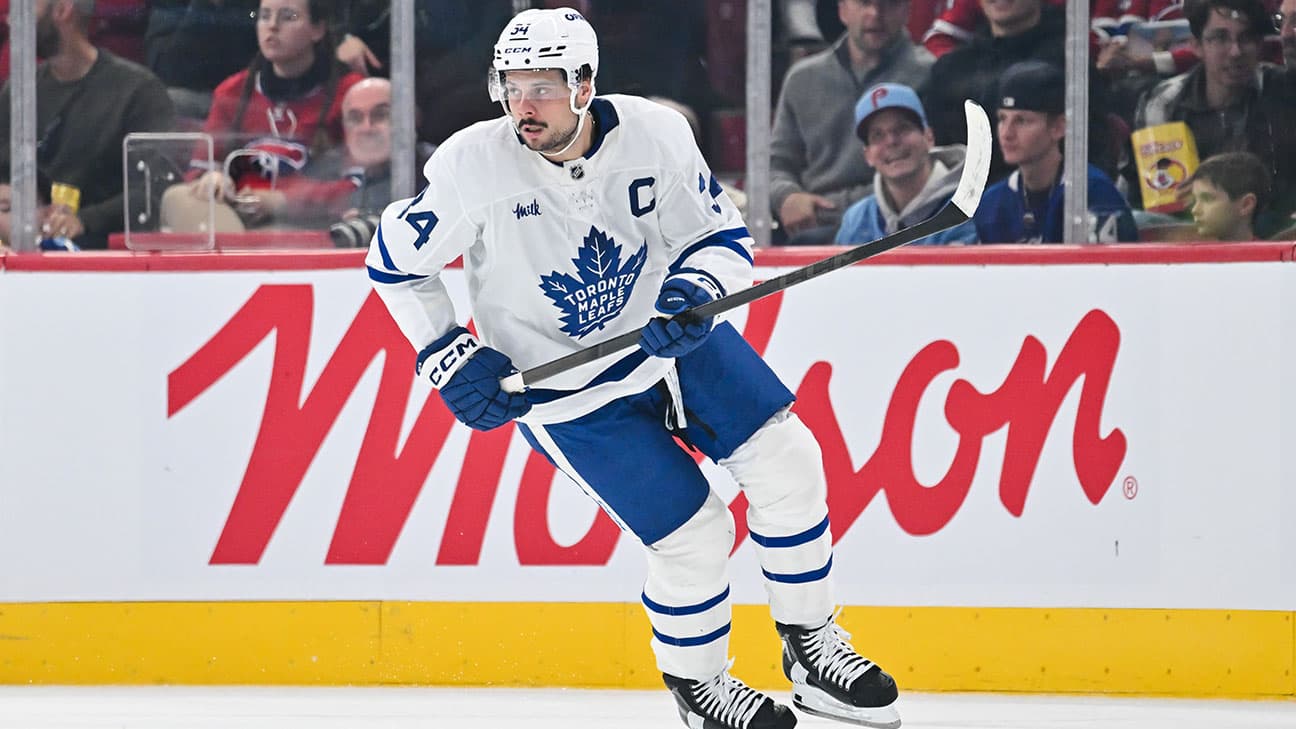
Photo: NHL.com
Opinion: Biron Has the Maple Leafs Finishing Second in the Atlantic. That's Too Rich.
Table of Contents
A Bold Maple Leafs Atlantic Division Prediction — and a Reality Check
The boldest Maple Leafs Atlantic Division prediction of the summer belongs to TSN's Martin Biron, who has Toronto climbing all the way to second in the division next season, joining Florida at the top. His reasoning is clean: a healthy, bounce-back year from Auston Matthews and much-improved goaltending. It is a defensible take. It is also, in my view, at least a tier too generous for a team that finished 8th in the Atlantic at 32-36-14 and watched the playoffs from home last spring.
Let me be clear about the frame here. This is not a case against the retool. John Chayka's summer has been genuinely good, and Toronto is a better, deeper, more sensibly built team than the one that limped to 8th. But there is a difference between "better" and "second in the toughest division in hockey," and the gap between those two things is where I part ways with Biron.
What Biron Gets Right
Start with the parts of the argument that hold up. Matthews playing a full, healthy season is worth more than any single acquisition Chayka could make. A knee injury sabotaged last year, and a return to form from a legitimate 60-goal threat is the kind of swing that moves a team up the standings on its own. If you believe Matthews is back to his peak — and there is every reason to — Toronto's ceiling rises immediately.
The crease is the other pillar. Swapping uncertainty for a proven veteran in Sergei Bobrovsky, alongside Anthony Stolarz, gives Toronto a tandem it can actually trust, a subject we dug into when the Bobrovsky signing reset the crease. Goaltending was a genuine problem last season, and better netminding turns a handful of one-goal losses into one-goal wins. Over 84 games, that math adds up.
Where the Second-Place Case Falls Apart
Here is my problem. Second in the Atlantic means finishing ahead of some combination of Tampa Bay, Ottawa, Montreal, Detroit and Boston — teams that were, by and large, better than Toronto last year and did not stand still. The Atlantic is not a division you rise four or five spots in on vibes and one healthy star. You do it by being demonstrably better across the roster, and Toronto's improvement, while real, is not that emphatic.
Consider the middle of the lineup. Max Domi is out indefinitely after back-surgery complications, which is exactly why Chayka keeps circling centre help, whether that is a Vincent Trocheck trade or an internal solution. A team that is one injury from thin down the middle is not a team I am comfortable slotting second in a brutal division.
Then there is the blue line, which is in flux. A Morgan Rielly trade that insiders call 'when, not if' would subtract Toronto's longtime power-play quarterback and top-pairing minutes-eater, and the plan to replace him leans on younger, cheaper, unproven players. That might work. It might also be a step back on a back end that was already middling. You do not usually project a team upward while it is actively trading away a top-four defenceman.
The Standings Aren't the Only Skeptics
The betting markets agree with me more than they agree with Biron. Sportsbooks have been notably cool on Toronto's retool, pricing the Leafs as a middle-of-the-pack playoff hopeful rather than a division threat — the exact gap we broke down in our look at why the books still don't buy Toronto's retool. When a respected analyst and the sharpest money in the sport disagree this much, I tend to trust the money.
None of this is to say Toronto is bad. A wild-card berth is a perfectly reasonable expectation, and if the young pieces pop and Matthews stays healthy, the ceiling is a comfortable playoff team. But "comfortable playoff team" and "second in the Atlantic" are separated by two or three clubs that have every intention of finishing there themselves.
Look at the Teams Toronto Has to Pass
The Atlantic does not hand out second-place finishes. Florida is the reigning class of the division and the presumed No. 1 seed in almost everyone's projection, Biron's included. That means Toronto's path to second runs directly through Tampa Bay, Ottawa, Detroit, Montreal and Boston — and every one of those teams has a credible argument to finish ahead of the Leafs.
Tampa Bay still has a championship spine and one of the best goaltenders alive. Ottawa is a young, ascending club that took a step last season and expects another. Montreal's rebuild has turned the corner into genuine relevance. Detroit keeps adding. To slot Toronto second, you are betting the Leafs finish ahead of at least four of those five, in the same year they are integrating new bodies throughout the lineup and possibly trading their longest-tenured defenceman. That is a lot of things breaking right at once.
The 84-Game Grind Is a Depth Test
There is a structural wrinkle too. The 2026-27 season is the first 84-game schedule since the early 1990s, two extra games that tax exactly the areas where Toronto is thinnest: centre depth and a blue line in transition. A longer season rewards teams that can roll four lines and survive injuries, and it punishes clubs that lean too hard on a short list of stars. Toronto's stars are excellent. Its margin for injury, with Domi already out, is not.
That is the quiet case against the optimism. It is not that Matthews will not bounce back or that Bobrovsky will not steady the crease — I expect both. It is that the standings are decided in November and February by the bottom six and the third pairing, and those are the parts of Toronto's roster with the most question marks heading into the year.
What Would Change My Mind
I am not immovable on this. A few things could push Toronto genuinely into the top of the division. One: Chayka lands a real, controllable middle-six centre without gutting the young core — solving the Domi-shaped hole rather than papering over it. Two: the Rielly situation resolves into a legitimate return that adds futures or a younger top-four defenceman rather than just clearing money. Three: Gavin McKenna is not just NHL-ready but immediately impactful, which would be historic for an 18-year-old but not impossible given the reviews out of development camp.
Hit two of those three and I will happily revisit. Hit all three and second in the Atlantic stops looking rich and starts looking reasonable. But projecting that outcome in mid-July, before a single one of those questions is answered, is exactly the kind of optimism that gets Leafs fans in trouble every summer.
The Bottom Line
Biron's Maple Leafs Atlantic Division prediction is a compliment to the work Chayka has done, and it is not crazy. It is just early and a touch too sunny. My number for this team is a playoff spot in the 5th-to-7th range in the conference — better than last year, in the mix, and genuinely fun to watch, but not yet built to leapfrog the division's establishment. Prove me wrong, Toronto. I would love nothing more. For where the retool actually stands right now, our Atlantic Division breakdown lays out the case, and the standings tracker will settle it soon enough.
Frequently Asked Questions
Where will the Maple Leafs finish in the Atlantic Division in 2026-27?
Projections vary widely. TSN's Martin Biron has Toronto finishing second behind Florida, citing a healthy Auston Matthews and better goaltending. A more cautious read, given the roster turnover and a likely Rielly trade, places Toronto in a wild-card range around 5th to 7th in the conference.
Why does Martin Biron think the Maple Leafs will finish second?
Biron's case rests on two pillars: a bounce-back, healthy season from Auston Matthews after a knee injury derailed last year, and much-improved goaltending following the addition of veteran Sergei Bobrovsky alongside Anthony Stolarz.
How did the Maple Leafs finish last season?
Toronto finished 8th in the Atlantic Division in 2025-26 with a 32-36-14 record and missed the playoffs. That result triggered a front-office overhaul and John Chayka's retool of the roster.
What is holding the Maple Leafs back from a top Atlantic finish?
Centre depth is thin with Max Domi out indefinitely after back surgery, the blue line is in flux amid a likely Morgan Rielly trade, and the Atlantic includes established teams like Tampa Bay, Ottawa, Montreal and Boston that did not stand still this offseason.
Do betting markets think the Maple Leafs are contenders?
No. Sportsbooks have priced Toronto as a middle-of-the-pack playoff hopeful rather than a division threat, reflecting skepticism about the retool that runs counter to the most optimistic analyst projections.
What would make the Maple Leafs a real Atlantic contender?
Three things: adding a controllable middle-six centre without gutting the young core, turning a Rielly trade into futures or a younger top-four defenceman rather than just cap relief, and Gavin McKenna proving immediately impactful as an 18-year-old rookie.


