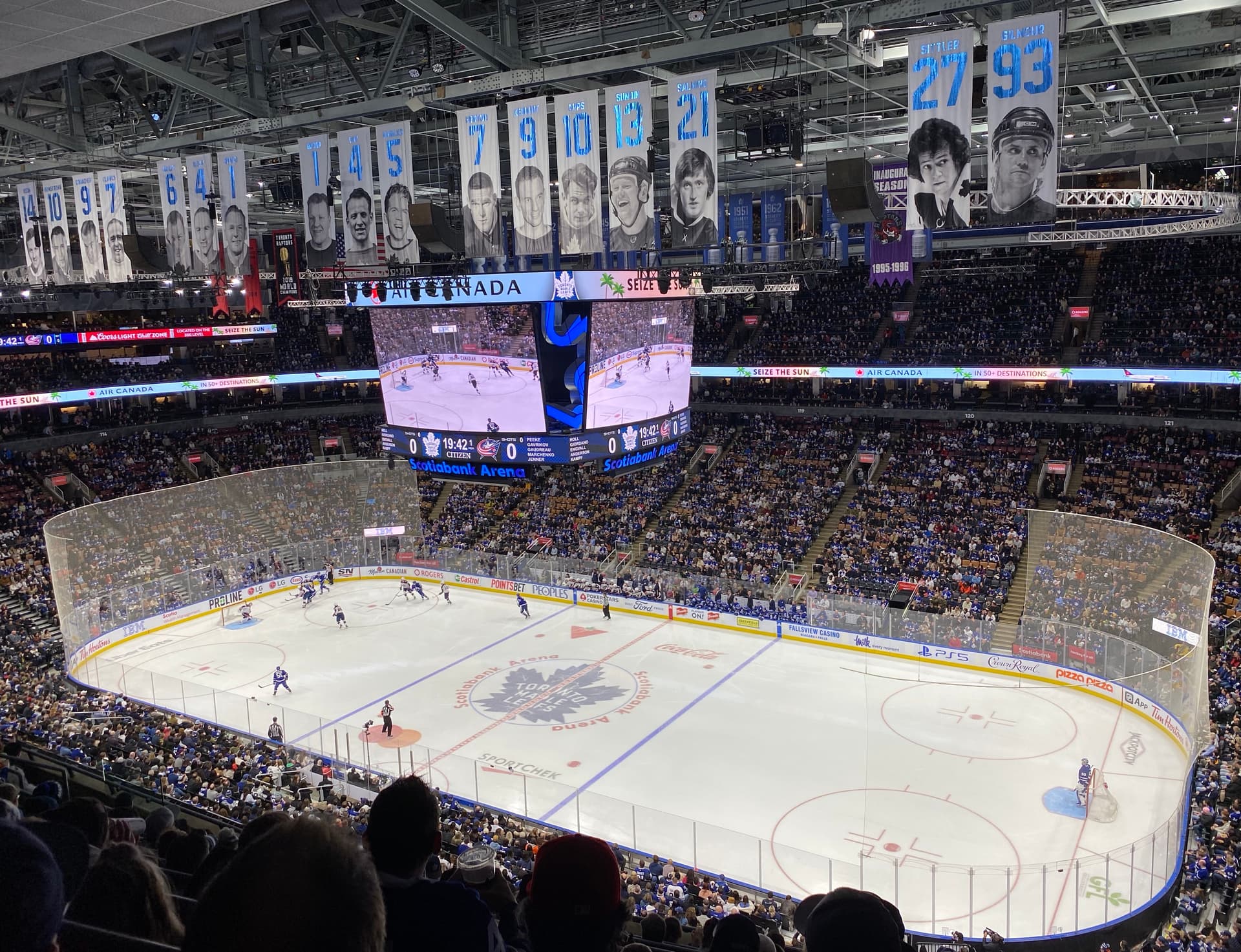
Photo: Adam Bishop, Wikimedia Commons (BY-SA-4.0)
NHL Signing Bonus Cap: The 60 Per Cent Rule Changes Toronto's Math
Table of Contents
The NHL signing bonus cap takes effect September 16
The new NHL signing bonus cap is the least discussed rule in the new collective bargaining agreement and, for the Toronto Maple Leafs specifically, it may be the most consequential. When the new CBA takes effect on September 16, 2026, total signing bonuses in any new contract will be limited to 60 per cent of the deal's total value. A team can still front-load the bonus in a given season — the 60 per cent is measured across the whole contract, not year by year — but the days of a nine-figure deal that is 90-plus per cent bonus money are over.
That matters everywhere. It matters more in Toronto than almost anywhere else, because the Maple Leafs have spent the last decade building their biggest contracts on exactly that structure. Two of the largest deals in franchise history would be illegal to write on September 17.
This is not a rule that unwinds anything already signed. Existing contracts are grandfathered and pay out exactly as written. It is a rule about the next contract — and Toronto's next big one is the one everybody in the market is already circling.
What Toronto has actually been doing with signing bonuses
Auston Matthews' four-year, $53-million extension carries $49.65 million in signing bonuses. That is roughly 94 per cent of the total value. His base salary in the final two years of the deal is $900,000 — league-minimum territory for a player earning $13.25 million against the cap. The bonus schedule paid out $15.925 million in 2024-25 and $14.425 million in 2025-26, then steps down to $10.18 million in 2026-27 and $9.12 million in 2027-28.
William Nylander's eight-year, $92-million extension is built the same way, just less aggressively: roughly $69 million of the $92 million comes in signing bonuses, about 75 per cent. Both deals carry full no-movement clauses. Neither would clear the new 60 per cent threshold.
Toronto was not alone in this. The heavy-bonus contract became the standard tool for star players across the league. But the Maple Leafs leaned on it harder than most, and paired it with the other structural tricks the new CBA also closes — deferred salary among them. If you want the full inventory of what changes in September, we broke it down in our guide to the new CBA contract structure rules.
Why the bonus structure mattered so much here
Signing bonuses do four things for a player, and all four have real dollar value.
- They are paid regardless of a work stoppage. Base salary is not paid during a lockout. Signing bonuses are. With the CBA now extended through 2030, that risk is deferred rather than eliminated, but it was a genuine negotiating chip in 2023 and 2024.
- They survive a buyout largely intact. A buyout pays out a fraction of remaining base salary. Bonus money already committed is not reduced the same way, which makes a bonus-heavy deal functionally buyout-proof.
- The money arrives early. Cash on July 1 is worth more than the same cash spread across an 84-game season. Agents price that difference explicitly.
- It softens the tax comparison. Toronto's combined tax rate is a recruiting problem the front office cannot legislate away. Structuring compensation as up-front bonus money has been one of the few partial answers available.
Strip the tool down to 60 per cent and every one of those advantages shrinks. Not to zero — 60 per cent is still a lot of guaranteed early cash — but a Toronto offer and a Florida or Nevada offer of identical face value just moved closer together in the only column that ever mattered.
Matthews' next contract cannot be built like this one
Matthews has two years left at $13.25 million. He becomes extension-eligible on July 1, 2027, which places the entire negotiation under the new rules. Whatever Toronto and his camp agree on, it will be a shorter deal than the last one, with less bonus money as a share of the total, no deferred compensation, and a year-over-year variance limit of 20 per cent off the first year with a floor of 71 per cent of the highest year.
The maximum term also shrinks: seven years to re-sign with your own club, six for a free agent signing elsewhere. We covered what that seventh year is worth in our piece on the new CBA's term limit and the Matthews extension math.
Layer on the market. Macklin Celebrini's five-year extension at an $18.8-million average annual value — $94 million total — reset the top of the pay scale in San Jose, passing Leo Carlsson's $18 million. James Mirtle has argued that Celebrini's five-year term, rather than the maximum available, is the shape of things to come for young stars who want to hit the market again while the cap is still climbing. Executives and agents broadly expect another sharp cap rise beginning in 2028. If you are 22 and the cap is going up, term is a cost, not a prize.
Matthews is not 22. He turns 29 in September, and he is coming off a season interrupted by injury. His leverage profile is the opposite of Celebrini's — he wants the security a long deal provides, and the new CBA just made long deals shorter for everyone. That is the underrated part of this: the rule changes hurt the player who wants term more than the player who wants a reset.
What it costs Toronto as a destination
The blunt version: the Maple Leafs lose one of the two levers they had for out-recruiting a low-tax contender, and they keep all of the disadvantages.
The other lever — the endorsement and market argument, the idea that Toronto is worth a discount because the commercial upside is larger — is real but wildly inconsistent in practice. It worked for some players. It plainly did not work for others, and the last three summers of Leafs free agency have been a running demonstration that the market premium is not something a general manager can bank on in advance.
John Chayka's front office has been building around this reality all offseason, and the structure of his signings shows it. The July 1 additions were mid-term, mid-money bets on fit rather than eight-year commitments to stars, and the cap sheet reflects a team trying to buy flexibility instead of certainty. That is the correct read of a league where the rules now punish long, exotic contracts.
The counter-argument: this helps Toronto too
There is a version of this where the 60 per cent cap is good for the Maple Leafs, and it is not a small version.
Bonus-heavy contracts are the hardest contracts in hockey to trade. A team acquiring a player mid-season inherits cap hit, but the acquiring owner also inherits an actual cash obligation that may already have been paid out by the selling club — which is precisely why bonus-laden deals with no-movement clauses become immovable. Toronto has been on the wrong side of that math more than once. Every future contract in the league being flatter and more cash-conventional makes the trade market more liquid for everybody, including a Leafs team that has spent two summers trying to move a $7.5-million defenceman.
The 20 per cent variance rule cuts the same way. Contracts that pay wildly different amounts in different years are the ones that create dead-cap traps and retention headaches. Flatter deals are easier to retain on, easier to move, and easier to value. If you believe Chayka intends to run an active, trade-heavy roster — and everything he has done since May suggests he does — a league of standardized contracts is a league that suits him.
The number to actually watch
Here is the practical test. Toronto currently sits about $2.75 million over the $104-million ceiling, a situation that resolves through Max Domi's long-term injured reserve status and the bottom of the roster rather than through anything dramatic — the mechanics are laid out in our look at the Leafs' cap compliance path. That is this season's problem, and it is a manageable one.
The 2027 problem is different. Matthews at 29, negotiating a maximum seven-year deal, under a bonus cap, against a pay scale where $18.8 million is the ceiling and the cap itself is projected to keep climbing. Every one of those variables is now fixed by rule except the number. Toronto's front office does not get to be creative about the shape of the deal anymore. It only gets to be right about the price.
What's next
Nothing changes before September 16. Contracts signed between now and then — including any PTO conversions out of training camp — can still be written under the old structure, which is a small, real incentive to get business done early. After that date, every new Leafs contract, from Gavin McKenna's eventual second deal to whatever Matthews signs in 2027, lives inside the new box.
Keep an eye on the Leafs contract sheet as camp approaches, and on whether Chayka closes any extension business in the six weeks before the rules change. If he does, that is not a coincidence — it is the last window to build a contract the old way.
Frequently Asked Questions
What is the NHL's new signing bonus cap?
Under the new collective bargaining agreement, total signing bonuses in a contract cannot exceed 60 per cent of the deal's total value. A single season within the contract can still be bonus-heavy — the limit applies across the whole contract, not year by year. The rule takes effect September 16, 2026.
When do the new NHL contract rules take effect?
September 16, 2026. Contracts signed before that date are written under the old rules and are grandfathered. Everything signed on or after that date is subject to the 60 per cent signing bonus cap, the ban on deferred salary, the 20 per cent year-over-year variance limit and the shorter maximum terms.
How much of Auston Matthews' contract is signing bonus?
Matthews' four-year, $53-million extension carries $49.65 million in signing bonuses, roughly 94 per cent of the total value. His base salary in the final two years is $900,000 per season. That structure would not be legal under the new 60 per cent cap.
Does the signing bonus cap change existing NHL contracts?
No. Contracts already signed pay out exactly as written, including Matthews' bonus schedule and William Nylander's eight-year, $92-million deal that carries roughly $69 million in bonuses. The cap applies only to contracts signed on or after September 16, 2026.
What is the maximum contract length under the new NHL CBA?
Seven years for a player re-signing with his own team and six years for a player signing with a new club as a free agent. That is down from eight and seven years respectively under the previous agreement.
When can Auston Matthews sign a contract extension with the Maple Leafs?
July 1, 2027. He has two years remaining at a $13.25-million cap hit, which means his entire next negotiation happens under the new CBA rules — shorter maximum term, capped bonuses, no deferred salary and a 20 per cent variance limit.
Why do NHL players want signing bonuses in their contracts?
Signing bonuses are paid even during a work stoppage, are largely protected in a buyout, arrive as cash earlier than base salary, and can soften the effective tax difference between markets. Those four advantages are why bonus-heavy deals became the standard for star players — and why capping them at 60 per cent matters.


