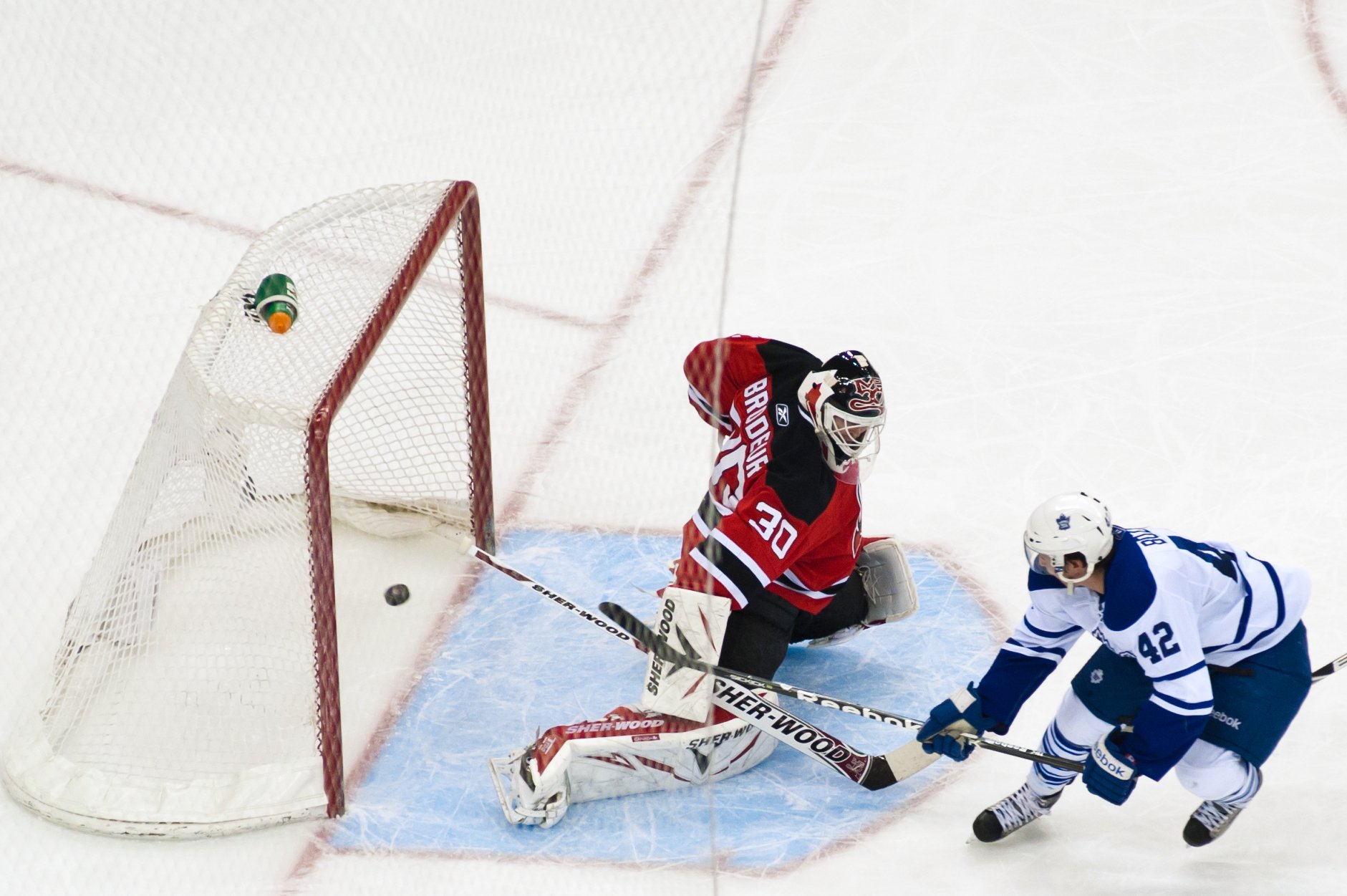
Photo: James DiBianco, Wikimedia Commons (BY-SA-2.0)
Matthew Knies Trade Rumours: Maple Leafs AGM Ryan Hardy Gives the Clearest Answer of the Summer
Table of Contents
The Matthew Knies trade rumours that have followed the Toronto Maple Leafs since the draft got their most direct response yet this week, and it did not come from John Chayka. Assistant general manager Ryan Hardy went on TSN 1050's OverDrive and, asked plainly about the speculation, said Knies is an important part of the Maple Leafs and that anything past that is speculation. He then spent several minutes explaining exactly why the team has no interest in moving him.
It is not a signed guarantee. Front offices do not give those in July. But it is the first time anyone in Toronto's hockey operations department has addressed the Knies noise with something other than a shrug, and it came bundled with the closest thing the Leafs have offered to an honest answer on Morgan Rielly.
What Hardy actually said about Matthew Knies
Hardy's framing was that he understands where the speculation comes from. Toronto finished 32-36-14 last season and missed the playoffs for the first time since 2017. When a team bottoms out that hard, every asset gets discussed publicly whether the team is shopping it or not.
His case for keeping Knies came down to three things: the player's playoff profile, his positional flexibility, and his fit alongside Auston Matthews. Hardy described Knies as built for the playoffs and pointed to his ability to move around the lineup and play in different situations, including on Matthews' line. He characterized Knies as the type of player who helps teams win Stanley Cups.
On the contract side, Hardy said the team is in contact with Knies' representatives the way it is with every player's group, then drew the line: Knies is an important part of the Maple Leafs, and the rest is speculation.
The facts underneath the Matthew Knies trade rumours
Knies is entering the second season of a six-year, $46.5 million contract that carries a $7.75 million cap hit. He played 79 games in 2025-26 and finished with 23 goals and 43 assists for 66 points on a team that scored badly and defended worse.
That is the crux of why other clubs keep calling. A 23-year-old power winger producing 66 points on a non-playoff team, signed long-term at a number that will look better every year as the cap climbs from $104 million toward $113.5 million, is one of the most valuable contracts in the league. The New York Rangers were reported to have interest, with one insider describing Toronto's asking price as exorbitant. Vancouver has been floated by outside voices as another club that should try.
None of that reporting suggested Toronto was shopping him. It suggested other teams were asking, and being told no. We took the other side of the argument earlier this month in our piece on whether the Leafs should sell high on Knies — a case built on his value peaking, not on any suggestion the team wanted out.
Hardy's comments do not settle that debate. They do settle the factual question of whether Toronto has been actively marketing him. It has not.
The Rielly part is more revealing
The same appearance touched on Morgan Rielly, and that is where the summer's real awkwardness lives.
Rielly has four years left on his deal and a no-movement clause. He has reportedly given Toronto a list of four Western Conference teams he would consider, which is permission to explore rather than permission to trade. Four clubs is a thin market for a $7.5 million defenceman, and it has stayed thin. We tracked the market's contraction in our piece on the four-team list and again when Chayka said he did not anticipate a trade.
Then the Leafs put Rielly in their 2026-27 promotional material. Dave Feschuk of the Toronto Star noted that it is beginning to get awkward, and he is right. The organization is simultaneously selling Rielly as a core piece to season-ticket holders and, by every account from national insiders, listening on him.
Both things can be true without anyone lying. Rielly has a no-movement clause. If nothing materializes from his four-team list, he is a Maple Leaf on opening night, and putting him in the marketing is simply the club planning for the likeliest outcome. But it does make the summer look confused, and it puts a veteran who has given the franchise thirteen years in an uncomfortable spot he did not create.
Why the Leafs cannot trade both anyway
There is a cap reason Hardy's answer on Knies should be taken at face value, and it has nothing to do with sentiment.
Toronto is currently projected over the $104 million upper limit by roughly $2.75 million with 49 players under contract. That is not a crisis — Max Domi is expected to open on long-term injured reserve, teams can exceed the cap by 10 per cent in the offseason, and sending a depth contract or two to the Marlies clears more room. We ran the full math in our breakdown of how the Leafs get cap compliant.
But it does mean any Knies trade would be a cap-out move, and cap-out moves on a team already short of top-six scoring create a hole you then have to fill from a market that is nearly empty. The remaining unrestricted free agent pool is thin. The trade market for top-six wingers is expensive. Moving your best young forward to solve a $2.75 million problem is how bad teams stay bad.
Rielly is different. Moving Rielly clears real money off a position where Toronto has bodies, even if it does not have quality. That is why one name keeps coming up in trade talk and the other keeps coming up in denials.
The part of the contract that protects Toronto
There is a detail in Knies' deal that gets lost in the trade chatter, and it works in the Leafs' favour twice over.
Because he signed a six-year contract coming off his entry-level deal, Toronto bought out the entirety of his restricted free agent years and then several unrestricted ones. There is no arbitration hearing to survive, no qualifying-offer standoff, no offer sheet to match. The club that signs a young forward long-term early is buying certainty, and Toronto has it through the seasons that matter most for this roster.
The second benefit is arithmetic. At $7.75 million against a $104 million cap, Knies costs 7.5 per cent of Toronto's payroll this season. Against the $113.5 million ceiling in 2027-28, the same contract is 6.8 per cent. A player producing 66 points at that share of the cap is not a piece you trade to fix a short-term problem, and Hardy's answer suggests the front office understands the math as well as anyone.
The flip side, and the reason the calls keep coming, is that the same features make him enormously attractive to a rival. Clubs are not asking about Knies because they think he is undervalued in Toronto. They are asking because a cost-controlled 23-year-old power winger is close to the most valuable thing in the sport, and the only way to get one is to ask a team that has one.
What's next
Salary arbitration hearings around the league wrap by August 1, which historically loosens the trade market as teams finally know their number. Toronto's next real deadline is training camp in September, when Domi is re-evaluated and the cap picture becomes concrete rather than projected.
Expect the Knies rumours to keep running regardless — a 23-year-old with that contract will be asked about every summer for six years. Expect the Rielly situation to resolve one of two ways: a trade to one of his four approved teams before camp, or a season in which Toronto's longest-serving player skates out on opening night having spent the summer reading about where he might go. Track the roster and cap picture as it firms up on our contracts page.
Hardy's OverDrive appearance did not make news in the traditional sense. Nothing was announced. But it was the first time the front office put a marker down on the two players everyone has been arguing about, and on one of them, the marker was unusually firm.
Frequently Asked Questions
Are the Maple Leafs trading Matthew Knies?
There is no indication they are. Assistant general manager Ryan Hardy said on TSN 1050's OverDrive that Knies is an important part of the Maple Leafs and that anything beyond that is speculation. Reporting has suggested other clubs, including the Rangers, have asked and been quoted a high price.
What is Matthew Knies' contract with the Maple Leafs?
Six years and $46.5 million, a $7.75 million average annual value. He is entering the second season of that deal. With the cap rising to $104 million in 2026-27 and $113.5 million in 2027-28, the contract becomes better value for Toronto each year.
How many points did Matthew Knies score in 2025-26?
66 points in 79 games — 23 goals and 43 assists. He produced that on a Maple Leafs team that finished 32-36-14 and missed the playoffs, which is a large part of why rival clubs have been calling about him.
Why can't the Maple Leafs trade Morgan Rielly?
He holds a no-movement clause and has four years left on his contract. He has reportedly given Toronto a list of four Western Conference teams he would consider, which allows the club to explore a deal but limits the market to those four destinations. Nothing has materialized to date.
Who is Ryan Hardy with the Maple Leafs?
Ryan Hardy is an assistant general manager in Toronto's hockey operations department under GM John Chayka. He has spoken publicly this summer about the roster, the Bobrovsky signing, and the status of both Matthew Knies and Morgan Rielly.
How much cap space do the Maple Leafs have for 2026-27?
They are currently projected roughly $2.75 million over the $104 million upper limit with 49 players under contract. That is manageable: Max Domi is expected to open on long-term injured reserve, offseason rosters can exceed the cap by 10 per cent, and depth contracts can be assigned to the Marlies.
When do NHL salary arbitration hearings end in 2026?
Hearings for the 2026 class were scheduled between July 20 and August 1. Fifteen players elected arbitration before the July 5 deadline, and most settled on new contracts before their hearing dates. The close of that window typically loosens the summer trade market.