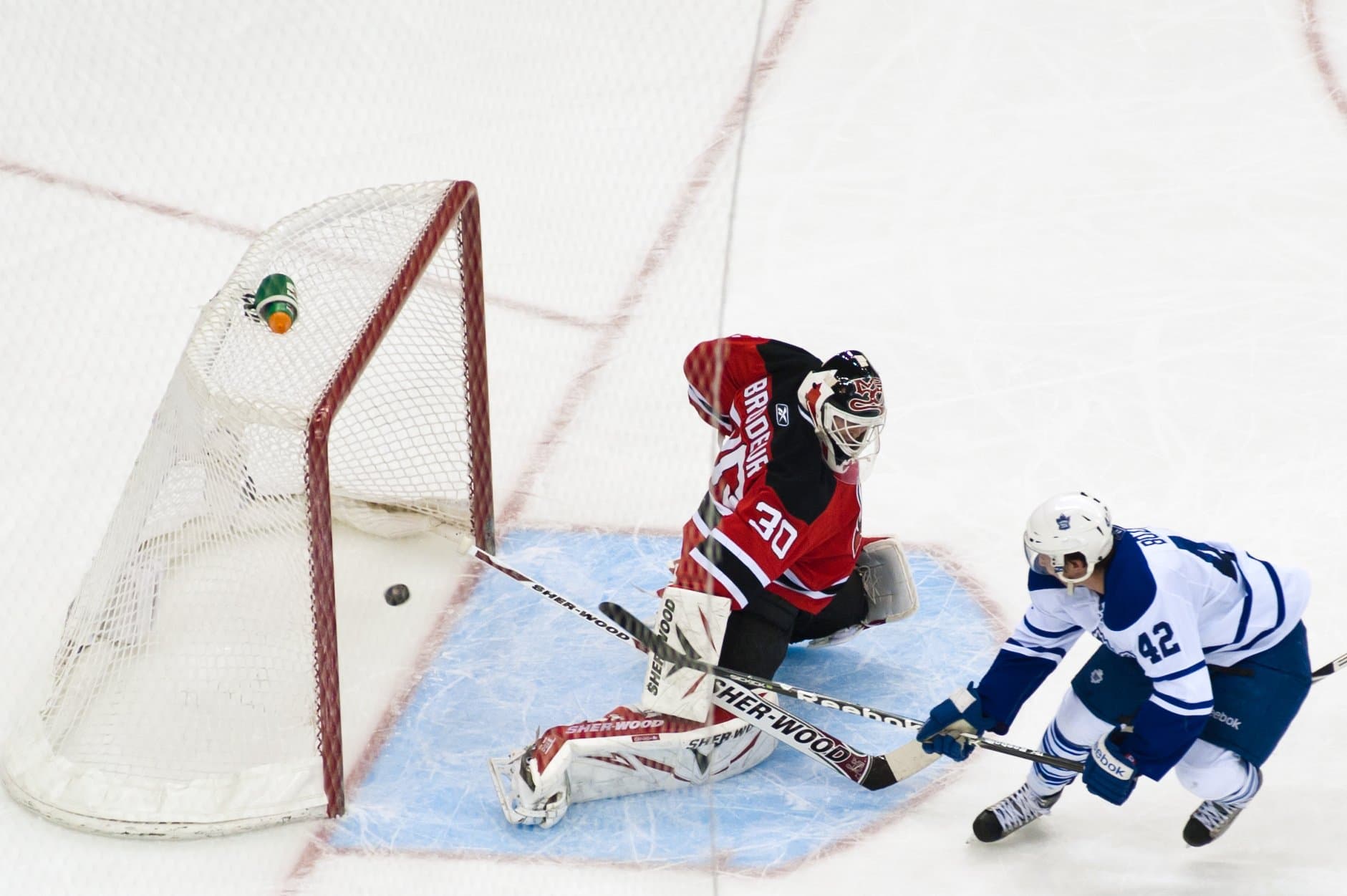
Photo: James DiBianco, Wikimedia Commons (BY-SA-2.0)
Matthew Knies Trade Rumours Are Over. He Set His Own Standard Instead
Table of Contents
Matthew Knies finally answered the trade rumours himself
The Matthew Knies trade rumours followed him through an entire summer, and on Friday at Maple Leafs training camp he addressed them in his own words for the first time. Asked what John Chayka told him after taking over as general manager, Knies said the message was direct: "He felt that I was a valuable piece here, and that's kind of what I have to earn and show every day."
That is a more interesting sentence than it looks. Knies did not say he was promised anything. He said he was told he mattered and then handed a standard. The second half of that quote is the part worth sitting with.
Chayka had already shut the door publicly on the first day of camp, framing the winter's trade chatter as an artifact of the previous front office rather than anything his regime was pursuing. We covered that when he said it. Friday was the first time the player on the other end of those conversations got to respond.
The Matthew Knies trade rumours were real, and they were close
This was not idle talk radio speculation. Reporting after Brad Treliving's firing indicated that the former general manager had a framework in place to send Knies to Montreal for a package built around prospects Alexander Zharovsky and Bryce Pickford plus two first-round picks, and that the deal did not get processed in time. We broke down what that trade would have meant when the details surfaced.
Whatever you think of the return, the relevant fact is that a 23-year-old top-six winger on a long-term deal came within an administrative window of being traded to Toronto's oldest rival. Knies has spent the months since being asked about it by everyone he meets.
His public posture has been consistent and, frankly, healthier than most players manage in that spot. Earlier in camp he said he was fortunate to still be here. On Friday he turned the whole thing into a performance standard rather than a grievance. That is the response an organization hopes for and rarely gets.
Auston Matthews thinks the ceiling is much higher
The same day, Matthews was asked about his linemate and delivered the most unqualified endorsement any Leaf has given another Leaf this camp. "For him, he hasn't even scratched the surface of his ceiling," the captain said. "He's going to continue to get better and better, and he works at it as well."
Take that seriously, because Matthews is not a player who hands out inflation. Knies is entering his fourth full NHL season having just posted 23 goals and a career-high 66 points in 79 games, with 152 hits and 16 power-play points. Through 240 career games he has 67 goals and 160 points. Those are good numbers for a 23-year-old. They are not, on their own, numbers that justify a $7.75 million cap hit.
That is the tension Toronto is carrying. Knies signed a six-year, $46.5 million extension running through 2030-31 — a deal the club made as a bet on growth, not on what he had already done. The contract page lays out how much of Toronto's structure is now built on players who need to be better than their last season.
Why the trade talk existed in the first place
The uncomfortable answer is that Knies is Toronto's most tradeable good asset, and good assets on a team that finished 32-36-14 get shopped. He is young, he is signed long-term at a number that will look reasonable as the cap climbs, and he plays a style — heavy, net-front, forechecking — that every contender says it wants in the spring.
He is also, at the moment, a winger whose value is entangled with Matthews. Knies has spent most of his career on Matthews' left side, including this camp, where the top line is Knies, Matthews and Jack Roslovic. Separating what Knies generates from what the line generates is the analytical question that has driven both the trade interest and the internal reluctance to move him.
Chayka appears to have resolved it in the simplest way available: he decided Knies is part of the core and stopped taking calls. Whether that was conviction or the absence of an offer good enough is a question the general manager has not been asked directly enough.
The standard Knies set for himself
"That's kind of what I have to earn and show every day" is the operative clause. What does earning it look like in 2026-27?
- Thirty goals. He has never hit it. He has been within range twice. On a top line with Matthews healthy and a coaching staff promising more offensive freedom, 30 is the number that turns his contract from fair into good.
- Power-play production. Sixteen power-play points is thin for a net-front player on a unit with this much talent. Toronto's power play finished 25th last season, and Knies occupies the job where a fix most visibly shows up.
- Playing through a full season. Seventy-nine games is a good baseline. Toronto needs him to hold it, because the forward group behind the top six is thinner than it looks.
What it says about how Chayka operates
There is a pattern forming. Chayka has now publicly and unambiguously closed two of the biggest trade storylines the Leafs carried into camp — Knies and Morgan Rielly — rather than leaving them open as leverage. That is unusual. Most general managers prefer ambiguity because ambiguity is free.
Chayka has chosen clarity instead, and told players directly rather than letting them read about themselves. Knies confirmed as much Friday. Rielly said something similar last week. Whatever else you make of the new front office, the communication style is a real departure from what preceded it.
It is also a commitment with a cost. Having said publicly that Knies is too valuable to move, Chayka has made it materially harder to trade him later at a price that makes sense. That is the trade-off of saying the honest thing out loud.
The comparables have moved, and they moved in Toronto's favour
One reason Chayka can sound relaxed about the $7.75 million is that the market has kept climbing underneath it. In the week before camp alone, Cutter Gauthier signed a six-year deal worth $81 million in Anaheim and Luke Evangelista landed five years and $36.25 million in New Jersey. Ottawa committed $86 million to Drake Batherson. Those are wingers in roughly the same age and production band as Knies, and none of them signed for less per year than he did.
That is what Toronto bought when it extended him early: not a discount on today's production, but insulation against tomorrow's market. With the upper limit rising under the new CBA, a $7.75 million cap hit in 2029 will occupy a materially smaller share of the payroll than it does now. Trading him would mean surrendering that curve to whoever acquired him.
It also explains why the offers reportedly never got compelling. Rival teams were being asked to pay a premium for a player whose contract is already the asset. Chayka has said no serious proposal reached his desk that changed the calculation, and the structure of the deal is the reason.
Where this leaves the top line
With the trade question settled, the evaluation shifts to something more concrete: whether Knies, Matthews and Roslovic can actually function as a line. Roslovic arrived on a two-year, $8 million contract to solve Toronto's long-running problem on Matthews' right side, and the early camp alignment puts all three together. We wrote this week that Roslovic has earned the first look and nothing more.
Knies is the constant in that equation. He has played left wing beside Matthews through most of three seasons, and the staff has never seriously looked elsewhere. If the line works, it is because the third piece finally fits, and Knies gets to do the job he is best at — winning pucks, standing in the blue paint, and converting the chances Matthews manufactures.
If it does not work, Knies is still the player least likely to be moved off the unit. Hiller's first camp has made that clear. The roster page shows how few alternatives exist on the left side of the top six.
What's next
Knies plays in the home half of Saturday's split-squad doubleheader against Montreal, the team that nearly acquired him, which is the kind of coincidence a schedule-maker could not have designed better. Toronto opens the regular season against the Canadiens on Sept. 29.
The rumours are over for now. The standard Knies described is not. He said he has to earn it every day, and for the next six years, the cap sheet says the same thing.
Frequently Asked Questions
Did the Maple Leafs try to trade Matthew Knies?
Reporting after Brad Treliving's firing indicated the former general manager had a framework to send Knies to Montreal for a package including prospects Alexander Zharovsky and Bryce Pickford plus two first-round picks, but the deal was not processed in time. Current GM John Chayka has said publicly that the trade chatter came from the previous regime and that he has no interest in moving Knies.
What did John Chayka tell Matthew Knies?
Knies told reporters at training camp that Chayka's message was that he was a valuable piece in Toronto. Knies added that it is something he has to earn and show every day, framing the conversation as a standard rather than a guarantee.
What is Matthew Knies' contract?
Knies signed a six-year, $46.5 million contract with the Maple Leafs carrying a $7.75 million average annual value. It runs through the 2030-31 season, after which he would become an unrestricted free agent.
What were Matthew Knies' stats in 2025-26?
Knies posted 23 goals and a career-high 66 points in 79 games, with 152 hits, 140 shots on goal and 16 power-play points. Through 240 career NHL games he has 67 goals and 160 points.
What did Auston Matthews say about Matthew Knies?
Matthews said Knies ‘hasn’t even scratched the surface of his ceiling’ and that he will continue to get better, noting that Knies works at his game. Matthews made the comments at Maple Leafs training camp in September 2026.
Has Matthew Knies ever scored 30 goals?
No. His career high is 29 goals, and he scored 23 in 2025-26 while setting a personal best with 66 points. Reaching 30 on a top line with Auston Matthews is widely seen as the benchmark that would make his $7.75 million cap hit look like a bargain.
Who plays on Matthew Knies' line at Leafs training camp?
Knies has opened camp at left wing on the top line with Auston Matthews at centre and free-agent signing Jack Roslovic on the right side. Head coach Jim Hiller put the trio together on the first day of on-ice sessions.


