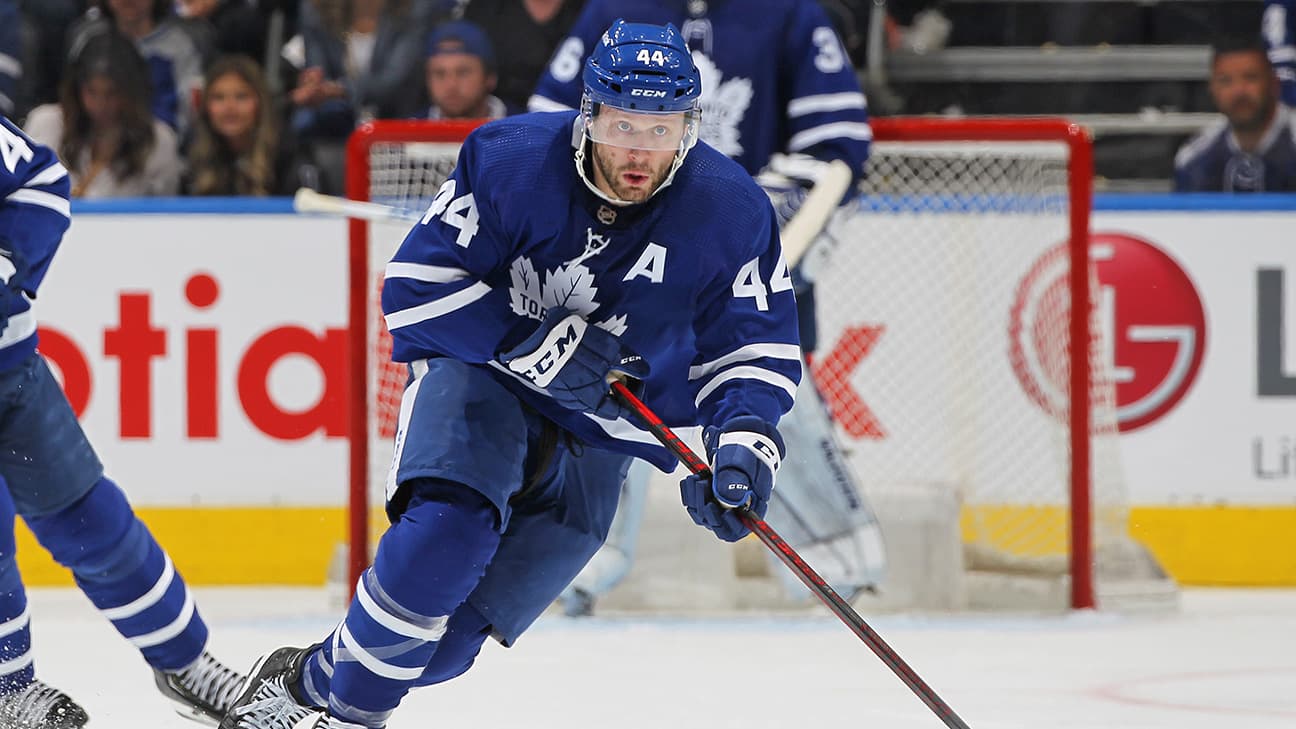
Photo: NHL.com
Maple Leafs Second Period Problem: Rush Defence Is the Real Leak
Table of Contents
The Maple Leafs second period problem, in one road trip
The Maple Leafs second period problem has a body count now. Toronto was outshot 21-8 in the middle frame in Vegas on Oct. 8 on the way to a shootout loss, and then gave up four goals in the second period in Salt Lake City on Oct. 13 in a 5-4 loss to the Utah Mammoth. Head coach Jim Hiller said after the Utah game that three second periods on the trip were not good enough, per Maple Leafs Hot Stove.
LeafsLurker's position: this is not a goaltending problem and it is not bad luck. It is a breakout problem that the long change exposes, it got worse the moment Chris Tanev went on injured reserve, and it will not be fixed by effort speeches. Hiller needs to change how his defence moves the puck, and GM John Chayka needs to give him another defenceman who can do it.
Why the second period is different
The second is the only period in which each team's bench sits farther from its own net. Changes take longer, tired players get caught deeper, and a turnover at your own blue line turns into an odd-man rush the other way before the fresh skaters arrive. Every team deals with it. Good defensive teams handle it by getting the puck out cleanly and changing on their terms.
Toronto is not doing that. After the Vegas game, The Hockey News described defencemen rimming pucks around the boards to forwards who collected them with no clear idea of what to do next. A rim is fine as a release valve. As a default, it hands the puck back to a forechecker who is already fresh, and it strands your own forwards on the wall facing their own net.
Utah showed what happens next. The Hockey News counted five of Utah's goals in the 5-4 game as rush goals. Morgan Rielly put it plainly to NHL.com afterward: "If you look at their goals, they're off the rush, so there is something going on there that we have to fix."
The evidence from three games
The pattern is clearest when the three road games sit side by side:
GameResultSecond-period storyOct. 8 at Vegas3-4 shootout lossOutshot 21-8 in the period, 43-24 overallOct. 10 at Colorado6-3 winNylander and Cowan scored 46 seconds apart late, but Hiller still rated the period poorlyOct. 13 at Utah4-5 lossFour Utah goals, including a short-handed one; five rush goals in the gameColorado is the instructive one. The Leafs won 6-3 and scored twice late in the second, and their coach still did not like the period. That tells you he sees the same thing the shot clocks show: Toronto is surviving middle frames on finishing talent rather than controlling them.
It is also worth saying what this is not. In the 3-2 loss to Ottawa on Oct. 3, Maple Leafs Hot Stove's review described Toronto's second period as dominant. The team can play the middle frame well. It stopped doing so on the road, against three fast, heavy Western teams, and the trip lined up with the loss of its best defensive defenceman.
Nor is it a goaltending story, even though Anthony Stolarz stopped only 23 of 28 shots in Utah. Sergei Bobrovsky was in net for the Vegas game, when the Leafs were outshot by 13 in one period, and he was the reason that night ended in a shootout rather than a regulation loss. Swapping goalies changes how many of the rush chances go in. It does not change how many rush chances there are, and that number is the one the coaching staff controls.
The Tanev factor
Tanev left the Colorado game with an upper-body injury and went on injured reserve for at least three games, with Marshall Rifai recalled. The Hockey News reported that Oliver Ekman-Larsson and Darren Raddysh would absorb more minutes against Utah. Our Tanev injury analysis went through what the pairings look like without him.
Tanev's value has never been offence. It is the 10 feet of ice he takes away from a rushing forward before the play gets to the blue line, and the short first pass he makes when the puck comes back. That is exactly the skill set that disappears from the Utah tape. The first goal came when Daniil But carried through the neutral zone and beat Rielly one-on-one. That play gets broken up earlier when Tanev's partner can step up knowing someone has the middle.
He is also 36, played 11 games last season and is on IR again before the middle of October. The Leafs cannot plan around Tanev being available every night, which is why this is now a roster question as well as a coaching one.
What Hiller should change this week
Three adjustments are within the coach's control before Thursday's home game against Buffalo:
- Make the D-to-D pass the first option. When the forecheck comes hard to one side, reversing the puck behind the net buys the half-second a rim does not. It costs nothing but patience.
- Bring the centre low. A centre swinging below the faceoff dots gives the defenceman a short outlet instead of a 100-foot gamble. On the long change, short passes are what let a line get off the ice.
- Shorten the second-period shifts. If the team cannot change cleanly, it can at least avoid getting stuck. Fresh legs reduce how many rush chances a tired five-man unit gives up.
None of this is radical, and none of it requires a lineup change. What it requires is a coach being specific with his players about how he wants the puck out, and holding them to it.
What Chayka should do this month
The coaching fix only goes so far without the personnel to run it. Toronto has reportedly made exploratory inquiries with Calgary about Zach Whitecloud, according to David Pagnotta of The Fourth Period. Whitecloud carries a $2.75 million cap hit, per PuckPedia, on a six-year, $16.5 million deal that ends after 2027-28. We laid out why he is the right type of player in our Whitecloud trade case.
The Leafs' own sheet shows room to do it. Per CapWages' figures on our contracts page, Toronto opened the season with about $7.0 million in cap space against the $104 million upper limit. A defence-first defenceman at $2.75 million fits without touching the forward group.
Waiting has a cost. Seven games in, the Leafs are 3-3-1, and the next stretch is four home games in eight days against Buffalo, the Islanders, San Jose and the Rangers. Those are winnable games, and they are the ones a team cannot afford to give away with four-goal middle periods. We argued in our earlier defence-trade column that Chayka was right to wait early. The road trip is the deadline he was waiting for.
What's next
The homestand starts Thursday, Oct. 15, against the Sabres, who are also 3-3-1 and may be missing captain Rasmus Dahlin. The second period against Buffalo is the first test. If the Leafs get through it with the puck moving cleanly and the rush chances down, Hiller's message landed. If they get stretched again, the problem is personnel, and the phone in Chayka's office should be ringing.
Follow the race on our standings page.
Frequently Asked Questions
Why do the Maple Leafs struggle in the second period?
In the second period each team's bench is farther from its own net, so line changes are longer and turnovers become odd-man rushes. On their October 2026 road trip, the Leafs were outshot 21-8 in the second in Vegas and allowed four second-period goals in Utah. Observers pointed to defencemen rimming pucks instead of making clean first passes.
What is the long change in hockey?
The long change is the second period, when each team defends the net farthest from its bench. Players have farther to skate to change, so tired players get caught on the ice more often. It typically produces more odd-man rushes and goals against for teams with poor breakouts.
How many goals did the Leafs give up in the second period against Utah?
Utah scored four times in the second period on Oct. 13, 2026: Vincent Trocheck, Mikhail Sergachev (short-handed), Dylan Guenther and MacKenzie Weegar. Toronto scored twice in the period, and Utah won 5-4.
Is Chris Tanev injured?
Yes. Tanev left the Leafs' 6-3 win in Colorado on Oct. 10, 2026, with an upper-body injury and was placed on injured reserve for at least three games. Marshall Rifai was recalled. No return date has been announced.
Are the Maple Leafs trading for Zach Whitecloud?
No trade has been made. David Pagnotta of The Fourth Period reported that Toronto has made exploratory inquiries with Calgary about Whitecloud, who carries a $2.75 million cap hit through 2027-28.
How much cap space do the Maple Leafs have?
Per CapWages' figures from Oct. 3, 2026, the Leafs had about $7.0 million in cap space against the 2026-27 upper limit of $104 million. That figure moves with injuries, recalls and LTIR use.


