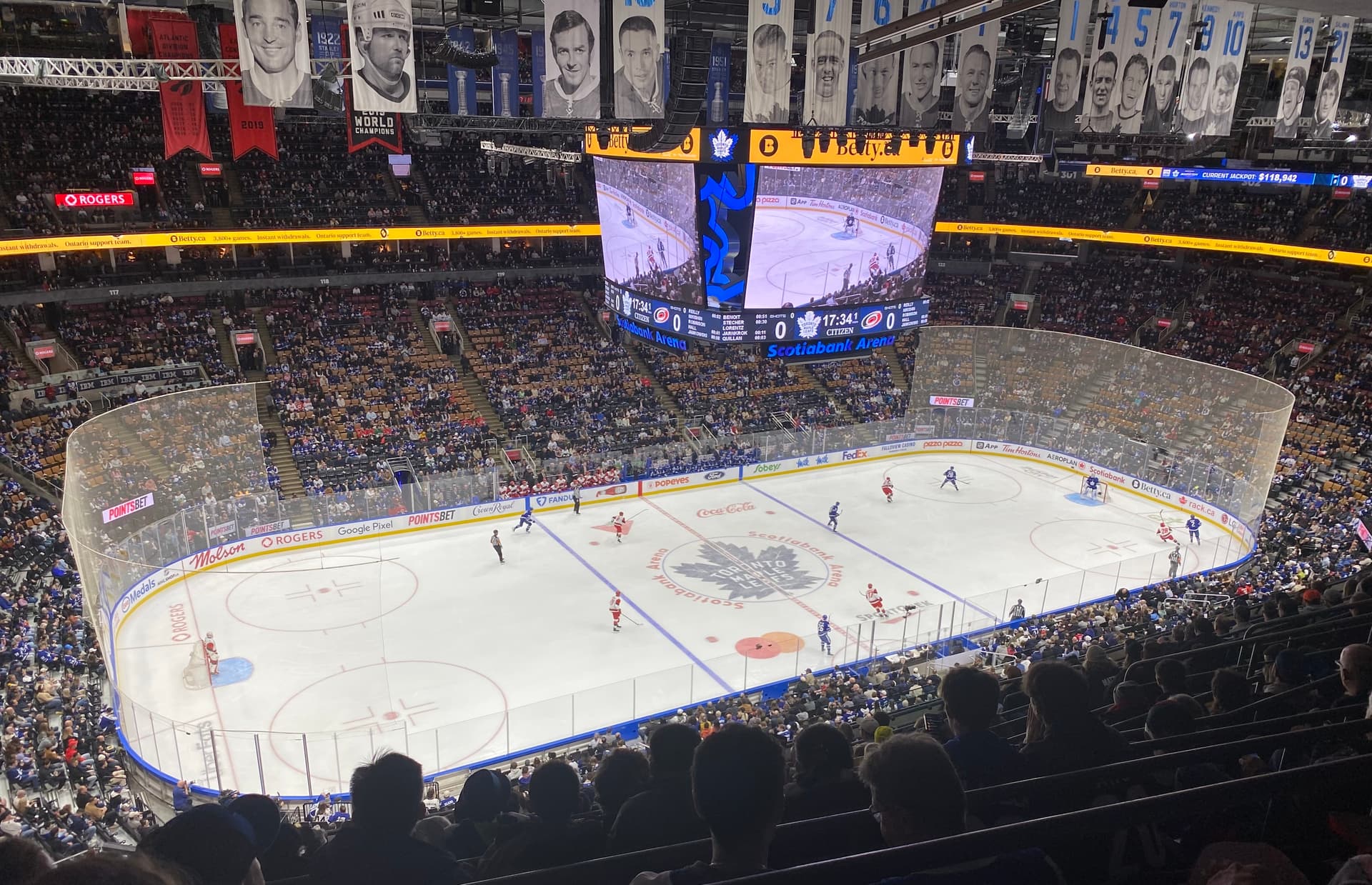
Photo: Adam Bishop, Wikimedia Commons (BY-SA-4.0)
Maple Leafs Roster Deadline Math: How Toronto Gets Cap Compliant by Monday
Table of Contents
The Maple Leafs roster deadline arrives Monday at 5 p.m. ET
The Maple Leafs roster deadline is Monday at 5 p.m. ET, and Toronto will submit a cap-compliant 23-man list with less breathing room than any team in the division. Every NHL club has to file an opening-day roster that fits under the $104-million upper limit before the 2026-27 season begins Tuesday. The Leafs opened training camp with a cap charge near $106.75 million. That is a $2.75-million gap that has to close in the next 48 hours, and the mechanism that closes it is a player who will not dress.
This is not a crisis. It is arithmetic, and the club has known the shape of it since July. But it is arithmetic with consequences — it determines who makes the opening-night roster, who sits in the press box, and how much freedom Chayka has to fix anything in October.
Max Domi's LTIR placement is the whole plan
Max Domi carries a $3.75-million cap hit and is not expected to start the season. Placing him on long-term injured reserve gives Toronto relief against that number, and once it is applied the club clears the upper limit — by a margin reported around $70,000. Seventy thousand dollars. That is roughly the cost of one recall for a handful of days.
We broke down the mechanics of the new LTIR rules under the 2026 CBA and why the threshold matters so much this year. The short version: LTIR does not create space you can bank. It creates permission to be over the limit by a specific amount, and the accounting is unforgiving about how you use it. Toronto is not going to have room to carry an extra body for insurance.
Chayka effectively pre-solved the hockey side of Domi's absence in free agency. Nick Paul, Colton Sissons, Teddy Blueger, Brandon Duhaime, Jack Roslovic and Zack MacEwen cover most of what Domi would have provided in the middle six. The cap side is what remains, and it is tight enough that a single unexpected injury changes the math.
Why the Lorentz waiver move mattered more than it looked
Steven Lorentz hitting the wire last week read as a mild surprise. It was really a cap manoeuvre. Toronto placed eight players on waivers for assignment to the Toronto Marlies — forwards Brendan Brisson, Vinni Lettieri, Lorentz, Michael Pezzetta, Henrik Rybinski and Ryan Tverberg, plus defencemen Philippe Myers and Marshall Rifai — and all eight cleared.
Clearing is what the Leafs needed. Assigning Lorentz to the Marlies lets Toronto bury all but $125,000 of his cap hit while keeping him in the organization and recallable. That is the ideal outcome: the depth stays, the money leaves, and nobody claims him for free. Ten more players went directly to the Marlies, including goaltenders Artur Akhtyamov, Ken Appleby and Samuel Hlavaj, and prospect Tinus Luc Koblar was returned to Rögle BK in Sweden.
The waiver window also explains the calendar. Because waivers take a full 24 hours, anyone who needed to clear before Monday's submission had to be on the wire by Sunday. That is why the league saw roughly 30 players placed Thursday, more than 50 Friday and another 18 Saturday. The Leafs did their business early.
What the 23-man roster looks like
The forward group is close to set: Matthew Knies, Auston Matthews and Roslovic on the top line, Gavin McKenna with John Tavares and William Nylander on the second, with Paul, Sissons, Easton Cowan, Dakota Joshua, Blueger and Duhaime filling out the bottom six. Zack MacEwen earned real consideration in camp; Hiller praised the way he handled himself physically as much as the goal he scored.
The blue line runs through Morgan Rielly, Chris Tanev, Darren Raddysh, Oliver Ekman-Larsson and the rest, with the 13th-forward and seventh-defenceman decisions functioning as the actual cap levers. Sergei Bobrovsky and Anthony Stolarz are the goaltending tandem after Joseph Woll was traded to Philadelphia in June.
Two injuries complicate the submission. Nick Paul is day-to-day with an undisclosed injury after leaving Wednesday's preseason game against Ottawa in the second period, though he returned to practice in Arizona on Sunday. Dakota Joshua has been managing a core issue and looked a step slow in weekend drills; Hiller has been explicit that Joshua is not being rushed.
The injury workaround, and its cost
If either Paul or Joshua cannot go Tuesday, Toronto has an option that is also a trap: place him on regular injured reserve and recall a cheaper body from the Marlies. That solves the lineup and creates a small amount of temporary relief. It also means the club is running its opening night on borrowed flexibility.
There is a second, quieter cost. Because the cushion is so small, Toronto effectively cannot carry a full 23-man roster with any comfort. Clubs in this position often open the year at 21 or 22 players, leaving one or two spots empty as accounting headroom. That saves money and creates a problem: fewer bodies means a single in-game injury forces an emergency recall, and emergency recalls under a tight LTIR structure are exactly the transactions that go wrong.
The trap is the return trip. With $70,000 of cushion, activating a player off IR later in October can force another move — a waiver placement, a paper transaction, or an actual demotion of someone who has earned a spot. Teams in this position spend October making roster decisions for accounting reasons rather than hockey ones, and that is where the real cost of being $2.75 million over shows up.
It is also why the Kirill Marchenko trade chatter is more complicated than the asking price suggests. Toronto cannot simply add a $3.85-million contract. It would have to subtract one first.
How Toronto compares in the Atlantic
The Leafs are not uniquely squeezed, but they are on the wrong end of the division. Montreal spent the summer extending its core and still has functional room. Ottawa has managed its cap carefully enough to absorb a midseason addition. Detroit, working under an interim general manager, has room it may not be positioned to use.
Florida and Tampa Bay are in the familiar position of being excellent and creative with LTIR. Boston has flexibility and has reportedly already used it to inquire about Marchenko. Toronto enters the season with the least capacity to respond to anything that goes wrong, in a division where our projections put the Leafs around 91 points with playoff odds near 37 per cent.
Thin margins and no cap room is a combination that punishes bad luck. Track the season's standings picture on our standings page as it develops.
What's next
Monday at 5 p.m. ET, the roster becomes official. Expect a quiet submission: Domi to LTIR, the waiver-cleared group formally assigned to the Marlies, and one of Paul or Joshua potentially starting on injured reserve. There is no obvious reason for Chayka to make a splash in the next 48 hours, and every reason to keep his options open.
Then Tuesday at 7 p.m., Montreal at Scotiabank Arena, and a season in which the cap sheet will be a recurring character. The Leafs have built a deeper roster than last year's. They have also built one where every addition requires a subtraction, and that constraint is going to shape October more than any line combination.
Frequently Asked Questions
When is the NHL roster deadline for the 2026-27 season?
All 32 clubs must submit cap-compliant 23-man opening-day rosters to the league by 5 p.m. ET on Monday, September 28, 2026. The regular season begins the following night, September 29.
How far over the salary cap are the Maple Leafs?
Toronto opened training camp with a cap charge of roughly $106.75 million against the $104-million upper limit, a gap of about $2.75 million. Placing Max Domi on long-term injured reserve is the primary mechanism for reaching compliance.
How does Max Domi's LTIR placement help the Maple Leafs?
Domi carries a $3.75-million cap hit and is not expected to start the season. LTIR relief against that number takes Toronto from $2.75 million over the limit to compliant by a reported margin of about $70,000 — enough to file the roster, not enough to add anyone.
Did Steven Lorentz clear waivers?
Yes. Lorentz was one of eight Maple Leafs placed on waivers for assignment to the Toronto Marlies, and all eight cleared. Assigning him to the AHL lets Toronto bury all but $125,000 of his cap hit while keeping him recallable.
Who is injured for the Maple Leafs heading into opening night?
Nick Paul is day-to-day with an undisclosed injury after leaving the September 23 preseason game against Ottawa, though he practised in Arizona on Sunday. Dakota Joshua is managing a core issue and his availability for Tuesday is uncertain.
Who are the Maple Leafs' goalies for 2026-27?
Sergei Bobrovsky, who signed a three-year contract on July 1, and Anthony Stolarz. Joseph Woll was traded to Philadelphia on June 16 and Dennis Hildeby was also moved, leaving Bobrovsky and Stolarz as the tandem.
When do the Maple Leafs play their first game of 2026-27?
Tuesday, September 29, 2026 at 7 p.m. ET against the Montreal Canadiens at Scotiabank Arena. It is the seventh consecutive season the two Original Six clubs have met on opening night.


