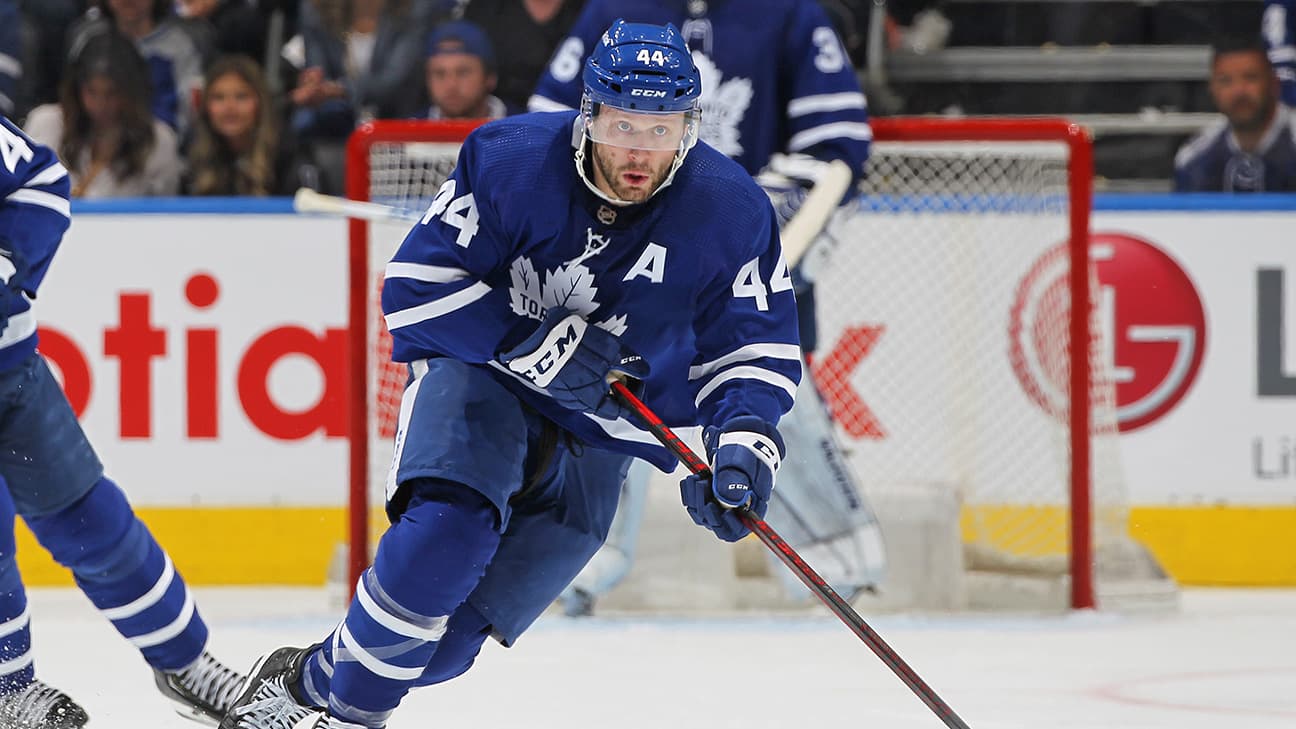
Photo: NHL.com
Maple Leafs Draft-Floor Trade Scenarios: What Chayka Could Actually Pull Off in Buffalo
Table of Contents
The Maple Leafs draft-floor trade window opens the moment McKenna's name is called
For most of the league, the 2026 NHL Draft is about prospects. For the Maple Leafs, the more interesting story might be the trades. The draft floor at KeyBank Center on June 26-27 is the busiest in-person marketplace of the offseason — every GM in one building, agents working the room, and a hard July 1 free-agency deadline bearing down. With John Chayka holding the No. 1 pick, real cap space, and at least one movable veteran, the Maple Leafs draft-floor trade scenarios are the part of this weekend Toronto fans should actually circle.
Chayka has already shown he will work fast and creatively. In a span of days he flipped Joseph Woll to Philadelphia, brought in Samuel Ersson and Emil Andrae, and pulled off a sign-and-trade for Darren Raddysh out of Tampa. That is not a GM who waits for July 1. Here is the realistic menu in Buffalo.
Scenario 1: the Morgan Rielly trade finally lands
This is the obvious one. Rielly's situation has shifted from "untouchable" to "actively in motion." Reporting through draft week suggests Rielly, who holds a no-movement clause, has softened his stance and that his agent, J.P. Barry, has handed the front office a list of teams the defenceman would consider — most of them in the Western Conference. We mapped the destinations in our breakdown of the Rielly trade list, where the Ducks, Sharks, Canucks, and Jets have all surfaced.
The math is the obstacle. Rielly is 32, carries a $7.5 million cap hit through 2028-29, and has full control over where he goes. To move him, Toronto almost certainly retains salary, takes back a shorter or younger contract, or both — and the return is more about cap relief and a roster reset than a haul of picks. The draft floor is the perfect venue precisely because retention and three-team structures are easier to build when everyone is in the same room.
Scenario 2: a cap dump to clear runway for July 1
Toronto's cap space is healthy — projections put the Leafs somewhere in the $19 million to $27 million range for 2026-27 against the new $104 million ceiling, depending on how you count the bodies still to be signed. But space is only useful if it lines up with the players Chayka wants, and a thin centre market means he may need ammunition to win a bidding war or absorb a contract in a trade. You can follow the live picture on our contracts page and in our cap-space breakdown after Raddysh.
The draft is where teams pre-position. If Chayka wants to make a run at a centre on July 1, expect him to clear a mid-roster salary or two in Buffalo, possibly attaching the 60th-overall pick as a sweetener to make a contract palatable to a budget team. That is standard draft-floor business, and it is how cap-rich contenders quietly create the room they need before the market opens.
Scenario 3: trading the 60th-overall pick to move or add
Toronto's draft capital is top-heavy: No. 1 overall, then a long wait until 60th. That second-rounder is the most liquid mid-round asset Chayka owns, and it is exactly the kind of chip teams flip on the floor — to slide up into the back of the first round for a specific prospect, to complete a Rielly framework, or to grease a salary move. The full picture of Toronto's selections is in our look at the full 2026 draft board beyond McKenna.
The case against moving it: Toronto's prospect pipeline is thin after years of trades, and a 60th-overall pick is real draft-and-develop value. The case for: a rebuilding team with one elite young winger incoming can afford to be aggressive everywhere else. Chayka's track record says he is comfortable spending futures when he sees a fit.
Scenario 4: the No. 1 pick stays put — and that's the point
Let's be clear about what is not happening: Toronto is not trading the first overall pick. Chayka has said the probability is that the Leafs make the selection, McKenna is a generational-tier winger, and there is no package a rebuilding team should accept for a player like that. We argued the case at length in our piece on why the Leafs' draft strategy points straight at McKenna.
The reason it matters to the trade conversation is that everything else flows from keeping the pick. McKenna on an entry-level deal is a cap cheat code — elite production at a rookie-scale number — which is precisely what frees Chayka to take on salary elsewhere and operate like a buyer in the same summer he is supposedly retooling.
Scenario 5: a smaller, sneaky depth move
Not every draft-floor trade is a blockbuster. Toronto has restricted free agents to sort out, including Matias Maccelli and Nick Robertson, and the qualifying-offer math can spill into trade talks at the draft. We covered the deadline pressure in our piece on Nick Robertson and the qualifying-offer deadline. A team that likes Robertson's shot or Maccelli's playmaking could turn an RFA decision into a small trade rather than an offer sheet.
Toronto also still has a centre-shaped hole down the middle after the Max Domi injury and the thin UFA class. Chayka has been circling the trade market for a pivot all spring, and a draft-floor deal — picks and a prospect for a controllable centre — is a cleaner path than overpaying on July 1. The bottom-six and middle-six both need bodies.
What a realistic Rielly return looks like
Set expectations now, because the Rielly return will not look like a top-pairing-defenceman trade from his prime. He is a 32-year-old, second-pairing puck-mover on a contract that runs three more years at $7.5 million, with full control over his destination. Teams know Toronto wants to move on, and a no-move clause that limits the market further depresses leverage. The honest comp is a deal where Toronto retains salary to make the number workable and accepts a middling pick, a prospect, or a shorter contract coming back.
That is not a knock on Rielly the player — it's the reality of trading a veteran defender at this stage of a contract. The win for Toronto is the cap relief and the chance to get younger and faster on the back end, which is precisely the profile Chayka has been chasing since the day he took over. If the Leafs can move even half of Rielly's cap hit while shedding the term, they should take it and not look back. The pick or prospect attached is gravy, not the goal.
What's next: watch the room, not just the podium
The smart way to watch this draft as a Leafs fan is to keep one eye on the podium for McKenna and the other on the trade ticker. Chayka has been the most active GM in hockey since the day he was hired, and the draft floor hands him the whole league under one roof for 48 hours. A Rielly resolution, a cap-clearing move, or a centre acquisition would all fit the pattern. Track every move on the draft hub and check the standings context that shaped this roster on our standings page. Whatever happens, this will not be a quiet weekend in Toronto's front office.
Frequently Asked Questions
Will the Maple Leafs trade Morgan Rielly at the 2026 draft?
It's a live possibility. Reporting through draft week suggests Rielly has softened on his no-movement clause and his agent has given Toronto a list of teams he would consider, most in the Western Conference. The draft floor is a natural venue for a deal involving salary retention.
How much cap space do the Maple Leafs have for 2026-27?
Projections put Toronto in roughly the $19 million to $27 million range against the new $104 million cap, depending on how many open roster spots are counted. That gives Chayka room to add an impact player or absorb salary in a trade.
Are the Maple Leafs trading the No. 1 overall pick?
No. Chayka has said the probability is that Toronto makes the selection, and the consensus is the Leafs take Gavin McKenna. A rebuilding team does not move a generational-tier prospect.
What is Morgan Rielly's contract and cap hit?
Rielly is 32 and carries a $7.5 million cap hit through the 2028-29 season. He holds a full no-movement clause, so he controls which teams Toronto can trade him to.
Why is the NHL Draft a hub for trades?
The draft floor puts every general manager in one building for two days, just before July 1 free agency opens. That makes it the easiest time of year to build multi-team deals, salary retention, and pick swaps face to face.
Could the Maple Leafs trade their 60th overall pick?
Yes. It's Toronto's most movable mid-round asset and could be attached to a Rielly framework, used to move up the board for a specific prospect, or added to a cap-clearing trade.


