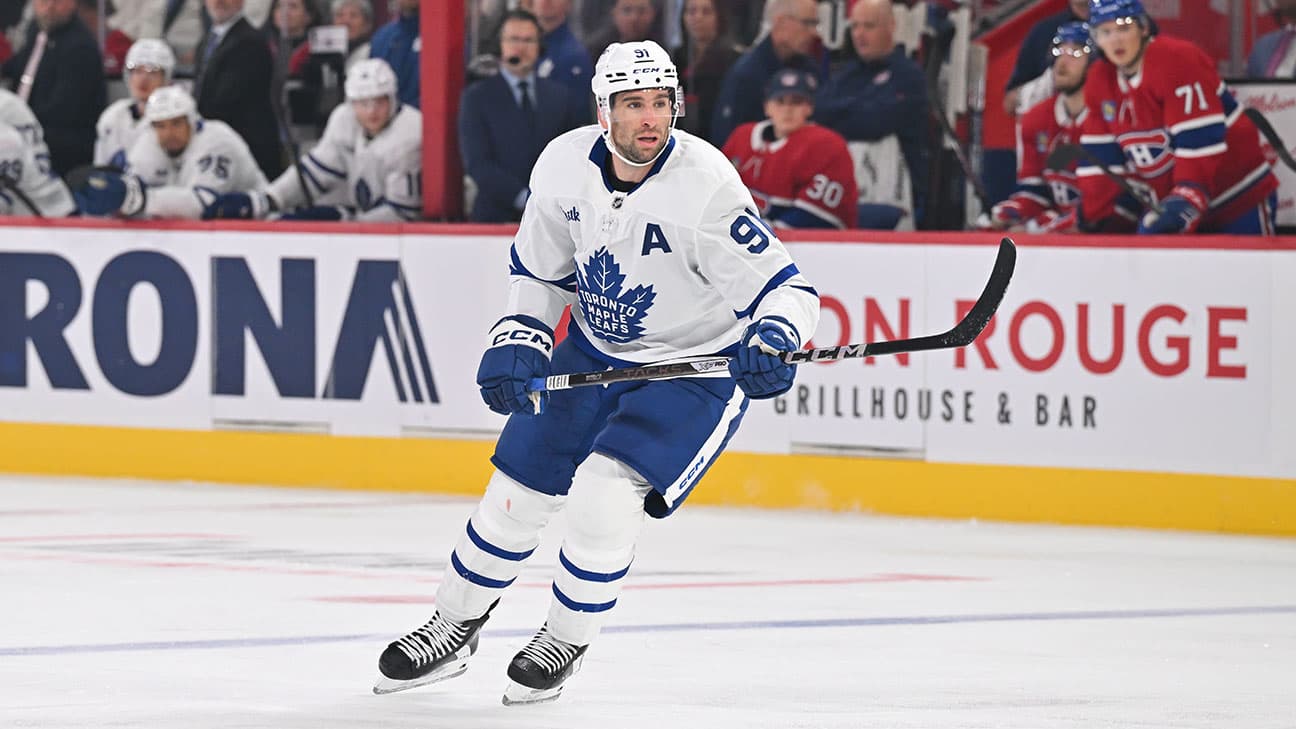
Photo: NHL.com
John Tavares on the Leafs Overhaul: 'Clearly We Weren't Very Good'
Table of Contents
John Tavares did the thing almost nobody in a Maple Leafs uniform did last season, which is say the quiet part out loud. Asked at the NHL player media tour in Las Vegas about the roster John Chayka tore down and rebuilt around him, the 35-year-old centre did not reach for a cliché.
"Clearly we weren't very good, and it's resulted in a lot of change," Tavares said. "And when that happens, take responsibility, and look forward, learn from it, and embrace what's ahead and what the change is bringing."
Twenty-two words of accountability from the longest-tenured veteran in the room, delivered without a single reference to bounces, injuries, or the standard Toronto deflection about how close the group really was. It was not close. Toronto went 32-36-14, finished with 78 points and missed the playoffs for the first time since 2016.
Why the John Tavares Maple Leafs quote lands differently
Because of who said it, and because of what he had to lose by saying it.
Tavares is the player with the least reason to accept blame. He was one of the few Leafs who held up. He is on a contract that pays him $4.38 million against the cap through 2028-29, a number he accepted in June 2025 at roughly half his previous rate, and which is now the best value contract on the roster by a distance. He could have said the veterans did their part. He did not.
Compare that to the standard version of this press conference. Most players in a turnover season say the group had the right pieces, the results did not follow, and the new faces bring energy. Tavares skipped straight to "take responsibility." That is not a small thing in a market where accountability is usually outsourced to whoever was just fired.
What actually changed around him
The scale of Chayka's summer is easy to understate because it happened in pieces. Put it in one place and it is startling.
Gone: Joseph Woll and Simon Benoit to Philadelphia in Chayka's first trade as GM, Dennis Hildeby to Tampa Bay in the deal that brought back Nick Paul, and a long list of depth forwards who will not be at camp. In: Sergei Bobrovsky on a three-year, $21-million contract at a $7-million cap hit, Emil Andrae from the Flyers, Nick Paul down the middle, Colton Sissons, Teddy Blueger and Jack Roslovic through free agency, Darren Raddysh on the right side, and Gavin McKenna as the first overall pick. Samuel Ersson came back in the Woll deal and was flipped to Ottawa 11 days later for a 2027 fifth, which is its own small lesson in how Chayka works.
Around nine additions in total. Tavares, Auston Matthews, William Nylander, Matthew Knies and Morgan Rielly are the survivors of the core. Everything else is new or newly arranged, and we mapped the full shape of it here.
Tavares has been through one of these before, in Long Island and then again in Toronto's post-2024 reconfiguration. He is also the player most likely to be asked to absorb whatever the new alignment does not cover.
The part he did not say
Here is where the analysis has to push back a little, because accountability is easier when your own numbers are fine.
Tavares's 2025-26 was solid. Nylander led the club in scoring with 79 points in 65 games. Matthews played 60 games, scored 27 goals and finished with 53 points, the lowest goals-per-game rate of his career, before a knee-on-knee hit from Radko Gudas ended his season after the Olympic break. Knies put up 66 points in 79 games. The top of the lineup was not the disaster. The disaster was everything behind it and a goals-against number that ranked among the worst in the league.
So when Tavares says "we weren't very good," the honest ledger says: the supporting cast was not good, the goaltending was not good, the defensive structure was not good, and the two highest-paid forwards were hurt. He is taking on a share of something that was mostly not his. That is what a veteran does, and it is also worth naming so the accountability does not get misfiled as a confession.
The role question nobody has answered
Tavares turns 36 this month and is the second-line centre on a team that just drafted an 18-year-old first overall and is trying to establish Easton Cowan and Knies as drivers. Projections have him around 63 points this season, down from his recent range, which is what you expect from a centre entering his late 30s.
The interesting question is not production. It is deployment. If Jim Hiller wants McKenna in the top six, somebody's minutes move. If Nick Paul is the third-line centre, Tavares stays second. If Paul pushes up, Tavares becomes an expensive matchup piece on the third line, which at $4.38 million is a luxury rather than a problem. Our projected lineup has him second, but it is one of the least settled calls on the sheet.
There is also the McKenna piece, which is not a coincidence. Tavares has taken the first overall pick into his home for the season, a development arrangement the club did not have to arrange and which tells you something about how the room is being built. The veteran absorbing the roster turnover is also the veteran raising the player who may eventually take his minutes.
The 84-game problem
There is a practical reason the Tavares role question is harder this year than last, and it has nothing to do with him. The season is two games longer.
The NHL expands to 84 games in 2026-27, the first schedule change since 1995-96, and the two extra dates land on a roster whose most important forwards are 29, 30 and 35. Toronto also has the shortest possible runway into it: four preseason games, a 13-day camp, and an opener on Sept. 29 rather than in early October.
Load management is not a phrase NHL coaches enjoy, but Hiller will be doing a version of it by December whether he calls it that or not. Tavares at $4.38 million is the single most useful piece of insurance in that conversation. He can take draws, kill penalties, play up when somebody is hurt and play down when nobody is, and the cap hit never becomes an argument. Toronto's depth chart at centre looks a lot better in February because of him than it does on paper in September.
Why this matters more than a media tour soundbite usually would
Toronto's 2026-27 problem is not talent distribution. It is belief. The Leafs lost 30 points off their previous season, fired a head coach, changed general managers, and watched a fanbase spend the summer arguing about whether the core is finished. Camp opens Sept. 17 with a new coach installing a new system on a 13-day runway.
In that environment, what the veterans say in the first week sets the frame. A room that opens camp insisting it was unlucky is a room that will relitigate last season every time it loses three in a row. A room that opens with "clearly we weren't very good" has already done the hard part.
Tavares is not the captain. Matthews is, and the alternates are Tavares and Rielly, with one letter still unassigned. But Tavares is the player other players listen to on this specific subject, because he is the one who took less money to stay.
What's next
Medicals are Sept. 16, camp opens Sept. 17, and the preseason runs Sept. 19 against Montreal and Sept. 23 against Ottawa. Opening night is Sept. 29 at Scotiabank Arena against the Canadiens, the first NHL regular season to start in September since 2007-08.
Tavares will be asked about this again in a week, on the ice, with a coach watching. The follow-up question is whether the rest of the room says the same thing. Track the depth chart on our players page and the money on the contracts page.
Frequently Asked Questions
What did John Tavares say about the Maple Leafs' roster changes?
At the NHL player media tour in Las Vegas, Tavares said 'clearly we weren't very good, and it's resulted in a lot of change,' adding that when that happens a player should take responsibility, learn from it and embrace what the change brings. He was speaking about the roster overhaul general manager John Chayka carried out over the summer.
What is John Tavares's contract with the Maple Leafs?
Tavares signed a four-year, $17.52-million extension in June 2025 that carries a $4.38-million average annual value and runs through the 2028-29 season. It was a significant pay cut from the seven-year, $77-million deal he signed as a free agent in 2018.
How did the Maple Leafs finish the 2025-26 season?
Toronto went 32-36-14 for 78 points and missed the playoffs for the first time since 2016, ending a run of nine consecutive postseason appearances. It was a 30-point drop from the previous season's 108-point total.
Who did the Maple Leafs add in the 2026 offseason?
John Chayka added roughly nine players, including goaltender Sergei Bobrovsky on a three-year, $21-million contract, centre Nick Paul via trade from Tampa Bay, forwards Colton Sissons, Teddy Blueger and Jack Roslovic, defencemen Darren Raddysh and Emil Andrae, and goaltender Samuel Ersson. First overall pick Gavin McKenna signed a three-year entry-level deal.
Is John Tavares still the Maple Leafs' second-line centre?
That is the expectation heading into camp, but it is not settled. Nick Paul's arrival and Gavin McKenna's push for top-six minutes could reshuffle the middle of the lineup. At a $4.38-million cap hit, Tavares is affordable in any of the top three centre roles.
When does Maple Leafs training camp open in 2026?
Medicals are Sept. 16 and the first on-ice session is Sept. 17. Camp is capped at 13 days under the new collective bargaining agreement, and Toronto plays four preseason games: split squads against Montreal on Sept. 19 and against Ottawa on Sept. 23.
When is the Maple Leafs' 2026-27 season opener?
Toronto hosts the Montreal Canadiens at Scotiabank Arena on Tuesday, Sept. 29 at 7 p.m. ET. It is the first NHL regular season to begin in September since 2007-08, a consequence of the schedule expanding to 84 games per team.


