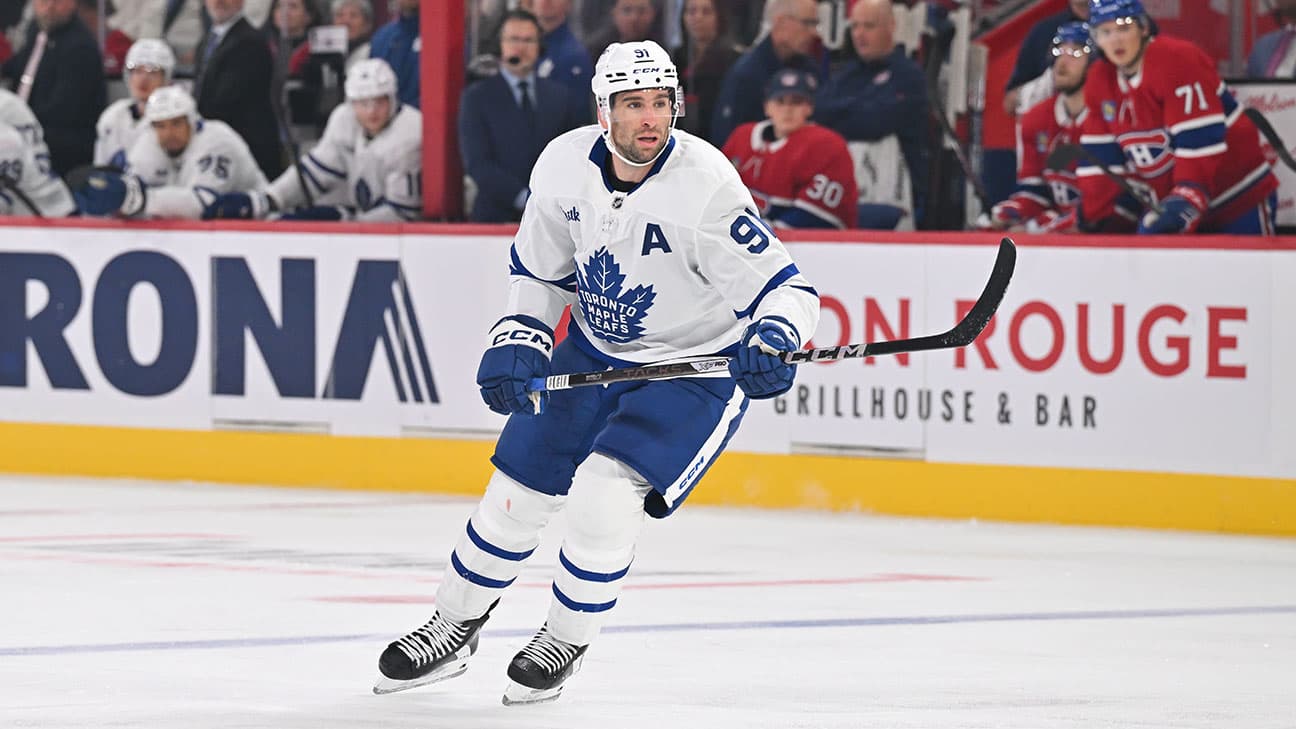
Photo: NHL.com
John Tavares at 36: The Maple Leafs' Best Contract and Quietest Plan
Table of Contents
John Tavares is the best value contract on the Maple Leafs, and nobody talks about him
John Tavares turns 36 on September 20, nine days before the Toronto Maple Leafs open their season, and he is going to be the least-discussed important player on this roster for the third straight year. That is a mistake. Tavares produced 31 goals and 40 assists in all 82 games last season on a cap hit of $4,389,280. There is no other contract in Toronto that returns that much for that little, and there is no obvious plan for what happens when it stops working.
Every other name in the lineup has had its summer news cycle. Auston Matthews' knee. Gavin McKenna's entry-level deal. Morgan Rielly's trade saga that ended in nothing. William Nylander's no-move clause. Tavares has been treated as furniture — reliably there, requiring no thought. Jim Hiller does not have that luxury, because how he deploys Tavares determines whether Toronto's centre depth is a genuine strength or a top-heavy pile with a soft middle.
The contract is the story
Tavares signed a four-year, $17,557,120 extension in June 2025 — a $4.39-million average annual value running through 2028-29. At the time it was described as a hometown discount, which undersold it. It was a structural gift.
Put it against the market that has developed since. Leo Carlsson signed for roughly $18 million a year. Macklin Celebrini landed in the same neighbourhood. Adam Fantilli and Cutter Gauthier are unsigned in August with asks north of $12 million. The going rate for a top-six centre in the $104-million cap era has detached from anything Toronto is paying Tavares, and he outproduced a fair number of the players in that tier last season.
He also reached 500 career goals, which places him in genuinely rare company. The Maple Leafs are getting Hall-of-Fame-adjacent counting stats at a fourth-line-plus price, and Toronto's cap sheet only works because of it. Strip out the Tavares surplus and Chayka's roster does not fit under the ceiling at all.
What the production actually looks like now
Be honest about the shape of it. Tavares' 74 points in 75 games in 2024-25 came with 38 goals. Last season he played all 82 and finished with 71 points on 31 goals. That is a small step down in rate and a meaningful step down in finishing, on a team that was worse around him.
What has not declined is the thing that made him valuable in the first place: he is still one of the better net-front and inside-the-dots operators in the league, he still wins his share of draws, and he does not get run out of the building defensively the way ageing offensive centres usually do. His game was never built on speed, which is why it has aged better than his critics predicted when he arrived in 2018.
The realistic 2026-27 projection is 25 to 30 goals and somewhere in the mid-60s in points, with the downside scenario being a season where the goals dry up and the assists hold. At $4.39 million, both outcomes are fine. That is the whole point of the contract.
Where Hiller should play him
Here is the argument. Tavares should be the second-line centre and he should get the softer of the two matchups, and Toronto should stop pretending that is a demotion.
Hiller's system, the one that produced the stingiest defensive team in the NHL in Los Angeles, works by assigning roles precisely rather than distributing minutes evenly. His best defensive centre eats the hard zone starts. His best offensive centre gets fed. Tavares is neither of those things anymore — he is the third option, and the third option on a good team is a luxury, not a problem.
Toronto now has the bodies to make that work. Nick Paul arrives as a legitimate third-line centre who can take defensive zone draws. Colton Sissons and Teddy Blueger were signed to make the bottom six functional on the penalty kill. Jack Roslovic gives Hiller a middle-six forward who can play either wing or the middle. That group did not exist last season, when Tavares was routinely asked to do things a 35-year-old should not be doing because there was nobody else.
The power play is the other lever. Tavares in the bumper spot with McKenna and Nylander working the flanks is the most obvious PP1 configuration Toronto has, and it is the deployment that squeezes the most out of what Tavares still does well. Toronto's man advantage was a season-long problem in 2025-26 until it was fixed midstream. It should not be a problem again.
The McKenna question sits underneath all of this
Gavin McKenna is 18 and is a centre by trade, and Toronto will spend the next three seasons deciding whether to develop him there or on the wing. The temptation to start him on Matthews' wing is real and probably correct in year one.
But the moment McKenna is ready to play centre in the NHL — realistically 2027-28 or 2028-29 — Tavares is in the way. That is not a criticism of either player. It is a roster-construction fact, and it lines up almost exactly with the end of Tavares' contract in 2028-29 and with the summer when nearly all of Toronto's core deals come due.
Chayka has built the timeline so those two events converge. If McKenna develops on schedule, Tavares' final season is McKenna's first as a full-time NHL centre, and the handoff happens without anyone having to be traded or bought out. If McKenna needs longer, Tavares is still there and still productive. That is good planning, and it deserves more credit than it has received.
The insurance policy nobody wants to think about
There is a version of this season where Tavares matters far more than any of the above. Matthews is working back from March surgery on a Grade 3 MCL tear and has not been publicly cleared. If he misses time — or plays through something at reduced effectiveness — Tavares becomes Toronto's first-line centre by default, at 36, in an 84-game season.
He has done it before, most recently in stretches at the start of 2021-22 while Matthews worked back from wrist surgery. It was serviceable then and he was five years younger. But it is not a plan, it is a fallback, and the difference between those two things is the difference between a playoff team and a repeat of last season's 32-36-14.
The take
Tavares is the most undervalued player on the Toronto Maple Leafs and the easiest one to plan around, and the organization should stop treating his presence as a given. He is 36, on the best-value contract on the team, in a role that finally has support underneath it, with a clean succession path behind him.
The correct expectation for 2026-27 is a second-line centre who scores 25-plus goals, runs PP1's interior, and takes the second-toughest matchup on a team that is finally deep enough to give him one. If that is what Hiller gets, it will be the quietest important thing that happens to this roster all season.
What's next
Camp opens mid-September and the season starts September 29. The first real signal will be line combinations in the exhibition games — specifically, whether Tavares is centring Nylander or a lesser winger, and whether he is on the first power-play unit or the second. Both answers tell you how Hiller has ranked his centres before a single game counts.
Frequently Asked Questions
What is John Tavares' contract with the Maple Leafs?
Tavares signed a four-year extension worth $17,557,120 in June 2025, carrying an average annual value of $4,389,280. It runs through the 2028-29 season, after which he can become an unrestricted free agent. It is widely regarded as the best value contract on Toronto's books.
How many points did John Tavares score in 2025-26?
Tavares recorded 31 goals and 40 assists for 71 points in all 82 games during his age-35 season. The year before he put up 38 goals and 36 assists for 74 points in 75 games. He also reached the 500-goal milestone for his career.
How old is John Tavares?
He turns 36 on September 20, 2026, days before the Maple Leafs open the regular season on September 29. He signed with Toronto as a free agent in July 2018 and has been with the club ever since.
Where will John Tavares play in the Maple Leafs lineup in 2026-27?
The most likely role is second-line centre with the softer of the two matchups, plus a spot in the bumper on the first power-play unit. Toronto's additions of Nick Paul, Colton Sissons and Teddy Blueger give Jim Hiller the depth to stop asking Tavares to take hard defensive zone starts.
Will Gavin McKenna replace John Tavares at centre?
Eventually, possibly. McKenna is 18 and a centre by trade, but he is likely to start on the wing in 2026-27. If he is ready to play centre full-time by 2027-28 or 2028-29, that lines up with the end of Tavares' contract in 2028-29, allowing a handoff without a trade or buyout.
What happens to the Leafs at centre if Auston Matthews is not healthy?
Tavares becomes the de facto first-line centre. Matthews is working back from March surgery for a Grade 3 MCL tear and has not been publicly cleared. Tavares carried a similar load early in 2021-22 while Matthews worked back from wrist surgery, but at 36 and across an 84-game schedule it is a fallback rather than a plan.
Why is Tavares' contract so valuable relative to the market?
The market for top-six centres has exploded under the $104 million cap. Leo Carlsson signed at roughly $18 million per season, Macklin Celebrini is in the same range, and unsigned restricted free agents Adam Fantilli and Cutter Gauthier are seeking north of $12 million. Tavares outproduced several players in that tier last season at $4.39 million.


