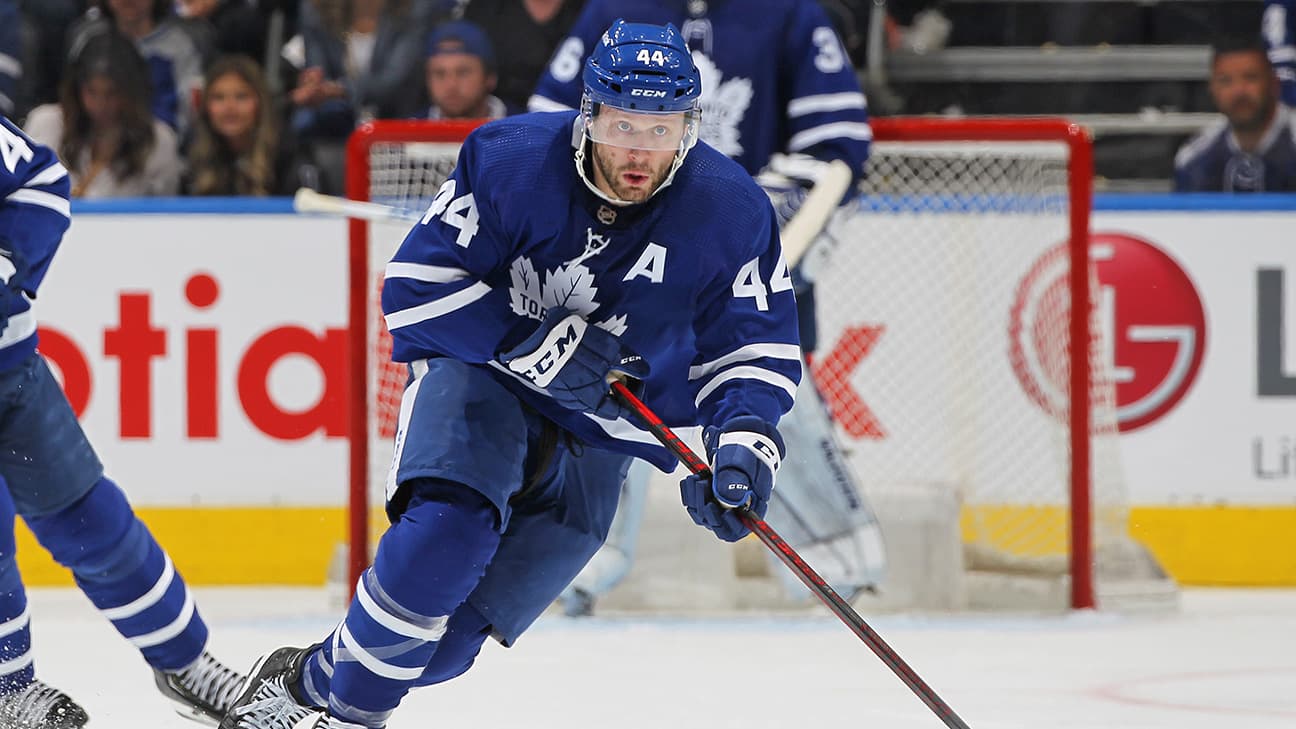
Photo: NHL.com
John Chayka's Direct Approach Is Quietly Changing the Maple Leafs
Table of Contents
John Chayka told Morgan Rielly the truth, and it mattered
The most revealing Maple Leafs quote of the summer came from a defenceman at a charity game. Speaking in Brampton on August 19, Morgan Rielly said he appreciated John Chayka's direct approach through an off-season in which his own name was in trade rumours almost daily. It is a small comment. It also describes a genuine change in how this organization operates.
Toronto's front office has spent most of the last decade treating information as a hazard. Players learned about their own situations from insiders. Contract talks leaked. Trade speculation went unaddressed for months because addressing it was considered riskier than silence. Chayka, four months into the job, has been doing something different, and it is starting to show up in what his players say out loud.
Whether it works is a separate question. Transparency is cheap in August and expensive in February. But it is the clearest cultural marker of the Chayka era so far, and it deserves more attention than the depth signings that got the headlines.
What Chayka has actually said in public
Start with his own mandate. At his introductory availability in May, Chayka said the directive he received from Edward Rogers was to do whatever it takes to win a Stanley Cup. That is not the language of a general manager managing expectations downward. It is a public commitment with a scoreboard attached.
Then Rielly. Rather than let the speculation run, Chayka stated publicly that he did not anticipate trading him — a statement several insiders openly doubted at the time, and one that has now aged correctly. Rielly is still a Maple Leaf, and he said Wednesday that he expects to stay.
Then Matthew Knies. Through weeks of speculation tying the 23-year-old winger to a top-four defenceman, Chayka repeatedly vouched for him in public and, by multiple accounts, told Knies directly that the club had not come close to a deal. We wrote at the time that the denial was more specific than the usual GM boilerplate. Knies remains in Toronto on his six-year, $46.5 million contract.
Why silence used to be the strategy
It is worth being fair to the people who did it the other way. There are sound reasons a general manager says nothing. Publicly ruling out a trade destroys leverage. Telling a player he is untouchable removes a bargaining chip. Confirming that a veteran has been shopped can poison a room for the eight months that follow.
In most markets that calculus holds. Toronto is not most markets. Here, silence does not create ambiguity — it creates a vacuum that gets filled by thirty insiders, four radio stations and an unlimited supply of aggregation. The player finds out anyway. He just finds out from a stranger, in public, with no context and no assurance.
That is the specific problem Chayka appears to have identified. In Toronto, discretion does not buy privacy. It only decides whether the player hears it from his employer first.
Role certainty is the actual product
The communication style is downstream of something more concrete: this front office has been unusually explicit about who does what. Colton Sissons, Teddy Blueger and Brandon Duhaime were signed to defend and kill penalties. Nick Paul came from Tampa Bay for Dennis Hildeby to play a heavy middle-six role. Darren Raddysh was acquired to handle top-pair right-side minutes next to Jake McCabe.
Look at the resulting depth chart and there is very little ambiguity in it. Sergei Bobrovsky was signed for three years at $7 million to be the starter, with Anthony Stolarz behind him. Rielly slots to a second pair. Gavin McKenna arrives with a top-six job realistically waiting. That is a roster built by someone who prefers to tell people the answer rather than let them compete for it in September.
The upside is obvious: players who know their jobs prepare for them. The downside is equally obvious. A club that hands out roles in July has fewer honest competitions in camp, and less room to be surprised by a player who deserves more. Ask Easton Cowan, who has said he will trust what the organization decides to do with him. The full picture is on our projected lineup breakdown.
Where directness gets expensive
Here is the part that should worry Leafs fans, and it has nothing to do with sincerity.
Chayka has now publicly attached himself to this roster. He said he did not expect to trade Rielly. He vouched for Knies. He built a group with almost no expiring contracts and told everyone the plan runs on roughly a two-year horizon. Every one of those statements is a promise that becomes harder to break the longer it stands.
Now imagine Toronto is six points out of a wild-card spot on February 1. The honest general manager has to walk back into a room full of players he personally reassured and trade one of them. That is not impossible — professionals understand the business — but it costs more credibility than a trade made by a GM who never said anything to begin with. Transparency is a loan against future flexibility.
There is also the cap. Toronto sits roughly $2.75 million over the $104 million ceiling, one of only two clubs above the line. Compliance is coming, and it will involve somebody being sent down or moved. The person who has spent the summer telling players where they stand will shortly have to tell one of them something worse. You can follow the money on our contracts page.
Independent, not neutral: this is the right trade-off
We would take it anyway, and it is not particularly close.
Toronto's recurring failure has not been a shortage of talent. It has been a shortage of clarity — coaches unsure of their mandate, players unsure of their roles, a front office that governed by hedging. The team missed the playoffs last spring, fired Craig Berube in May, and replaced Brad Treliving with Chayka. That sequence happens to organizations that lose the plot, not to organizations that run out of skill.
A GM who says what he thinks is at minimum falsifiable. Chayka's public positions can now be graded, in order, against results: he said Rielly would stay, and Rielly stayed. He said Knies was not close to being moved, and Knies was not moved. That is two for two on statements his predecessors would simply not have made. It is a low bar and he has cleared it, which tells you something about the bar.
The blueprint we sketched in early August — the culture piece of the rebuild — assumed exactly this. Not slogans. Just a front office that treats its players as adults capable of hearing bad news.
What's next
Two tests are coming, both quickly. The first is cap compliance in late September, when Toronto has to get under $104 million and somebody who was told he had a job discovers that the job was conditional. Watch how that is communicated, and whether the player says anything afterward.
The second is the McKenna decision. If the first-overall pick struggles through October, Chayka faces a choice between a public commitment to winning now and a nine-game entry-level window that closes forever. There is no version of that call where directness makes it easier.
Training camp opens in mid-September, with prospect games in Gatineau on September 12 and 13, preseason from September 19 and the regular season starting September 29. From there the talking stops and the standings take over. Chayka has spent the summer telling people the truth. The season decides whether the truth he told was any good.
Frequently Asked Questions
Who is the Maple Leafs general manager?
John Chayka, hired in May 2026 after Brad Treliving was let go. Mats Sundin serves as a senior executive adviser, and Jim Hiller was hired as head coach following the dismissal of Craig Berube on May 13, 2026.
What did Morgan Rielly say about John Chayka?
Speaking at the Hockey Night in Brampton charity game on August 19, 2026, Rielly said he appreciated Chayka's direct approach through the off-season trade speculation. He also said he expects to remain with Toronto for 2026-27.
What is John Chayka's mandate with the Maple Leafs?
At his introductory media availability in May 2026, Chayka said the directive he was given by Edward Rogers was to do whatever it takes to win a Stanley Cup. Rogers became sole owner of MLSE earlier this year.
Did the Maple Leafs try to trade Matthew Knies?
Chayka repeatedly said publicly that the club had not come close to a deal involving Knies, and by multiple accounts told the player directly. Knies remains in Toronto on a six-year, $46.5 million contract carrying a $7.75 million cap hit.
Are the Maple Leafs over the salary cap in 2026-27?
Yes. Toronto sits roughly $2.75 million above the $104 million ceiling as of mid-August 2026, one of only two teams over the limit. The club must be compliant by opening night on September 29.
Who did the Maple Leafs add this off-season?
Toronto signed goaltender Sergei Bobrovsky to a three-year, $21 million deal and added forwards Colton Sissons, Teddy Blueger, Brandon Duhaime and Jack Roslovic, plus Nick Paul via trade from Tampa Bay and defenceman Darren Raddysh. Gavin McKenna arrived as the first overall pick.
Why did the Maple Leafs miss the 2026 playoffs?
Toronto missed the postseason for the first time in a decade in 2025-26, finishing eighth in the Atlantic Division. Auston Matthews lost the end of the season to a Grade 3 MCL tear and quadriceps injury, and the club won the subsequent draft lottery.
When does Maple Leafs training camp start in 2026?
The club had not released exact camp dates as of mid-August. Prospect games run September 12-13 in Gatineau, preseason opens September 19, and the regular season begins September 29 under the NHL's new 84-game schedule.


