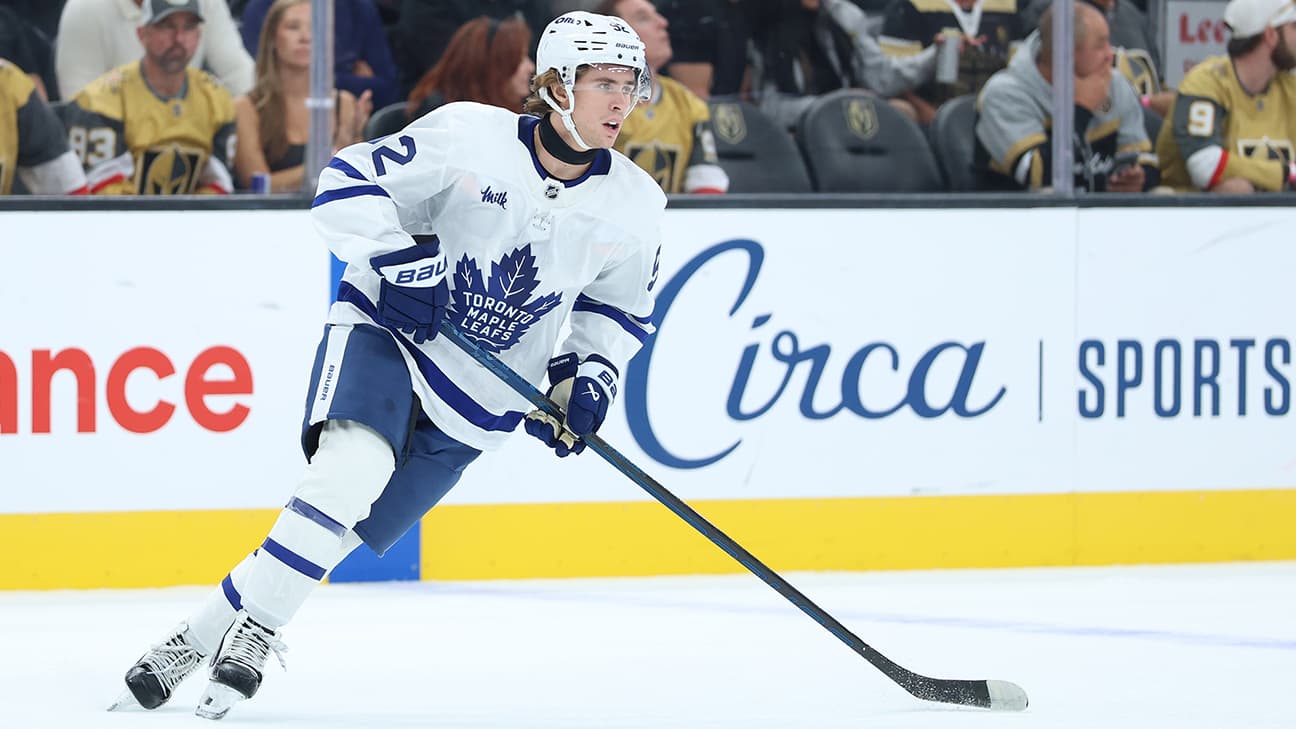
Photo: NHL.com
Gavin McKenna Overtime Snub: Hiller's Three-on-Three Logic Doesn't Hold Up
Table of Contents
The Gavin McKenna Overtime Question, Again
Gavin McKenna did not take an overtime shift on Thursday night, Nov. 19, when the Maple Leafs and Los Angeles Kings played five scoreless minutes of three-on-three before Adrian Kempe won it 4-3 in the shootout. That is not new. Per The Hockey News, McKenna has yet to see the ice in overtime at any point this season. What was new is that Jim Hiller promoted the 18-year-old to the second line and the top power-play unit for this game — then left him on the bench when the game opened up.
Hiller's explanation, given after the loss, was that overtime is a different game and he wants to make sure McKenna is ready for it. Our position is simple: the Gavin McKenna overtime snub is the wrong call, the reasoning behind it is backwards, and on an eight-game losing streak the Leafs cannot afford to leave their most creative young player on the bench in the one format built for him.
What Hiller Actually Said
The quotes matter, so here they are as reported after the game. Hiller called overtime a high-leverage time where "you need somebody who can make a play," and added: "But again, I just want to make sure he's ready for that." He said he does not evaluate McKenna's five-on-five play when deciding three-on-three usage — "3-on-3, it's just a different game in the NHL" — and that the staff has come close: "We've had him up and then called him off. He'll get out there eventually."
Reports also described Hiller as not wanting to put McKenna in a spot where a bad result would leave him feeling bad. That is a coach protecting a teenager, and the instinct is understandable. It is also the wrong protection.
Instead of McKenna, the forward minutes went to Auston Matthews, Jack Roslovic, John Tavares, William Nylander and Easton Cowan. Nobody is asking Hiller to bench Matthews in overtime. The question is whether McKenna should be ahead of the third and fourth names on that list.
Three-on-Three Rewards Exactly What McKenna Does
"You need somebody who can make a play" is the case for McKenna, not against him. Overtime is open ice, possession and one-on-one skill. Defensive structure barely exists. The player who wins at three-on-three is the one who can carry the puck through the neutral zone, hold it under pressure until a lane opens, and make the pass nobody else sees. That is the scouting report that made McKenna the first overall pick in June 2026.
The usual knock on young players in overtime is that one turnover becomes a two-on-one the other way. That is real. But Hiller has already trusted McKenna with the riskiest puck job on the team: the top power play, where a bad pass at the blue line becomes a short-handed breakaway. He trusted him there on Thursday and the unit scored, with Matthews finishing a Nylander feed at 13:54 of the first period. If McKenna is ready to quarterback a power play, he is ready for a 45-second overtime shift with Matthews.
The "different game" argument also cuts both ways. If Hiller doesn't evaluate five-on-five play for overtime, then McKenna's defensive lapses at five-on-five — the reason he has been sheltered at times this season — are not disqualifying either. The only way to learn whether he can do it is to put him out there.
Look at who did get the minutes. Roslovic and Cowan are useful players. But neither is the puck-carrier McKenna is, and three-on-three is not a format that rewards responsible. It rewards the player who can make two defenders commit and then find the open man. The Leafs had that player on the bench for all five minutes and then lost the shootout.
The Numbers Say He's Earned a Look
McKenna entered Thursday with 14 points, six goals and eight assists, in 23 games, averaging about 13:55 of ice time per night per NHL.com. That is strong production for an 18-year-old playing third-line minutes for long stretches of the season, on a team that has scored very little during the losing streak.
| Measure | Gavin McKenna | Context |
|---|---|---|
| Games | 23 (before Nov. 19) | Every Leafs game through Nov. 17 |
| Goals | 6 | Rookie, age 18 |
| Assists | 8 | Mostly middle-six minutes |
| Points | 14 | About a 50-point 82-game pace |
| Average ice time | 13:55 | Per NHL.com |
| Overtime shifts | 0 | Per The Hockey News, all season |
The plus-minus is ugly — he was at minus-9 heading into the Chicago game, per Yahoo — and that is the honest case for caution. But overtime is not a plus-minus test. It is a "can you make something out of nothing" test, and McKenna has been doing that since he was 15.
Confidence Is the Point, Not the Risk
Hiller's worry is that a bad overtime shift would damage McKenna's confidence. Consider the other version. The coach promotes a teenager to the top six and first power play, tells everyone the team needs changes, then signals in the highest-leverage moment of the night that he is not one of the five forwards the coach trusts. Every player understands what overtime deployment says. McKenna does too.
There is also the development argument, which is supposed to be the whole reason he is in the NHL at 18 instead of somewhere else. Hiller sat him for the rest of the second period against Montreal on Nov. 7, and we said at the time that Hiller got that one right — accountability for effort is coaching. This is different. Keeping him off the ice in overtime is not accountability for anything he did; it is a ceiling placed on him in advance.
We have pushed for more McKenna minutes before, in our October case for more ice time. The argument is stronger now, because the team around him has gone 0-7-1 in eight games and the "safe" choices are not producing results either.
What Hiller Should Do Next Time
This does not need to be complicated. The next time Toronto goes to overtime, McKenna should get the second forward slot on the second shift, paired with Matthews or Nylander and a reliable defenceman behind them. One shift. If he turns it over, it is one shift; Matthews and Tavares have turned pucks over at three-on-three too.
And if Hiller still wants to wait, he should at least stop moving McKenna up for 60 minutes and then hiding him for five. Promoting him to the second line and top power play, as Hiller did on Thursday, is a statement about where McKenna fits. Overtime should match it.
The Bigger Picture for the Leafs
Toronto is 8-13-3, last in the Atlantic, and 0-7-1 in its last eight. The Leafs blew a 3-0 home lead on Thursday; we broke down that collapse in our Maple Leafs vs Kings recap. Overtime deployment did not cause that loss. But a team in this hole has to squeeze every advantage it has, and the first overall pick in open ice is an advantage.
McKenna is on a three-year entry-level deal at a $1,075,000 cap hit, per our contracts page. He is going to be here a long time. The sooner Hiller lets him fail or succeed in overtime, the sooner the Leafs find out what they have in the situations that decide close games. "He'll get out there eventually" is not a plan. Saturday against Columbus is a good place to start.
Frequently Asked Questions
Why doesn't Gavin McKenna play in overtime?
Maple Leafs coach Jim Hiller has said he wants to make sure McKenna is ready for three-on-three, calling overtime a high-leverage situation and 'just a different game in the NHL.' He said the staff has had McKenna up and then called him off, and that 'he'll get out there eventually.'
Has Gavin McKenna played in overtime this season?
No. Per The Hockey News, McKenna had not taken an overtime shift through the Leafs' 4-3 shootout loss to the Los Angeles Kings on Nov. 19, 2026, even though he had been promoted to the second line and top power-play unit for that game.
How many points does Gavin McKenna have this season?
McKenna entered the Nov. 19 game against Los Angeles with 14 points, six goals and eight assists, in 23 games, per NHL.com. He was averaging about 13:55 of ice time per game.
Who played overtime for the Leafs against the Kings?
Toronto's forwards in overtime on Nov. 19 were Auston Matthews, Jack Roslovic, John Tavares, William Nylander and Easton Cowan, per postgame reports. The game ended 4-3 for Los Angeles after Adrian Kempe scored the only shootout goal.
How old is Gavin McKenna?
McKenna was born on Dec. 20, 2007, in Whitehorse, Yukon, so he is 18 and turns 19 next month. Toronto drafted him first overall in the 2026 NHL Draft.
What is Gavin McKenna's contract?
McKenna is on a three-year entry-level contract with a $1,075,000 cap hit that runs through the 2028-29 season, after which he would be a restricted free agent.


