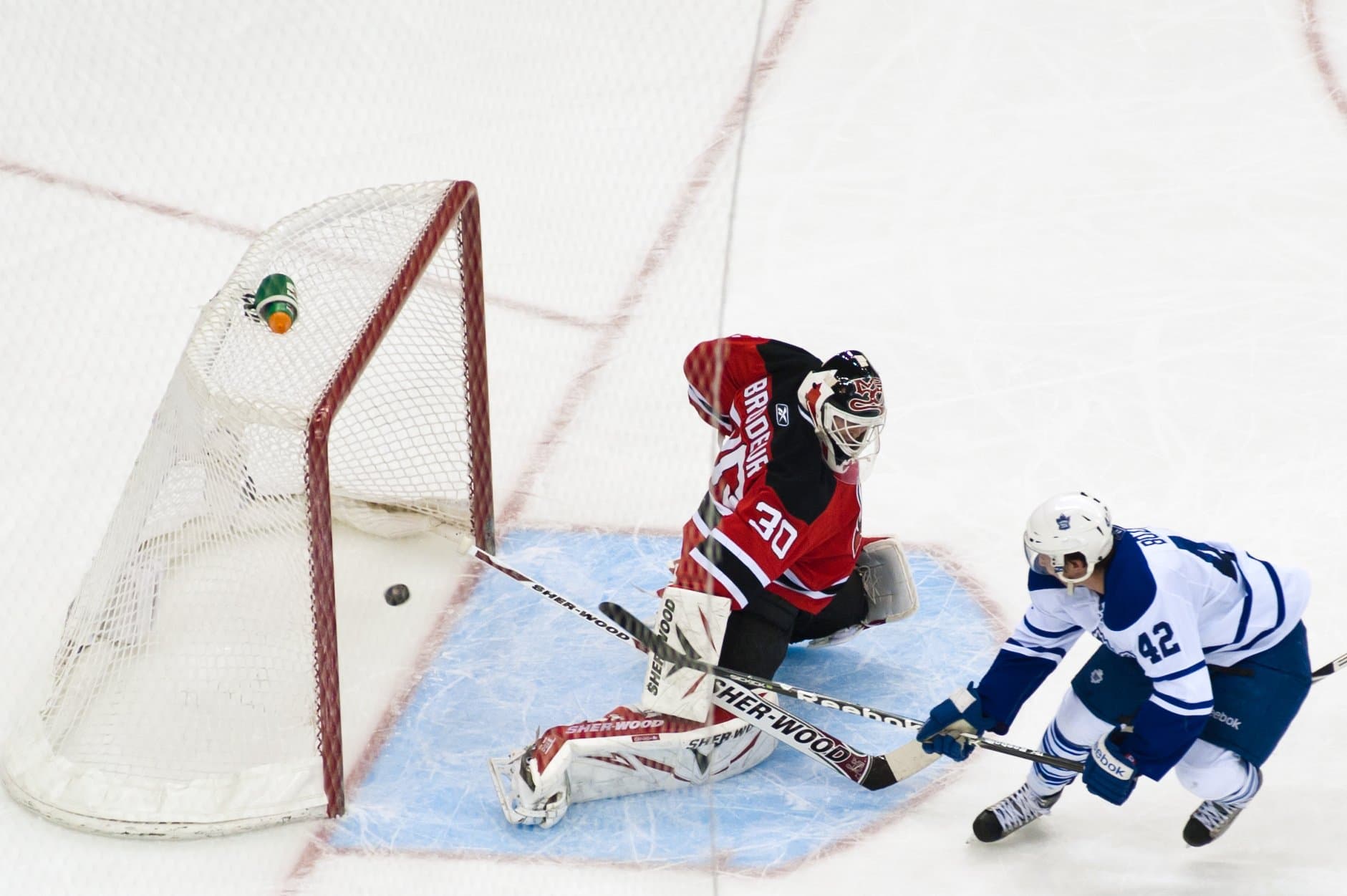
Photo: James DiBianco, Wikimedia Commons (BY-SA-2.0)
Gavin McKenna Has to Show the Maple Leafs Where He Fits. Hiller Is Right
Table of Contents
The coach declined to write the script
Gavin McKenna arrived at his first Maple Leafs training camp as the first overall pick in the 2026 draft, the most anticipated Toronto prospect in a generation, and a player half the city has already penciled onto Auston Matthews' wing. Jim Hiller, in his first camp media availability on Wednesday, declined to do the same. McKenna, he said, will show the staff where he fits.
That is the correct answer, and it is not the answer most of the building wanted to hear. It is also more revealing than it sounds, because Hiller was not hedging about whether McKenna makes the team. Nobody thinks he does not. He was refusing to promise an 18-year-old the easiest job on the roster before the 18-year-old had taken a shift.
We have argued since early September that the linemate question was going to define this camp. Hiller just confirmed it by refusing to answer it.
What "show us where he fits" actually means
Read it as a range, not a threat. The floor for McKenna is not the press box or a return to junior. The floor is a third-line role with real minutes and power-play time, in a lineup where Matthews and John Tavares are the locked-in centres and William Nylander and Matthew Knies occupy two top-six wing spots.
The ceiling is opening night beside Matthews. The gap between those two outcomes is about 90 seconds of five-on-five ice time a night and a very large difference in scrutiny.
Reporting through camp has consistently suggested Toronto intends to ease him in rather than plug him into the top line immediately. Hiller's phrasing is consistent with that. It gives the staff room to start him lower, move him up when he earns it, and never have to publicly demote a first overall pick — which is exactly the kind of detail that matters when the player is 18 and the market is Toronto.
Why the slow start is the right call
Here is our position, and it is not the popular one: McKenna should not open the season on Matthews' wing.
Start with the schedule. The league expanded to 84 games this season, the longest regular season in NHL history, and an 18-year-old's first professional year is already a conditioning problem before you add two games. Front-loading his workload with top-line minutes and the associated matchups is how you get a player who is worse in March than he was in October.
Then look at what actually went wrong in Toronto last season. The Leafs missed the playoffs because they gave up too much, not because they could not score. Matthews' line is where the opposition's best defensive pairing lives. Putting a rookie there is asking him to solve the hardest problem on the ice while learning a new system in a camp the CBA cut to 13 days.
The third line is not a demotion. It is a sheltered start with soft matchups, a runway to build chemistry, and a coach who can promote him in November as a reward rather than in December as a correction.
What a Gavin McKenna rookie season should look like
Set the bar honestly. Eighteen-year-old forwards who step straight into the NHL and produce at a first-line rate are rare enough that you can name all of them. The realistic good outcome for McKenna is a season in the 50-to-65-point range, trending upward, with his best hockey in the final two months.
The markers that matter more than the point total are usage and trust. Does he finish the season taking defensive-zone draws on his wing? Does he get power-play time on the first unit by December? Is he on the ice in the final minute of a one-goal game in March? Those are the things that tell you a coach believes in a young player, and they move independently of whether the pucks are going in.
The failure mode to watch for is the opposite: strong October, diminishing minutes by January, and a spring spent as a passenger. That pattern has happened to plenty of talented teenagers whose clubs pushed them too hard too early, and it is exactly what Hiller's cautious framing is designed to avoid.
The part of this that is genuinely unusual
Most first overall picks land on teams with nothing. McKenna landed on a team with a captain who scores 40 goals, a second-line centre with 1,000 games of professional habits, and a 38-year-old two-time Vezina winner in net.
That is the direct result of the 2026 draft lottery, which Toronto won after missing the playoffs — a combination that almost never happens to a club with this much veteran talent still under contract. The full picture is on our draft page.
The practical consequence is that McKenna does not have to carry anything. He has been skating with Matthews and Tavares heading into camp, and he is living with the Tavares family during his first season. Toronto has structured his entire environment around removing variables. That is what a competent organization does with an asset like this, and it is a marked change from how this franchise has handled young players in the past.
The cap argument nobody makes out loud
There is a cold financial reason the Leafs need McKenna to be good immediately, and it has nothing to do with marketing.
Toronto is projected slightly over the $104 million ceiling with roughly 50 contracts on the books, and is relying on Max Domi's long-term injured reserve placement to open the season compliant. An elite player on an entry-level contract is the only mechanism in the modern NHL that produces genuine surplus value at scale. Every point McKenna produces at rookie money is a point the Leafs did not have to buy on July 1.
That is the actual case for pushing him up the lineup fast, and it is a real one. It is also the case a general manager makes, not a coach. Hiller's job is to get 84 good games out of him. Chayka's job is to profit from them. Our contracts page shows how little room there is for anything else.
What camp has to answer in ten days
Three things. Can McKenna defend well enough to be trusted without a veteran centre covering for him? Junior hockey does not test that, and the NHL tests it constantly.
Can he win pucks at the wall against grown men? Skill translates. Strength is the variable that decides whether an 18-year-old wing gets 15 minutes or eight.
And does he look better with Tavares or with Matthews? Those are different jobs. Tavares' line asks a winger to finish plays from the slot. Matthews' line asks a winger to retrieve pucks and get out of the way. A rookie can be excellent at one and useless at the other, and Toronto has four preseason games — split-squads against Montreal on September 19 and Ottawa on September 23 — to find out.
What's next
McKenna skipped the Prospect Challenge in Gatineau so he would arrive fresh for main camp, a decision the club reversed course on in early September. That choice now looks like it was made with exactly this evaluation window in mind.
The first real signal comes from the preseason lineup sheets. Watch who he lines up with on September 19, and more importantly, watch whether that changes by the 23rd. The opener is September 29 against Montreal. Track the 73-man camp roster as it shrinks, and the lineup as it settles, on our players page.
Frequently Asked Questions
Will Gavin McKenna play on Auston Matthews' line?
Jim Hiller has not committed to it. At his first training camp media availability on September 16, 2026, Hiller said McKenna will show the staff where he fits, and reporting has consistently suggested Toronto plans to ease the 18-year-old in lower in the lineup first.
Will Gavin McKenna make the Maple Leafs roster in 2026-27?
He is widely expected to. McKenna was the first overall pick in the 2026 draft and was invited to Toronto's 73-man main training camp, and no reporting has suggested the club is considering sending him back to junior.
Why did Gavin McKenna skip the 2026 NHL Prospect Challenge?
Toronto kept him out of the four-team rookie tournament in Gatineau so he would arrive rested for main camp. The club had initially planned for him to attend and reversed course in early September.
How old is Gavin McKenna?
He is 18, entering his first professional season after being selected first overall by Toronto in the 2026 NHL Draft following the Maple Leafs' draft lottery win.
Who are the Maple Leafs' top-six forwards in 2026-27?
Auston Matthews and John Tavares are the top two centres, with William Nylander and Matthew Knies locked into two of the four wing spots. The remaining openings are being contested by McKenna, Easton Cowan, Jack Roslovic and Nick Paul.
Where is Gavin McKenna living during his rookie season?
He is staying with John Tavares and his family, a common arrangement for teenage NHL rookies that removes off-ice logistics from a player's first professional year.
How many games do the Maple Leafs play in 2026-27?
Eighty-four, up from 82 under the new collective bargaining agreement. The longer schedule is one reason Toronto has reason to manage an 18-year-old's early-season workload carefully.


